Wheel Stop Installation
In East Fort Worth, TX
Concrete and Rubber Parking Stops
1-800-STRIPER® provides professional wheel stop installation in East Fort Worth, TX — anchoring concrete, recycled-rubber, and composite wheel stops at stall heads to stop vehicle overhang from narrowing accessible routes, as the 2012 Texas Accessibility Standards advise for commercial properties.
1-800-STRIPER® of East Fort Worth PROVIDes Wheel Stops Services NEAR YOU
Need to protect vehicles or walls from accidental damage?
Wheel stops (also called parking blocks) protect your property, enhance safety, and improve parking lot organization.
Benefits:
Wheel stops prevent vehicles from parking too far into a space or overextending into other spots, pedestrian walkways, and other areas, while also helping with vehicle alignment. They can prevent damage to buildings, curbs, or landscaping. Wheel stops also serve as clear visual cues for proper parking and are sometimes used on slopes to prevent cars from rolling.
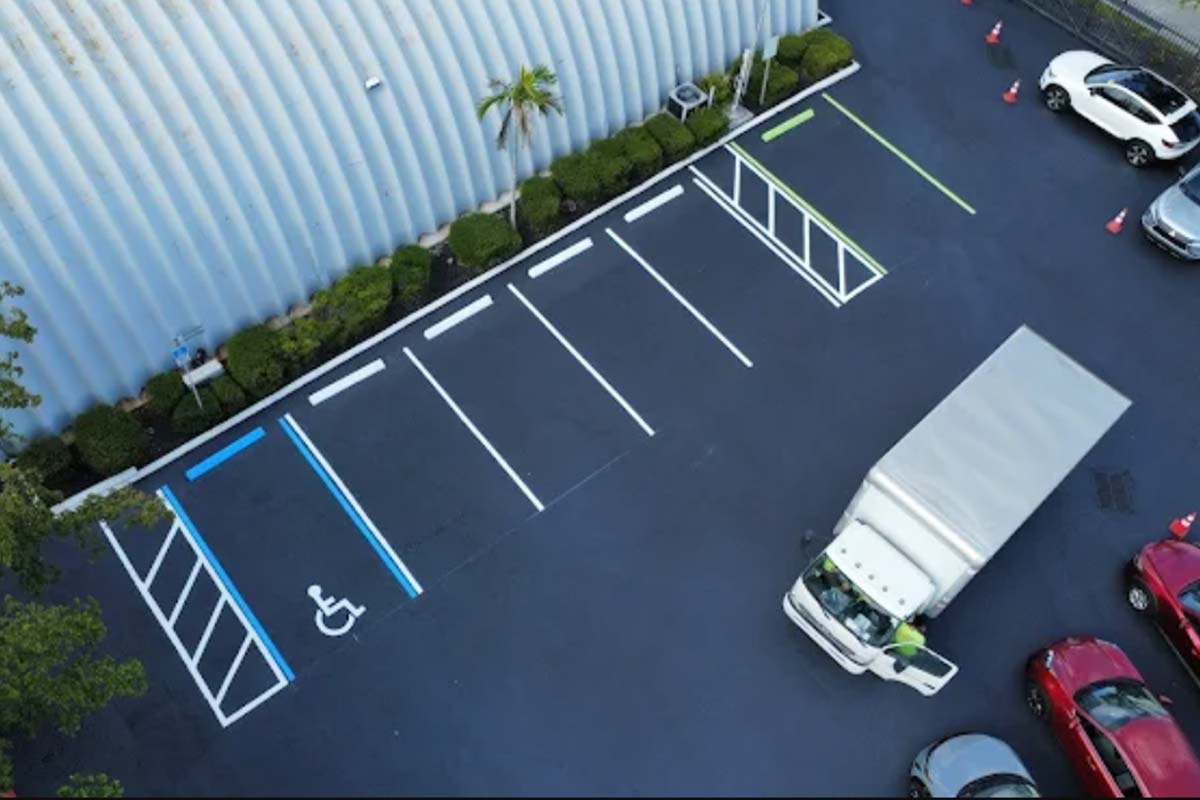
Wheel Stop Installation in East Fort Worth, TX
1-800-STRIPER® of East Fort Worth installs, replaces and re-anchors wheel stops on commercial lots across Fort Worth, Arlington, the Mid-Cities and the wider Dallas–Fort Worth Metroplex. A wheel stop is the low barrier fixed across the head of a stall. The front tire meets it, and it keeps the nose of the vehicle off the curb, the sidewalk, or the access aisle beside an accessible space.
We set stops as a standalone job or on the same visit as your line striping. Call (972) 543-1033 for a free estimate.
Why wheel stops — the TAS 502.7 Advisory and the overhang problem
Texas names wheel stops as the fix for one specific problem. The advisory to section 502.7 of the 2012 Texas Accessibility Standards reads: *”Wheel stops are an effective way to prevent vehicle overhangs from reducing the clear width of accessible routes.”*
Note the register. That is an advisory: it says wheel stops are effective, not that you must install them. What it points at is the aisle. On work that triggers the standard — new construction, alteration, change of occupancy — TAS 502 requires the access aisle beside an accessible space to be at least 60 inches wide, to run the full length of the space, and to not overlap the vehicular way.
A vehicle nosed a few inches too far forward moves none of your paint. Its overhang still eats into the clear width of that aisle, which is precisely the problem the state names wheel stops as an effective answer to. Paint alone cannot hold a vehicle back; a wheel stop can.
Materials — concrete, recycled rubber, or composite
Three materials cover nearly every lot we work on in Tarrant County. The choice comes down to substrate, impact and appearance.
| Pre-cast concrete | Recycled rubber | Plastic composite | |
|---|---|---|---|
| Handling | Heaviest; set with equipment | Light enough to place by hand | Light, like rubber |
| Anchoring | Rebar pins into asphalt; anchor bolts into concrete | Must be mechanically fastened | Same as rubber |
| Behavior | Rigid | Flexible rather than rigid | Flexible rather than rigid |
| Finish | Gray, paintable — yellow, or blue at accessible stalls | Molded; available with reflective inserts | Color molded through the body |
What we will not do is rank those three on durability with a number we cannot stand behind. DFW averages 20.2 days a year at or above 100°F and 29.2 freeze days. That argues for anchoring the stop properly rather than for one material over another.
Anchoring and placement
What sits under the stop decides how we anchor it. On asphalt we pin it, driving steel pins through the cast holes into the pavement. A pin will not drive into a concrete slab, so on concrete we drill the stop and fix it with anchor bolts. Rubber and composite stops always get mechanically fastened, because they are light enough for a vehicle to shove aside.
Placement is a layout decision, not a rule of thumb. Under the Fort Worth Code of Ordinances, a standard stall is 9 feet by 18 feet, but a stall abutting a landscape area may be 16 feet deep where it is separated from that area by curbing or approved wheel stops. If the row has no curb, the wheel stop is what earns the shorter stall. On those rows the stops carry part of the dimension of your lot. We set each stop back far enough that the vehicle’s overhang clears whatever sits beyond the stall head. That is a site measurement, because it depends on stall depth and what is on the far side.
Get a free estimate
Wheel stops are usually quoted with the rest of the lot: the stalls they terminate, the accessible markings they protect, and the line marking that goes down on the same visit. We will walk your lot, count the stalls, and flag the stops that are cracked, loose or missing. 1-800-STRIPER® of East Fort Worth is rated 4.6 stars from 9 Google reviews. Call (972) 543-1033.
For a full list of our pavement marking services, visit our parking lot striping in East Fort Worth page.
Businesses We Serve




How it Works

GET A FREE ESTIMATE
Contact us today and we’ll have a quote to you in 24 hours

SCHEDULE AN INSTALLATION
We’ll have your installation scheduled restriped in less than 7 days, without affecting your business hours

GET A PARKING LOT THAT POPS
For a budget-friendly price, you’ll get a parking lot that looks like new
We proudly work with:


We proudly work with:


Frequently Asked Questions About Wheel Stop Installation in East Fort Worth, TX
Why do I need wheel stops on my lot?
The 2012 Texas Accessibility Standards do not order you to install them. The advisory to TAS 502.7 says wheel stops “are an effective way to prevent vehicle overhangs from reducing the clear width of accessible routes.” What binds is the route, and the access aisle it protects. Wheel stops are the state’s own named remedy for the overhang that eats into them.
Concrete, rubber, or composite — which should I pick?
Concrete is the heaviest and sets with equipment. Rubber and composite are light enough to hand-place, and both always get mechanically fastened, because a tire will otherwise push them out of position. Concrete is rigid and takes paint. Rubber and composite flex, and carry their color through the body. We size the choice to your substrate, traffic and appearance at the walkthrough.
How are wheel stops anchored?
By what is under them. On asphalt we drive steel rebar pins through the stop’s cast holes into the pavement. A pin will not drive into a concrete slab, so on concrete we drill the stop and fix it with anchor bolts set into the slab. Rubber and composite stops get spiked or bolted every time. Their own weight will not hold them against a vehicle.
Where exactly do wheel stops go, and how far apart?
Spacing follows your stalls, not a fixed interval: one stop per stall, centered on the 9-foot standard stall width the Fort Worth Code of Ordinances sets. Setback from the stall head is a site measurement. It depends on stall depth and on what sits beyond it, whether that is sidewalk, landscaping, access aisle, or a route behind the row.
Can you replace broken or cracked wheel stops?
Yes, and it is the most common wheel stop job we do. We pull the failed stop, clear the old pins or bolts, patch the anchor holes, then set and anchor a replacement. If a row keeps getting hit, we will raise whether the setback is right for that row before putting an identical stop back in the same place.
How do wheel stops protect an ADA accessible route?
On work that triggers the standard — new construction, alteration or change of occupancy — TAS 502 requires the access aisle next to an accessible space to be at least 60 inches wide, to run the full length of the space, and not to overlap the vehicular way. A vehicle’s front overhang can encroach on that aisle without touching a painted line. A wheel stop holds the vehicle short of it, which is why the TAS 502.7 advisory names wheel stops as an effective way to keep overhang off an accessible route. It supports correct striping and signage; it never replaces either.