Fire Lane Striping
In East Fort Worth, TX
Code-Compliant Fire Lane Markings
1-800-STRIPER® provides professional fire lane striping in East Fort Worth, TX — six-inch red borders, “NO PARKING FIRE LANE” in four-inch white letters at 25-foot intervals, and tow-away signage per the Fort Worth Fire Code for commercial properties across Tarrant County.
1-800-STRIPER® of East Fort Worth PROVIDes Fire Lane Striping Services NEAR YOU
Is your parking lot ready for first responders?
Our team is well-versed in local fire regulations and will parter with you to design a fire lane striping plan that creates unobstructed emergency access to protect your customers and property.
Core Services:
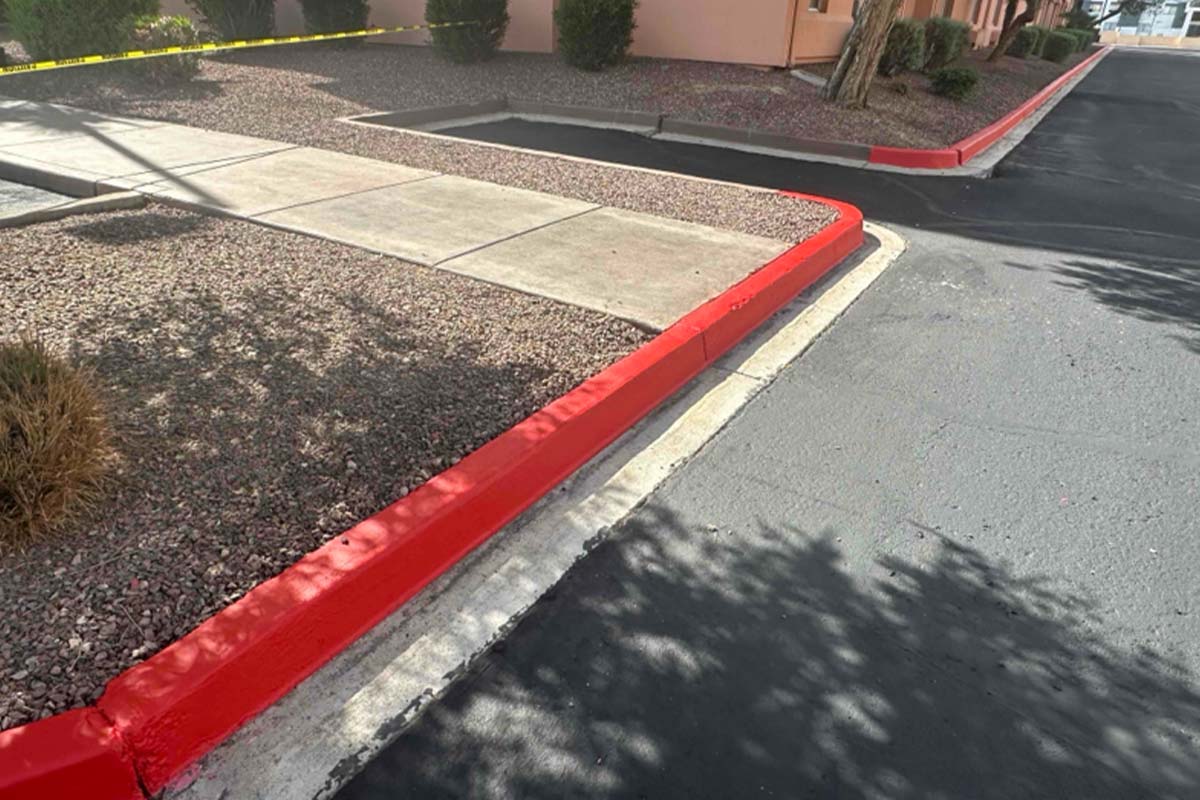
Fire Lane Striping in East Fort Worth, TX
On a lot that already has a fire lane, faded striping is a code failure, not a cosmetic one. Section 503.3 of the Fort Worth Fire Code requires fire-lane striping and signs to be “provided and maintained.” They must “be maintained in a clean and legible condition at all times,” and “be replaced or repaired when necessary to provide adequate visibility.” That sentence is about the condition of the paint and the signs, and the duty runs for as long as the lane exists.
Most fire-lane work on a Fort Worth commercial property, then, is not new layout. The job is restoring a lane that quietly stopped meeting the spec. Red borders wear thin under delivery traffic. Sign posts get clipped and never replaced, and the four-inch legend fills with tire rubber until it reads as a pink smudge.
1-800-STRIPER® of East Fort Worth stripes, restripes and re-signs fire lanes on commercial properties across Tarrant County and the wider Dallas–Fort Worth Metroplex: retail centers, warehouses, apartment communities, medical offices, schools. Fire lanes are the least forgiving line marking on any lot. The legend, the letter height, the interval and the sign dimensions are all written down. A line striping crew either hits them or it doesn’t.
What the Fort Worth Fire Code Actually Requires
Fort Worth writes its own fire-lane marking spec into the code and leaves none of the dimensions to the contractor. Section 13-2 of the Fort Worth Fire Code amends the adopted 2021 International Fire Code and sets out, in Section 503.3, exactly what the paint and the signs have to be. This is the table we stripe to:
| Element | What the Fort Worth Fire Code specifies |
|---|---|
| Border striping | Painted lines of red traffic paint, six (6) inches wide, showing the boundaries of the lane |
| Legend | “NO PARKING FIRE LANE” |
| Letter size | Four (4) inch white letters |
| Legend interval | Every twenty-five (25) feet |
| Legend placement | On the red border markings, along both sides of the fire lane |
| Curbs | Where a curb is available, the striping goes on the vertical face of the curb |
| Sign | “NO PARKING FIRE LANE” — 12 in wide × 18 in high |
| Companion sign | “TOW AWAY ZONE” — 12 in wide × 6 in high |
| Sign colors | White background, letters and borders in red |
| Sign lettering | Not less than two (2) inch lettering |
| Sign mounting | Permanently affixed to a stationary post; bottom of the sign 6 ft 6 in above finished grade |
| Sign spacing | Not more than 50 feet apart, along both sides of the lane |
Two details in that table do most of the work. The legend interval is twenty-five feet, on both sides — not a handful near the entrance. And where a curb is available, the red goes on the vertical face of the curb, so the lane still reads when cars are parked against it.
The maintenance language is the other half of the section, and it decides whether an existing lot passes. Legible is the test, not new. A border thinned to pink, a legend you have to stand over to read, a tow-away sign faded to gray: each one is the code’s own trigger for replacement or repair.
Access-Road Geometry: What the Lane Itself Has to Be
The paint marks the lane. The code also sets what the lane itself has to be, and a fire apparatus access road in Fort Worth carries published numbers on every axis: width, height, load, radius, length and slope.
| Requirement | Fort Worth Fire Code |
|---|---|
| Unobstructed width (§503.2.1) | Not less than 20 feet, exclusive of shoulders |
| Multi-family developments | Minimum 26 feet |
| Unobstructed vertical clearance (§503.2.1) | Not less than 14 feet |
| Surface (§503.2.3) | Asphalt or concrete, providing all-weather driving capabilities |
| Imposed load (§503.2.3) | Designed and maintained to support 85,000 lbs for fire apparatus |
| Inside turning radius (§503.2.4) | Minimum 25 feet |
| Outside turning radius (§503.2.4) | Minimum 51 feet in multifamily complexes, 45 feet otherwise |
| Dead ends (§503.2.5) | A dead-end fire lane over 150 feet long requires a turnaround |
| Grade (§503.2.7) | Shall not exceed 6 percent — the fire code official may approve up to 10 percent with adequate justification, such as topographical constraints |
Most of that geometry gets settled when the lot is built or repaved. Striping and signs are the part the code asks you to keep up, which is why an existing lot’s fire-lane problem is almost always a marking problem.
Section 503.4 is the obstruction provision, and it governs the space rather than the paint: the minimum widths and clearances, and any area marked as a fire lane, must be kept clear at all times. A dumpster rolled into the lane runs into that provision. So does a pallet stack left against the curb. The clear width and the clear height are what Section 503.4 asks you to keep; the condition of the striping and the signs is Section 503.3’s business.
Whether your property needs a fire apparatus access road in the first place is a separate question, and not one we answer. Section 503.1 leaves that determination to the Fort Worth fire code official, and it turns on the building, its size and its access geometry. If your lot is unmarked and you are not sure a lane is required, the fire marshal’s office makes that call.
Inside Fort Worth City Limits vs. the Rest of Tarrant County
For general commercial occupancies, there is no statewide municipal fire code. Texas Local Government Code Chapter 214 adopts the International Residential Code, the National Electrical Code and the International Building Code for Texas municipalities, and adopts no fire code. Each incorporated city passes its own and stands as the authority having jurisdiction inside its limits, which is why Section 13-2 controls in Fort Worth and why every number on this page is Fort Worth’s.
That is not the whole map, and we do not pretend to publish the rest of it. Your property’s use can matter as much as its address, and the authority having jurisdiction is the one who settles both.
Our service area runs well past the city line: Arlington, the Mid-Cities, the rest of Tarrant County, out into the Metroplex. We do not publish what those jurisdictions have adopted, because that has to be checked rather than assumed. Before any fire-lane job outside Fort Worth we confirm the adopted fire code with the fire marshal who has jurisdiction over the address and the use, then mark the lane to that code.
Our Fire-Lane Striping Process
Fire-lane work is a measurement job before it is a painting job.
- Walk the lane. We measure the existing lane end to end, note where curbs run and where it crosses open pavement, and photograph every existing sign and post.
- Confirm the code for the address. Inside Fort Worth, that is Section 13-2. Outside it, we confirm the adopted fire code with the fire marshal having jurisdiction before we specify anything.
- Prep the surface. Paint goes on clean, dry pavement. The standard we work to is TxDOT Item 666: a surface temperature of at least 50°F, plus a dry-pavement test you can run yourself. Lay a one-square-foot piece of clear plastic on the pavement, weigh down the edges, and after 15 minutes there must be no condensation on the underside. Item 666 is a highway spec, not law on a private lot; it is the spec we hold ourselves to.
- Set the layout. We snap the lane boundaries, station the legend at twenty-five-foot intervals down both sides, and chalk the curb faces so the six-inch red lands on the vertical face wherever a curb exists.
- Stripe. Six-inch red borders, then “NO PARKING FIRE LANE” in four-inch white letters at each station, on both sides.
- Sign. The 12 × 18 in sign with its 12 × 6 in “TOW AWAY ZONE” companion, on a stationary post, bottom 6 ft 6 in above finished grade, no more than 50 feet apart along both sides.
- Walk it back. We re-walk the finished lane with you, photograph it, and hand over the spec we built to, line by line.
If your fire lane is fading, if a sign has come down, or if you have been told to get it fixed, call 1-800-STRIPER® of East Fort Worth at (972) 543-1033 and we will come out and measure it. The estimate is free, and it tells you which parts of Section 503.3 your lane currently misses. Owner George Pareja runs the crews here, and the business is rated 4.6 stars across 9 Google reviews.
Code references on this page were verified against the published Fort Worth Fire Code on 13 July 2026. This is general information, not legal advice — confirm what applies to your property with the fire marshal having jurisdiction.
For a full list of our pavement marking services, visit our parking lot striping in East Fort Worth page.
Businesses We Serve




How it Works

GET A FREE ESTIMATE
Contact us today and we’ll have a quote to you in 24 hours

SCHEDULE AN INSTALLATION
We’ll have your installation scheduled in less than 7 days, without affecting your business hours

GET A PARKING LOT THAT POPS
For a budget-friendly price, you’ll get a parking lot that looks like new
We proudly work with:


We proudly work with:


Frequently Asked Questions About Fire Lane Striping in East Fort Worth, TX
Exactly what does Fort Worth require a fire lane to look like?
Six-inch-wide lines of red traffic paint mark the boundaries of the lane. “NO PARKING FIRE LANE” goes down in four-inch white letters at twenty-five-foot intervals on the red border markings, along both sides of the lane. Where a curb is available, the striping goes on the vertical face of the curb rather than the pavement beside it. Every one of those figures comes straight from Section 503.3 of the Fort Worth Fire Code.
Who enforces fire-lane marking in Fort Worth?
The fire code official. Under Section 503.1, whether a property is required to have a fire apparatus access road at all is that official’s determination, and it depends on the building, its size and its access geometry. We do not make that call, and no striping contractor should. Once a lane is required or marked, Section 503.3 sets the spec and the duty to keep the striping and signs legible, and Section 503.4 requires the marked area be kept clear.
How wide does a fire lane have to be?
Twenty feet. Section 503.2.1 requires an unobstructed width of not less than 20 feet, exclusive of shoulders, plus an unobstructed vertical clearance of not less than 14 feet. Multi-family developments are the exception and require a minimum of 26 feet. Section 503.4 requires those widths and clearances to be maintained at all times, so a dumpster or pallet stack inside the lane is the code’s problem, not just yours.
Should the red go on the curb or on the pavement?
On the curb, wherever a curb is available. The Fort Worth Fire Code puts the striping on the vertical face of the curb. Where the lane runs across open pavement with no curb to paint, the six-inch red borders go down on the pavement to show the boundaries of the lane. Either way, the “NO PARKING FIRE LANE” legend appears on the red border markings along both sides.
What is the sign spec, and how high does it get mounted?
The sign reads “NO PARKING FIRE LANE” and measures 12 inches wide by 18 inches high, with a companion sign 12 inches wide by 6 inches high reading “TOW AWAY ZONE.” Both use a white background with letters and borders in red, and not less than two-inch lettering. Both go on a stationary post, permanently affixed, bottom 6 feet 6 inches above finished grade, spaced not more than 50 feet apart along both sides.
How often does a fire lane need repainting?
The code sets a condition, not a calendar: striping and signs must be maintained in a clean and legible condition at all times, and replaced or repaired when necessary to provide adequate visibility. Legibility is the trigger, not a date on a schedule. Weather is the practical constraint. Paint wants a surface at 50°F or above and genuinely dry pavement, and the DFW freeze-free window runs roughly 12 March to 22 November on the 1991–2020 climate normals.
Does this page apply to my lot if it isn’t inside Fort Worth?
For general commercial occupancies, no statewide municipal fire code exists. Texas Local Government Code Chapter 214 adopts the building, residential and electrical codes but not a fire code, so each city adopts its own and is the authority having jurisdiction inside its limits. The figures on this page are Fort Worth’s. Outside it, we confirm the adopted code with the fire marshal having jurisdiction over your address and your use before we mark anything.