
Warehouse Line Painting
In East Fort Worth, TX
OSHA-Compliant Safety Markings
1-800-STRIPER® provides professional warehouse line painting in East Fort Worth, TX — OSHA-compliant aisle lines, pedestrian walkways, and safety zone markings per the permanent-aisle marking duty that 29 CFR 1910.176(a) imposes wherever mechanical handling equipment operates, using durable epoxy and traffic paint.
1-800-STRIPER® of East Fort Worth PROVIDes Warehouse Floor Markings Services NEAR YOU
Want your indoor space to operate more efficiently?
Warehouse and interior markings ensure clear traffic lanes, organized storage zones, and designated spaces designed to help your business operate safely and efficiently.
Benefits:
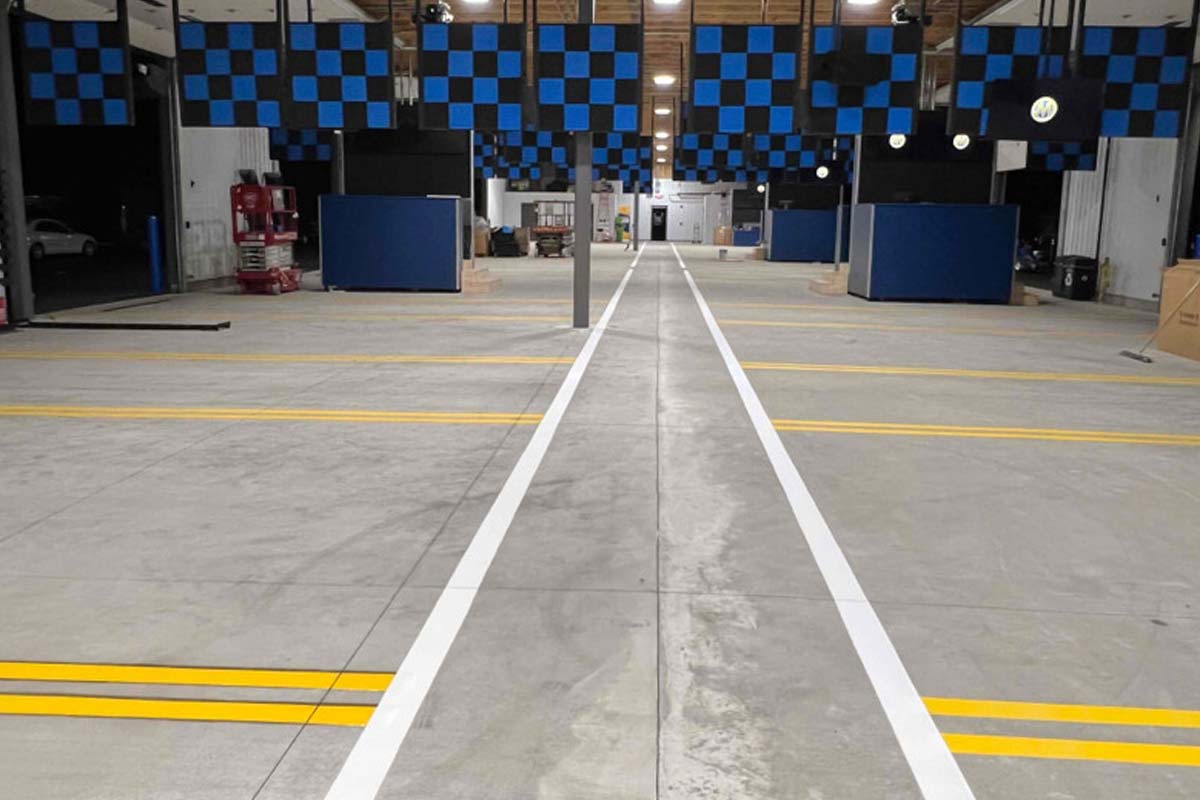
Warehouse Line Painting in East Fort Worth, TX
1-800-STRIPER® of East Fort Worth marks aisles, walkways, staging zones and dock lanes on warehouse floors across Fort Worth, Arlington and Tarrant County. The duty is federal. Wherever mechanical handling equipment operates, 29 CFR 1910.176(a) requires permanent aisles and passageways to be marked.
The rest is the slab: power-troweled, often sealed, point-loaded by forklift wheels all day. Paint a line onto a floor that is dusty, damp or sealed and the first pallet jack to turn on it lifts the line straight back off. We treat the floor as the job and the paint as its last step.
What OSHA Actually Requires
The rule is short, and it turns on a condition:
> “Where mechanical handling equipment is used, sufficient safe clearances shall be allowed for aisles, at loading docks, through doorways and wherever turns or passage must be made… Permanent aisles and passageways shall be appropriately marked.”
Two phrases carry it. Mechanical handling equipment (forklifts, reach trucks, order pickers) is the trigger: where those run, the duty attaches. Permanent aisles and passageways are the object. That means the routes the building runs on, not a pallet lane that lasts a week.
Inside the building, the duty binds. It does not reach your customer parking lot, which answers to the 2012 Texas Accessibility Standards and the Fort Worth Fire Code instead. Read it in full: OSHA 29 CFR 1910.176.
What We Mark
A working warehouse floor breaks into five families of line. We paint all five.
- Aisles and drive lanes. The permanent forklift routes 1910.176(a) speaks to.
- Pedestrian walkways. Office, break-room and dock personnel routes, plus crosswalks where they cross a drive lane.
- Staging, racking and inventory zones. Pallet boxes, lay-down areas, floor grids, rack-footprint lines.
- Hazard and keep-clear zones. Panels, eyewash stations, extinguishers, exit doors, equipment swing paths.
- Dock lanes. Trailer approach lines, dock-door lanes, chock zones.
Color Conventions and the ANSI Z535.1 Safety Color Code
Color is a convention, not a statute. The federal duty stops at “appropriately marked.” Which colors make an aisle legible is a question for your facility’s safety program, and plenty of programs are written against the ANSI Z535.1 safety color code. That code is voluntary. We work to it; we will never call it law. Tell us your scheme and we paint it exactly, aisle to aisle and shift to shift.
Epoxy vs. Traffic Paint
The slab decides more than the material does. We work to TxDOT Item 666 Retroreflectorized Pavement Markings. It is a highway spec, so it is not law on your floor; it is the standard we hold ourselves to. Item 666 calls for a clean, dry surface at least 50°F, and gives us a field test to prove it: a one-square-foot piece of clear plastic, weighed down at the edges, checked after 15 minutes. No condensation underneath means dry.
| Traffic paint | Epoxy | |
|---|---|---|
| Dry / cure | Dry time capped at 10 minutes (ASTM D711) | Cures on the product’s published schedule |
| Where it fits | Zones that move: staging boxes, lay-down areas | Permanent aisle lines under constant forklift traffic |
| What we need | Your color scheme and a shift to work in | A zone we can close for the cure window |
For epoxy cure hours or service life, ask for the manufacturer’s technical data sheet.
Working Around an Operating Facility
We phase the floor zone by zone rather than closing it, and the order of those zones follows your shift pattern, not ours. Traffic paint helps here: a 10-minute dry time means a lane returns to service in the shift it came out of. Epoxy on a main aisle is a different animal. It needs the product’s cure window, so those zones usually take a weekend, a shutdown or a planned changeover.
Get a Free Estimate
Send the floor plan, the traffic pattern and your safety program’s color scheme, and 1-800-STRIPER® of East Fort Worth will walk the slab, run the dry test and scope the marking in one visit. Our Google rating is 4.6 stars from 9 reviews. Call (972) 543-1033 for a free estimate.
For a full list of our pavement marking services, visit our parking lot striping in East Fort Worth page.
Businesses We Serve




How it Works

GET A FREE ESTIMATE
Contact us today and we’ll have a quote to you in 24 hours

SCHEDULE A STRIPING
We’ll have your space restriped in less than 7 days, without affecting your business hours

GET A PARKING LOT THAT POPS
For a budget-friendly price, you’ll get a parking lot that looks like new
We proudly work with:


We proudly work with:

Frequently Asked Questions About Warehouse Line Painting in East Fort Worth, TX
Does OSHA require aisle marking in a warehouse?
Yes, wherever mechanical handling equipment is used. 29 CFR 1910.176(a) states that permanent aisles and passageways shall be appropriately marked, and forklifts, reach trucks, order pickers and similar equipment are what trigger the duty. The duty runs to the aisles and passageways inside the facility and stops there. Your customer parking lot is governed by a different set of rules.
How wide should our aisle lines be?
The federal duty reads: permanent aisles and passageways shall be appropriately marked. We will not publish a width we cannot trace to a standard. What we do instead is match the width already in use in your building, or the width your safety program specifies, then hold it consistent from aisle to aisle so the scheme reads the same on every shift.
What do the floor marking colors mean?
Whatever your safety program says they mean. That is not a dodge; it is how floor color works. Many facilities write their scheme against the ANSI Z535.1 safety color code, a voluntary industry convention rather than a law. Give us the scheme you have documented and we paint it exactly as written. Nothing documented? Get it written first, because consistency is what makes a color legible.
Should we use epoxy or traffic paint?
It depends on whether the zone moves. Traffic paint suits lines that change as you re-rack or re-stage; the spec we work to caps its dry time at 10 minutes (ASTM D711), so the lane reopens quickly. Epoxy suits permanent aisle lines that stay put under constant forklift traffic. Ask for the manufacturer’s technical data sheet on the product we would use and we will send it over.
Can you work around our shifts?
Yes. We phase the work zone by zone rather than closing the floor. Tell us your shift pattern, your peak inbound and outbound windows, and any shutdown or changeover dates already on the calendar, and we build the sequence around them. We close a zone, prep it, mark it, hold it for its dry or cure window, then release it and move on.
How long until forklifts can drive on the new lines?
For traffic paint, the specification we work to caps dry time at 10 minutes (ASTM D711). We keep the zone closed until the surface is genuinely dry, then release it. For epoxy, the product’s published cure window sets the reopening time, not us. Ask for the technical data sheet before you plan a shutdown.
How do you stripe a warehouse floor?
Layout first, then surface, then paint. The aisles get set out against how your forklifts actually move, because that is what the duty is about: OSHA 29 CFR 1910.176(a) requires that “permanent aisles and passageways shall be appropriately marked,” and that duty is conditioned on mechanical handling equipment being in use, so it is about the forklift routes inside the building, not your customer parking lot. The floor then has to be genuinely clean and dry before anything goes down, and paint will not hold on a slab that is sweating. The moisture check we use is a borrowed one: lay a one-square-foot piece of clear plastic down, weigh the edges, and after fifteen minutes there should be no condensation underneath. Then we lay the lines and let them cure before the traffic comes back.