ADA Parking Lot Striping
In East Fort Worth, TX
ADA-Compliant Accessible Parking
1-800-STRIPER® provides ADA-compliant parking lot striping in East Fort Worth, TX — accessible stalls, van spaces, access aisles, and the surface-painted ISA symbol plus 12-inch “NO PARKING” aisle lettering required by 16 TAC 68.104 and the 2012 Texas Accessibility Standards.
1-800-STRIPER® of East Fort Worth PROVIDes ADA Compliance Services NEAR YOU
Need to make your property more accessible?
Upgrade your facility to become fully ADA compliant by partnering with us to create clear, accessible parking for all your visitors.
Our ADA Compliant line striping services include:
ADA Parking Lot Striping in East Fort Worth, TX
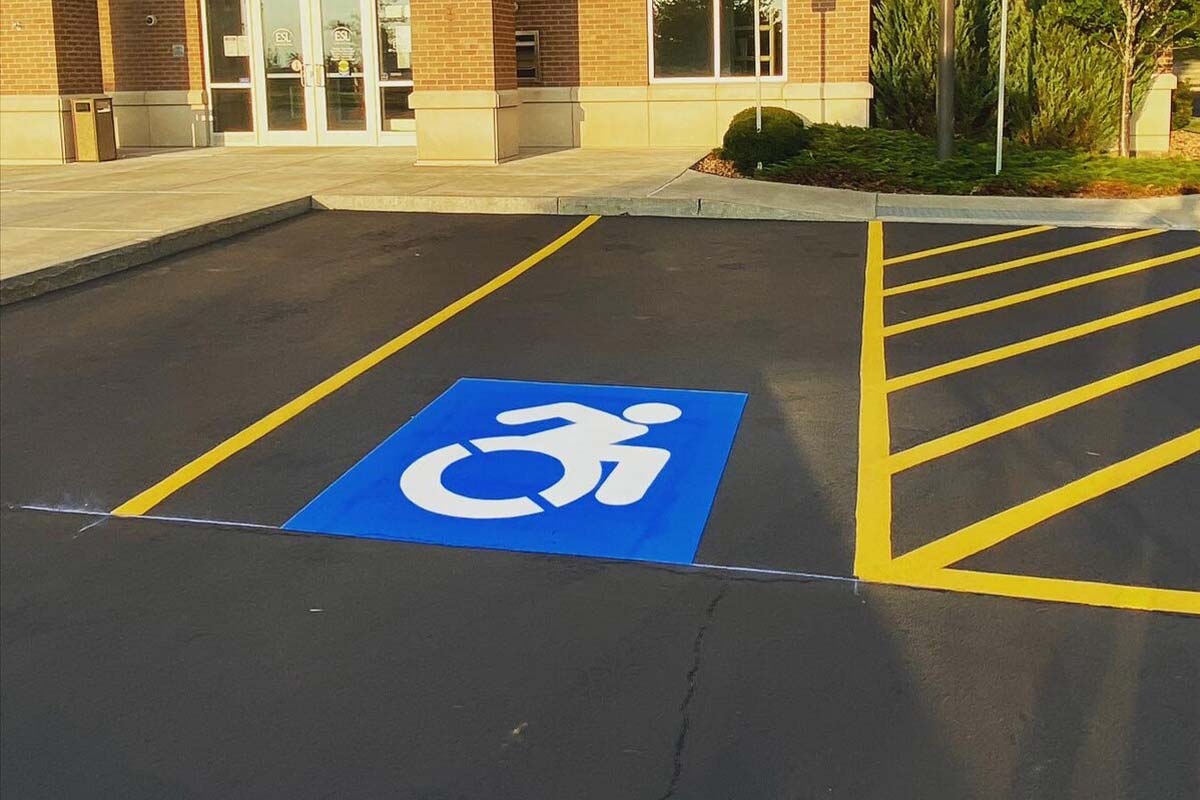
On work that triggers it, an accessible space in Texas is not finished just because the stall is the right width and a sign stands at the head of it. Texas adds a painted-marking rule on top of the federal standard: a contrasting-color accessibility symbol on the surface, and “NO PARKING” in twelve-inch capitals in the access aisle.
That rule is easy to miss, because it does not appear in the federal standard at all. A lot laid out from a federal-only checklist can have perfect geometry and still miss both marks. 1-800-STRIPER® of East Fort Worth lays out, stripes and restripes accessible parking for commercial properties across Tarrant County, Arlington and the Dallas–Fort Worth Metroplex, and we measure the line marking against the state standard.
16 TAC §68.104 — the Texas Rule That Governs Your Access Aisle
The federal standard deliberately does not tell you how to mark an access aisle. Texas filled the gap. The advisory to TAS 502.3.3 says it plainly: “The method and color of marking are not specified by these requirements but may be addressed by State or local laws.” That state law is 16 TAC §68.104, enforced by the Texas Department of Licensing and Regulation, effective 1 August 2020.
Under the rule, a paved accessible parking space must carry the International Symbol of Accessibility painted conspicuously on the surface in a color that contrasts the pavement, plus the words “NO PARKING” painted on any access aisle adjacent to the space. The lettering is not left to judgment: all capital letters, at least twelve inches tall, a stroke width of at least two inches, centered within each access aisle.
The rule has a start date, and it matters. TDLR states that projects registered with it on or after 1 August 2020 must comply, and that *”any new or alteration construction projects that begin on or after August 1, 2020… must also satisfy the rule if they include accessible parking requirements.”* So this is a duty on work you do, not an ambient duty that lands on an untouched lot. If your lot predates it and nothing has been altered since, whether you must be brought up to it is a safe-harbor question — the same question, and the same answer, as everywhere else on this page: a Registered Accessibility Specialist decides it, not a striping contractor.
Two things follow for work that does trigger it. The symbol on the sign post does not satisfy the symbol on the pavement — they are separate requirements. And an access aisle with hatching but no lettering is not marked as the state rule describes.
How Many Accessible Spaces You Need
Two rulebooks set the count in Fort Worth, and you have to read both.
The state count comes from TAS 208.2, scoped per parking facility, not per site. A property with three separate lots counts each lot on its own. These counts attach on new construction, on alteration and on a change of occupancy — they are not an ambient duty that lands on an untouched lot. The 2012 Texas Accessibility Standards, which are based on the federal 2010 ADA Standards, set the table:
| Total spaces in the parking facility | Required accessible spaces |
|---|---|
| 1 – 25 | 1 |
| 26 – 50 | 2 |
| 51 – 75 | 3 |
| 76 – 100 | 4 |
| 101 – 150 | 5 |
| 151 – 200 | 6 |
| 201 – 300 | 7 |
| 301 – 400 | 8 |
| 401 – 500 | 9 |
| 501 – 1,000 | 2% of the total |
| 1,001 and over | 20, plus 1 for each 100 over 1,000 |
Fort Worth raises that table for medical property. The city’s own ordinance, § 6.202(g)(1), applies the count to parking *”provided, either in accordance with parking requirements or voluntarily”* and then sets a percentage in place of the band for two use classes:
- 10% of the spaces provided at *”offices, professional and commercial uses, eleemosynary institutions and doctors’ clinics, any of which provides outpatient medical care.”*
- 20% of the spaces provided at *”general and long term hospitals, nursing and care homes, and philanthropic medical care uses, any of which specializes in the treatment of persons with mobility impairments.”*
The qualifier is doing the work in both. The 10% does not land on every office in the city — it lands on the ones providing outpatient medical care. Where it does land, it is not a rounding difference: a 100-space outpatient-medical lot reads as four accessible spaces on the TAS table and ten under the ordinance.
The ordinance carries a third percentage, for multifamily dwellings and apartment hotels with accessible or adaptable units *”as specified by the building code.”* We do not publish it as your number. On a small or mid-size lot that percentage falls below what the TAS table requires — a 100-space lot: four on the table, two at 2% — and no striping contractor should be the reason an apartment owner puts down fewer accessible spaces than the standard calls for. Which figure controls there is a Registered Accessibility Specialist’s question.
Van spaces come out of the required count, not on top of it. On new construction and on alterations, TAS 208.2.4 controls: *”For every six or fraction of six parking spaces required by 208.2 to comply with 502, at least one shall be a van parking space complying with 502.”* That is one van space per six required accessible spaces — not per six spaces in the lot. One in six.
You will see a different figure locally. Fort Worth’s zoning table still shows one van space for every eight accessible spaces or fraction thereof — the older federal standard. Where the two differ on a lot you are building or altering, build to the stricter TAS ratio.
Whether an existing, unaltered lot has to be brought up to that ratio is a different question, and not one we answer. It turns on when the lot was built and what has been done to it since — the safe-harbor analysis. A Registered Accessibility Specialist makes that call. Ask before you buy van spaces you may not owe.
Stall and Access-Aisle Dimensions
TAS 502 fixes the dimensions for work that triggers the standard — new construction, alteration, change of occupancy. A car accessible space runs at least 96 inches wide; a van space at least 132 inches, or 96 inches where the access aisle serving it is itself 96 inches. Aisles are at least 60 inches wide and must extend the full length of the space they serve.
Two constraints on the aisle do more work than the numbers. Access aisles must not overlap the vehicular way — an aisle that bleeds into a drive lane is not an aisle — and widths are measured from the centerline of the markings. Above ground, TAS 502.6 requires the ISA sign at each accessible space, a “van accessible” designation at van spaces, and the bottom of that sign at least 60 inches above the ground.
No Compliant Sign, No Citation on Your Own Lot
If an accessible space on your lot does not carry a compliant parking space identification sign, a peace officer may issue a warning but may not issue a citation to the driver parked in it. That is Texas Transportation Code Chapter 681, Section 681.011(f-2). The statute turns on the sign, not on the paint.
The van space blocked every morning by a delivery vehicle. The access aisle used as a staging bay. If the space carries no compliant sign, you have no enforcement remedy on your own lot — and the fix for that gap is a compliant sign on a post, not a repaint. We mount them: see parking lot sign installation in East Fort Worth. The pavement marking still has to be right. It is doing a different job.
The One-Year Inspection, and the Threshold Nobody Explains
Texas Government Code §469.105 requires the owner to have the facility inspected not later than the first anniversary of completion, by TDLR or by a Registered Accessibility Specialist.
The threshold is the part that gets misread. TDLR plan review only applies above the state’s threshold, but TDLR’s own guidance is explicit that a project below it “is still required to comply with TAS.” Below the line, the paperwork is optional. Compliance is not. Which work counts as an alteration, and what an older lot has to be brought up to, is a Registered Accessibility Specialist’s call — not a striping contractor’s.
Get a Free Estimate
The fastest way to find out where an existing lot stands is to measure it. Call 1-800-STRIPER® of East Fort Worth on (972) 543-1033 and we will walk the property, count each parking facility separately, and measure the stalls and aisles you have. Owner George Pareja runs the crews here, the business is rated 4.6 stars from 9 Google reviews, and the estimate is free.
Code references verified against the published standard on 13 July 2026. This is general information, not legal advice — what applies to your lot depends on when it was built and what has been done since. Confirm it with a Registered Accessibility Specialist.
For a full list of our pavement marking services, visit our parking lot striping in East Fort Worth page.
Businesses We Serve




How it Works

GET A FREE ESTIMATE
Contact us today and we’ll have a quote to you in 24 hours

SCHEDULE AN INSTALLATION
We’ll have your installation scheduled in less than 7 days, without affecting your business hours

GET A PARKING LOT THAT POPS
For a budget-friendly price, you’ll get a parking lot that looks like new!
We proudly work with:


We proudly work with:


Frequently Asked Questions About ADA Parking Lot Striping in East Fort Worth, TX
What does Texas require to be painted in the access aisle?
The words “NO PARKING,” painted on any access aisle adjacent to an accessible space. 16 TAC §68.104 specifies all capital letters, a letter height of at least twelve inches, a stroke width of at least two inches, centered within each access aisle. It applies to new and alteration projects beginning on or after 1 August 2020. The federal standard does not set this: its advisory to TAS 502.3.3 leaves method and color of marking to state or local law, and Texas filled the gap.
Does the accessibility symbol have to be painted on the pavement?
On work the rule reaches, yes. 16 TAC §68.104 requires the International Symbol of Accessibility to be painted conspicuously on the surface of a paved accessible parking space, in a color that contrasts the pavement, and it applies to new and alteration projects beginning on or after 1 August 2020. It is a separate requirement from the sign: TAS 502.6 requires an ISA sign at each accessible space, and a sign alone does not satisfy the painted-symbol rule.
How many accessible spaces does my lot need?
People search for the percentage, and mostly there isn’t one. TAS 208.2 is a table, not a percent: one accessible space for 1–25, two for 26–50, three for 51–75, four for 76–100, up through nine for 401–500. Only between 501 and 1,000 spaces does it become a percentage — 2% — and above 1,000 it goes back to a count: twenty spaces, plus one more for every additional hundred. Counted per parking facility, not per site. But Fort Worth § 6.202(g)(1) replaces that band with a percentage where a use provides outpatient medical care: 10% of the spaces provided, and 20% at hospitals and care homes specializing in treating people with mobility impairments.
How many of them have to be van spaces?
On new construction and alterations, one in six. TAS 208.2.4 requires that for every six, or fraction of six, required accessible spaces, at least one be a van space, so a lot needing three needs one and a lot needing seven needs two. Fort Worth’s zoning table still shows one in eight, the older federal figure; where they differ, build to TAS. Whether an existing, unaltered lot must be brought up is a safe-harbor question for a Registered Accessibility Specialist.
How wide does the access aisle have to be?
At least 60 inches, and it must extend the full length of the parking space it serves. Under TAS 502, the aisle must not overlap the vehicular way, and widths are measured from the centerline of the markings. An aisle that is hatched but short of the space’s full length does not meet the standard.
Can I have a violator ticketed if my accessible space has no compliant sign?
No. Under Texas Transportation Code §681.011(f-2), a peace officer may issue a warning but may not issue a citation to a person who parks in an accessible space that does not have a parking space identification sign meeting the standard. The trigger is the sign on the post, not the paint on the pavement, so the fix for an enforcement gap is a compliant sign rather than a repaint.
What is the one-year inspection?
Texas Government Code §469.105 requires the owner to have the facility inspected not later than the first anniversary of completion, by TDLR or a Registered Accessibility Specialist. Separately, TDLR plan review only triggers above the state’s threshold, but a project below it is still required to comply with the Texas Accessibility Standards. The paperwork is optional below the line; the compliance is not.
What are the requirements for an ADA parking lot in Texas?
Three things, and Texas adds one the federal standard leaves out. The 2012 Texas Accessibility Standards set how many accessible spaces you need — it is a table, not a flat percentage — and they set the identification sign for accessible spaces, with an exception for sites of four or fewer total spaces, and the “van accessible” designation on van spaces. 16 TAC § 68.104 then adds what Texas requires on the pavement: the International Symbol of Accessibility painted on the surface in a color that contrasts the pavement, and the words “NO PARKING” painted in any adjacent access aisle in capitals at least twelve inches tall with a two-inch stroke, centered in the aisle. It also requires the sign to carry wording — at minimum “Violators Subject to Fine and Towing,” in letters at least one inch high. That is not a second sign: § 68.104(b) says an identification sign that complies with TAS 502.6 and carries that wording satisfies the requirement on its own. All of this attaches to new construction and alterations beginning on or after 1 August 2020 — an older lot that has not been built on or altered is a safe-harbor question for a Registered Accessibility Specialist, not something we will tell you that you are failing today.
Does ADA striping have to be blue?
No. 16 TAC § 68.104(a)(1) requires the International Symbol of Accessibility to be painted on the surface “in a color that contrasts the pavement.” Contrast is the requirement — not blue. Blue is the convention almost everyone uses, and it satisfies the rule perfectly well, but the rule is written about contrast. Texas went the other way on the aisle lettering too: when the Texas Department of Licensing and Regulation adopted the rule it was asked to require the “NO PARKING” wording to contrast with the pavement, and it declined — that lettering has a required height and stroke width, not a required color.
Who is allowed to park in an accessible space?
Under Texas Transportation Code § 681.006, a vehicle may park in a space designated for persons with disabilities when it is being operated by or for the transportation of a person with a disability and it displays either the disabled parking placard on the rearview mirror or the qualifying disabled license plates. Two exceptions are worth knowing before you tow anyone: § 681.007 recognizes out-of-state plates and placards bearing the international symbol of access, and § 681.008 lets certain disabled-veteran and military-award plate holders use these spaces without a placard at all. Two more things owners routinely miss: the placard belongs to the person, not the car — § 681.011(d) makes it an offense to lend it to someone who then misuses it — and the access aisle beside the space is not a spare parking spot, because § 681.011(c) makes it an offense to stand a vehicle so that it blocks an access aisle or curb ramp. In Fort Worth, the Fort Worth Code § 22-174 makes unauthorized parking in a signed accessible space unlawful and towable on a private lot, and it is conditioned on the signage being there. No sign, no enforcement.