Parking Lot Restriping
In East Fort Worth, TX
Restripe Existing Lines and Markings
1-800-STRIPER® provides professional parking lot restriping in East Fort Worth, TX — refreshing faded lines, ADA stalls, fire lanes, and directional arrows with fast-dry traffic paint applied to the TxDOT Item 666 surface-temperature and dry-pavement standard for commercial properties across Tarrant County.
1-800-STRIPER of East Fort Worth PROVIDes Restriping Services NEAR YOU
Need to brighten up your faded parking lot?
Keep your parking lot safe and attractive by restriping annually to freshen up lines and symbols that have faded from the sun, weather, and traffic. Nothing beats a fresh coat of paint!
Benefits:
Parking Lot Restriping in East Fort Worth, TX
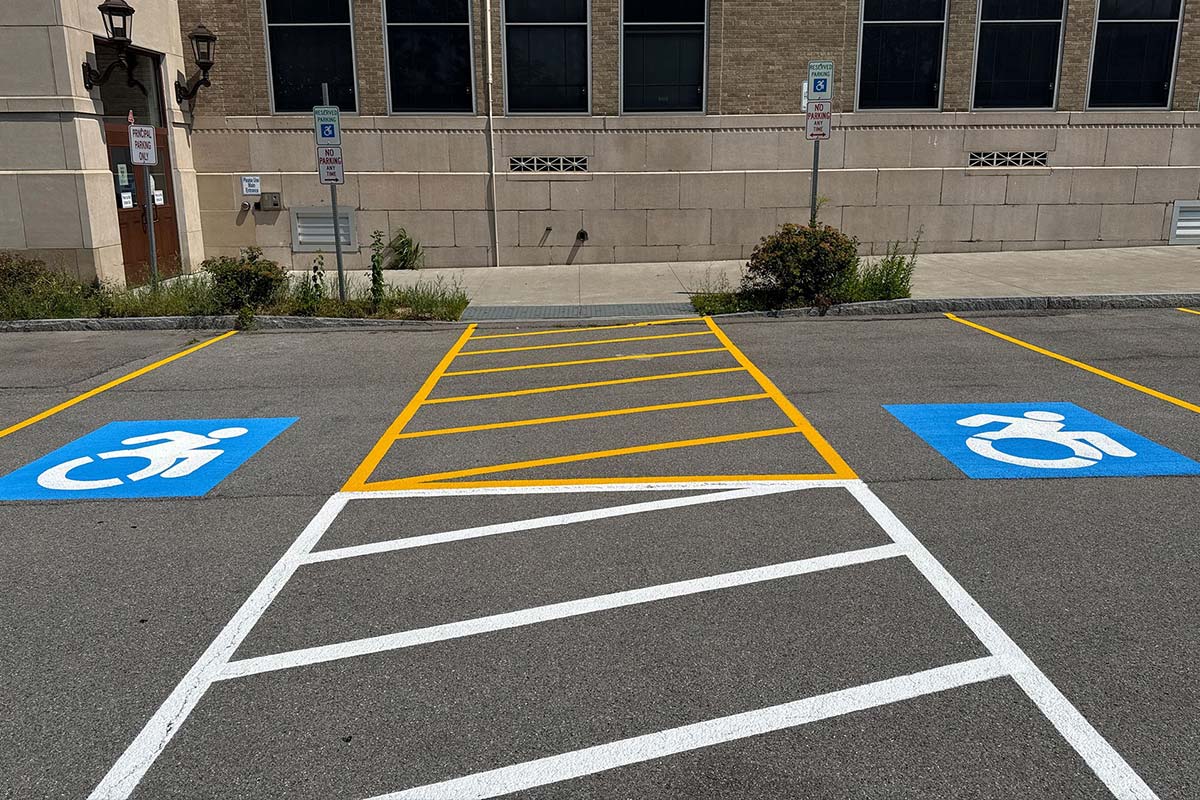
Restriping repaints an existing lot: the same stalls, ADA spaces, fire lanes, arrows and crosswalks, brought back to legibility. 1-800-STRIPER® of East Fort Worth handles line striping and line marking for retail, office, industrial and multifamily properties across Tarrant County and Arlington. Call (972) 543-1033. Rated 4.6 stars from 9 Google reviews.
Plan Review: What Fort Worth Requires Before a Restripe
If your restripe changes the layout — a new stall count, a new angle, new accessible spaces — plan on a city submittal. The Fort Worth Code of Ordinances at § 6.200(c), headed *”Plan required,”* is flat about it: *”Any future changes in parking arrangements must be approved by the planning and development department.”* A layout change is a change in arrangement. That one is not a close call.
The line-for-line repaint is the close call, and we will not pretend otherwise. § 6.202(g)(3) opens *”When parking areas are restriped, the provisions of this subsection (g)(3) shall apply,”* and those provisions include that *”plans for the restriping must be submitted to the planning and development department for review and approval before work begins.”* Read on its own, that reaches every restripe. But subsection (g) is headed *”Accessible parking,”* and the sentence between the two addresses restriping done *”voluntarily to existing parking for the purpose of installing accessible spaces”* — where staff may allow a reduction in the required stall count to fit them. Which reading the city applies to a straight repaint is the city’s call, not a striping contractor’s.
So we settle it with Fort Worth Development Services before the crew mobilizes. We would rather find out you need a submittal than find out afterwards. A restripe is also the moment to fix accessible-stall counts and worn access-aisle markings. See ADA parking lot striping in East Fort Worth.
When a Lot Needs Restriping
No Fort Worth ordinance sets a repaint calendar. Condition is the trigger, not the date.
- Lost retroreflectivity. The spec we work to sets minimums of 175 mcd/m²/lx for white traffic paint and 125 for yellow. A stripe that no longer reads at night is finished.
- Faded fire-lane markings. Where a lot *has* a fire lane, the Fort Worth Fire Code requires striping and signs to be *”maintained in a clean and legible condition at all times.”* A washed-out red border is a compliance failure, not a cosmetic one. See fire lane striping in East Fort Worth.
- ADA drift. Access-aisle lettering worn away, the accessibility symbol gone from the pavement. Where 16 TAC §68.104 reaches the work — new construction and alterations from August 2020 — Texas requires both painted on the surface.
Our Restriping Process
- Walk and count. Measure the layout, count stalls and accessible spaces, photograph fire lanes and arrows.
- Settle the plan-review question. § 6.200(c) requires any future change in the parking arrangement to be approved by the planning and development department, and § 6.202(g)(3) applies its provisions when parking areas are restriped. We confirm the scope with Fort Worth Development Services first. No paint lands until that is settled.
- Clean the surface. Item 666 calls for clean, dry pavement; heavy build-up goes to our parking lot pressure washing crew.
- Check temperature and dryness. Surface at or above 50°F, dry by the plastic-sheet test below.
- Lay out and stripe. Existing lines serve as control; we chalk corrected geometry first.
- Bead and verify. Beads go into wet paint; we check embedment and line width on site.
- Reopen in sections. The spec caps dry time at 10 minutes maximum, so the lot comes back a section at a time.
Paint, Beads and Retroreflectivity
No law tells a private lot what paint to use. TxDOT Item 666 Retroreflectorized Pavement Markings is a highway specification — voluntary on your lot, not a legal requirement. It is the standard we work to, and it puts numbers on the things that decide whether a line lasts:
| Spec | The standard we work to (TxDOT Item 666) |
|---|---|
| Retroreflectivity — traffic paint | 175 white / 125 yellow (mcd/m²/lx, ASTM E1710) |
| Retroreflectivity — thermoplastic | 250 white / 175 yellow |
| Glass bead embedment | 40–60% |
| Line width tolerance | ±1/8 in. |
| Alignment tolerance | 1 in. per 200 ft maximum deviation |
| Traffic paint dry time | 10 minutes maximum (ASTM D711) |
| Material retention | No more than 5% loss in any 1-ft. section |
Paint gives you the line; the beads give you the line at night.
The East Fort Worth Striping Calendar
The spec sets the rule: the surface must be at or above 50°F and completely dry. Heat is rarely the problem here. Water usually is.
| DFW climate normal (NOAA/NWS, 1991–2020) | |
|---|---|
| Last spring freeze | March 12 |
| First fall freeze | November 22 |
| Days at or above 100°F | 20.2 per year (July 7.4 · August 9.7) |
| Days with measurable precipitation | 79.3 per year |
| Normal annual precipitation | 37.01 in. |
The freeze-free window, roughly March 12 to November 22, is the reliable season; those 79 wet days are the constraint inside it. “Dry” is measurable, not a judgment call: lay a one-square-foot piece of clear plastic on the pavement, weigh the edges down, and check after 15 minutes. No condensation underneath means dry.
Get a Free Estimate
1-800-STRIPER® of East Fort Worth restripes commercial lots across Tarrant County and the Dallas–Fort Worth Metroplex. Call (972) 543-1033 and we will walk the lot, confirm the plan-review scope with Fort Worth Development Services, and hand you a free estimate.
Code references verified against the published ordinance and standard on 13 July 2026. This is general information, not legal advice — confirm what your project requires with Fort Worth Development Services.
For a full list of our pavement marking services, visit our parking lot striping in East Fort Worth page.
Businesses We Serve




How it Works

GET A FREE ESTIMATE
Contact us today and we’ll have a quote to you in 24 hours

SCHEDULE AN INSTALLATION
We’ll have your installation scheduled in less than 7 days, without affecting your business hours

GET A PARKING LOT THAT POPS
For a budget-friendly price, you’ll get a parking lot that looks like new
We proudly work with:


We proudly work with:

Frequently Asked Questions About Parking Lot Restriping in East Fort Worth, TX
Do I need city approval to restripe my parking lot in Fort Worth?
If the work changes your layout, yes — and we settle the scope before we paint rather than guess. Fort Worth § 6.200(c) requires that “any future changes in parking arrangements must be approved by the planning and development department,” and § 6.202(g)(3) states that when parking areas are restriped its provisions apply, including that plans “must be submitted… before work begins.” How far that reaches a like-for-like repaint is a question for the city, not for a striping contractor. We confirm the scope with Fort Worth Development Services first.
How often should a parking lot be restriped?
No Fort Worth ordinance sets a repaint interval, so condition drives cadence, not the calendar. We look at whether the lines still read at night, whether accessible-stall and access-aisle markings are legible, and whether fire-lane striping still reads. The Fort Worth Fire Code requires fire-lane markings to be “replaced or repaired when necessary to provide adequate visibility.”
What are the best months to restripe in Dallas–Fort Worth?
March through November. The specification we work to calls for a pavement surface at or above 50°F and completely dry, and DFW’s freeze-free window runs roughly March 12 to November 22 on the 1991–2020 NOAA normals. Rain is the tighter constraint: DFW averages 79.3 days a year with measurable precipitation.
How soon can we drive on fresh striping?
Quickly. The traffic paint specification caps dry time at 10 minutes under ASTM D711, so fresh lines are not a day-long closure. We stage the work and hand the lot back section by section, which keeps most of your parking open. The spec’s retroreflectivity minimums are themselves measured 3 to 10 days after application, once the markings have settled.
Does restriping change my ADA obligations?
The 2012 Texas Accessibility Standards attach on new construction, alteration and change of occupancy, and the Texas Department of Licensing and Regulation is explicit that a project below the state’s plan-review threshold is still required to comply. Whether a given repaint counts as an alteration, and what an older lot must be brought up to, is a Registered Accessibility Specialist’s call.
Paint or thermoplastic?
Both go down on clean, dry pavement at or above 50°F. The difference the specification records is brightness: TxDOT’s retroreflectivity minimums are 175 mcd/m²/lx white and 125 yellow for traffic paint, against 250 and 175 for thermoplastic. Traffic paint’s 10-minute dry time reopens a lot faster. Which suits your surface is a site call.