
Bollard Installation
In East Fort Worth, TX
Safety and Security Bollards
1-800-STRIPER® provides professional bollard installation in East Fort Worth, TX — setting concrete-filled steel pipe bollards at storefronts, loading docks, fuel islands, and utility cabinets, with crash-rated options specified to ASTM F3016 and ASTM F2656 for commercial properties.
1-800-STRIPER® of East Fort Worth PROVIDes Bollard Installation Services NEAR YOU
Want to prevent accidents and protect your property?
Bollards provide physical protection for your customers and your property.
Safety and security:
Bollards create a physical barrier between vehicles and pedestrians, protecting people in walking areas from accidental or intentional vehicle intrusions.
Bollards act as a protective barrier around storefronts, gas stations, and other vulnerable areas, minimizing the risk of costly damage from vehicle impacts.
Strategic Placement Locations:
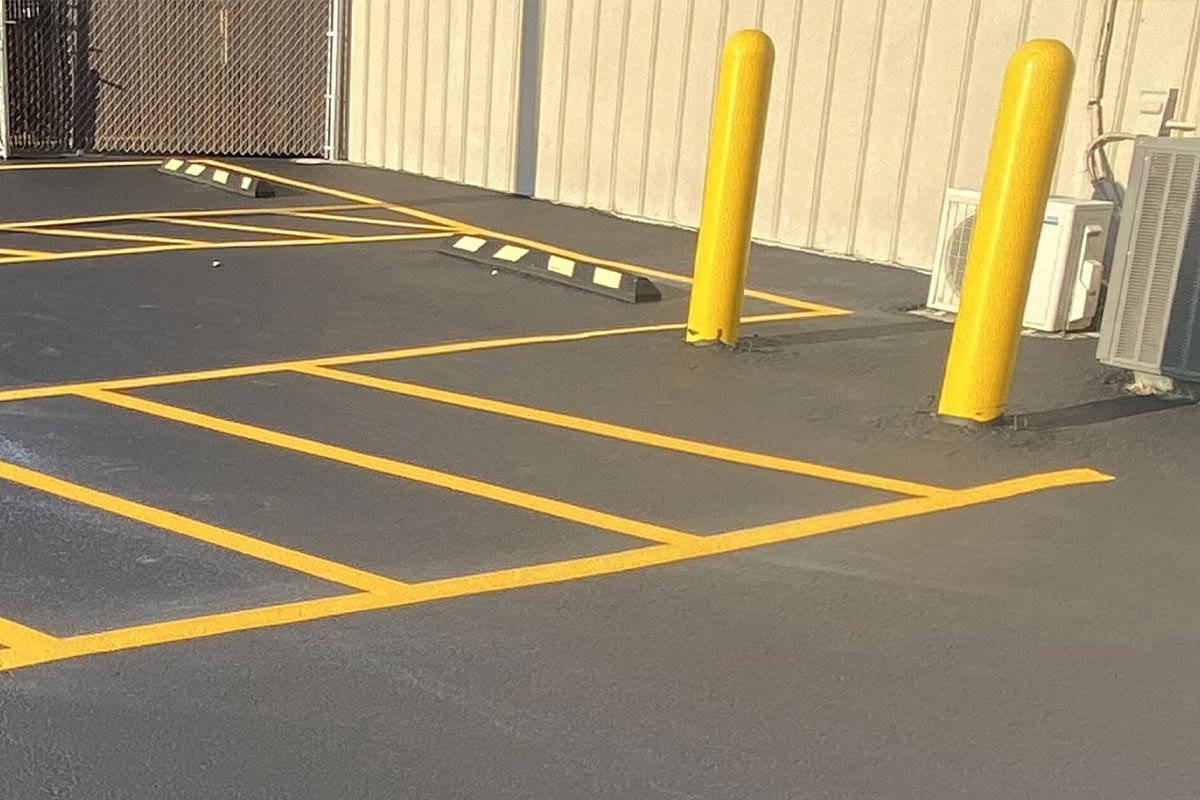
Bollard Installation in East Fort Worth, TX
1-800-STRIPER® of East Fort Worth sets concrete-filled steel pipe bollards on commercial property across Fort Worth, Arlington, the Mid-Cities and the wider Dallas–Fort Worth Metroplex. A bollard is a vertical post fixed into or onto the pavement to stop a vehicle reaching what is behind it: a storefront, a fuel pump, an electrical cabinet, a person at a walk-up window.
That is a different job from line marking. Paint tells a driver where not to go. A bollard is what is there when the driver goes anyway. Call (972) 543-1033.
Where bollards go, and what each one is protecting
What stands behind a bollard is what specifies it. Across the commercial lots we work in Tarrant County, the same placements keep coming up:
- Storefronts and glass. Where a stall faces the door and only paint sits between them.
- Loading docks. Levelers, door tracks, controls, and the corners of the opening.
- Fuel islands. The pumps and the dispenser cabinets.
- Utility cabinets, meters and transformers. Equipment that takes a whole site offline when it is hit.
- Drive-thru lanes. Order points, menu boards, payment windows, and the corners vehicles cut.
- Pedestrian corners, where a striped crosswalk meets a drive aisle, and building corners in covered parking.
Each is a different exposure, and they do not all call for the same bollard or anchoring.
Crash-rated vs. protective — what the ASTM standards cover
What the bollard is engineered to stop is the distinction that matters, and two ASTM standards capture it. Neither is a law that applies to your lot. They are specs we build to.
ASTM F3016 addresses low-speed vehicle impact: the parking-lot event, a vehicle that creeps, rolls or accelerates a short distance into a barrier. ASTM F2656 is a crash rating, covering vehicle impact and attack resistance. It is the standard invoked when the requirement is to stop a vehicle deliberately driven at a target.
| Protective bollard | Crash-rated bollard | |
|---|---|---|
| Standard | ASTM F3016 — low-speed vehicle impact | ASTM F2656 — crash rating, impact and attack resistance |
| Status | Voluntary — the standard we build to | Voluntary — the standard we build to |
On most lots the exposure is the first case. If a tenant or a site plan has called for F2656, say so at the walkthrough. That changes the foundation, not just the post.
Installation — embedded, surface-mounted, or removable
How the bollard is fixed to the ground decides whether it stops anything. Three methods, and they are not interchangeable:
- Embedded (core-drilled). We core-drill the pavement, set the pipe into a concrete footing below, and fill the pipe with concrete. This is the method for a bollard that must resist an impact rather than mark a boundary: the load goes into the ground, not into the surface.
- Surface-mounted. The pipe is welded to a base plate anchored to the slab. Faster, and the option where you cannot dig: over a structural slab, a deck, or shallow utilities. Those anchors and that slab limit its resistance.
- Removable. The bollard drops into a permanent sleeve set in the pavement and locks in place, then lifts out when you need the opening: fire access, deliveries, event load-in.
Footing depth is a site decision, not a number we quote off a page. It depends on your pavement section, what is under it, and what the bollard must resist, which is why we have utilities located before we core-drill. The sleeve or cover above ground is cosmetic. The protection is the steel, the concrete, and the anchoring.
Get a free estimate
Bollards are quoted alongside the rest of the lot: the stalls, the fire lane, and the line striping on the same visit. We will walk the site and look at what each bollard has to protect. 1-800-STRIPER® of East Fort Worth is rated 4.6 stars from 9 Google reviews. Call (972) 543-1033.
For a full list of our pavement marking services, visit our parking lot striping in East Fort Worth page.
Businesses We Serve




How it Works

GET A FREE ESTIMATE
Contact us today and we’ll have a quote to you in 24 hours

SCHEDULE AN INSTALLATION
We’ll have your installation scheduled in less than 7 days, without affecting your business hours

GET A PARKING LOT THAT POPS
For a budget-friendly price, you’ll get a parking lot that looks like new
We proudly work with:


We proudly work with:


Frequently Asked Questions About Bollard Installation in East Fort Worth, TX
What is the difference between a bollard and a wheel stop?
A wheel stop is the low barrier at the head of a stall that a front tire meets. It stops overhang, keeping a vehicle’s nose off a sidewalk or an access aisle. A bollard is a vertical post that stops the vehicle itself reaching what is behind it. One manages where a parked car ends. The other stands between a moving car and your glass.
Do I need crash-rated bollards or protective bollards?
ASTM F3016 addresses low-speed vehicle impact, the everyday parking-lot event. ASTM F2656 is a crash rating covering impact and attack resistance, for stopping a vehicle deliberately driven at a target. Both are voluntary standards we build to, not requirements we can put on you. Most lots are protecting against the first case. If a site plan specifies F2656, tell us at the walkthrough.
Embedded or surface-mounted — which should I choose?
Embedded, where you can dig. Core-drilling the pavement and setting the pipe into a concrete footing puts the load into the ground rather than into the surface. Surface-mounting welds the pipe to a base plate anchored to the slab, so those anchors and that slab set the limit on its resistance. Over a structural slab or shallow utilities it is the right answer. It is not the default one.
Will bollards protect my storefront?
We are not going to tell you any bollard is unstoppable. Nobody honestly can. What a properly anchored, concrete-filled steel pipe bollard does is stand between a vehicle and your glass, so low-speed contact that would otherwise reach the façade meets steel and concrete first. Anchoring is what carries that, which is why we treat the footing as the specification.
How far apart should bollards be spaced?
We set spacing on your site, not off a table. It has to be close enough that a vehicle cannot pass between two posts, open enough that people, carts and wheelchairs still can. Your accessible route through the line has to stay usable. The answer depends on what you are protecting and where pedestrians cross.
Do sleeves and covers actually matter?
They matter for appearance and upkeep. Not for protection. A plastic or stainless sleeve slides over the pipe, keeps a scuffed or rusting post looking finished, and saves you repainting it. It adds nothing to what the bollard will stop. The protection is the steel pipe, the concrete filling it, and the anchoring beneath, so a cover is never a reason to specify or skip one.
Do you need a permit to install bollards in Fort Worth?
We are not going to guess at that for you. We looked, and we found no Texas or Fort Worth code written specifically about bollards — the impact standards we build to, ASTM F3016 and ASTM F2656, are industry standards, not law. But “no bollard-specific code” is not the same as “no permit,” and we will not tell you it is. Whether a permit applies depends on what the work actually touches: whether you are cutting into a structure, changing the parking arrangement, or doing it as part of a larger alteration. We confirm the scope with Fort Worth Development Services before the crew mobilizes, and we would rather find out you need a filing than find out afterwards. What we can tell you is where a bollard must not go. The Fort Worth Fire Code requires that a marked fire lane and its clearances be “maintained at all times,” so a bollard set inside one is an obstruction. And when Texas adopted its accessible-parking rule, the Texas Department of Licensing and Regulation’s own record warned that a pipe bollard “could create an issue with access by obstructing access ways.” Placement is where bollards actually go wrong, and we walk it before we drill.