
Warehouse Line Painting
In Greenville, SC
OSHA-Compliant Safety Markings
1-800-STRIPER provides professional warehouse line painting in Greenville, SC — permanent aisle markings, pedestrian walkways, floor markings, and safety-zone striping that meet the OSHA requirement to appropriately mark permanent aisles and passageways in industrial facilities.
1-800-STRIPER® of Greenville PROVIDes Warehouse Line Painting Services NEAR YOU
Want your indoor space to operate more efficiently?
Warehouse and interior markings ensure clear traffic lanes, organized storage zones, and designated spaces designed to help your business operate safely and efficiently.
Benefits:
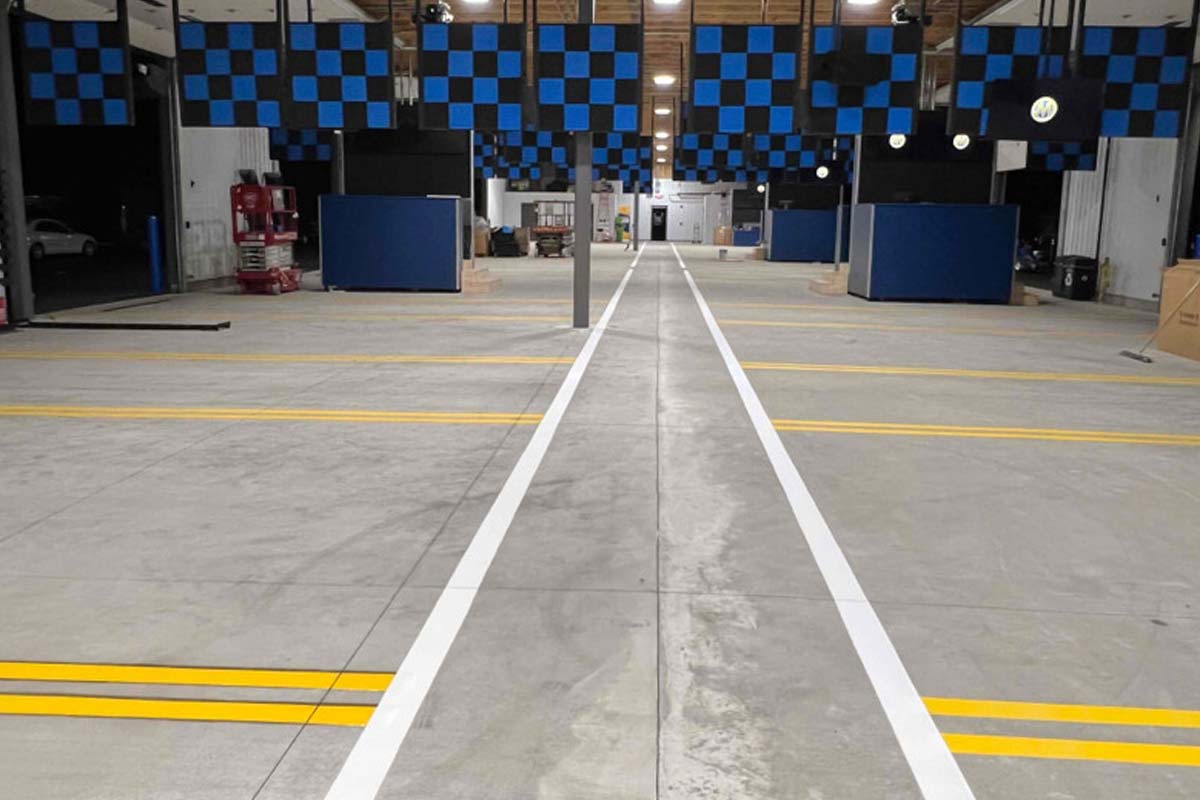
What Warehouse Line Painting Includes
Warehouse line painting is the interior equivalent of parking lot striping, and the stakes are different: the traffic is forklifts and people sharing the same concrete, and the markings are what keeps them apart.
A typical scope inside a Greenville or Spartanburg County distribution building covers permanent aisle lines, pedestrian walkways and crossings, dock and staging area boundaries, rack and bay identification, equipment and charging-station outlines, safety-zone perimeters around panels and eyewash stations, keep-clear areas at exits and fire equipment, and directional arrows on one-way aisles.
The work is planned around production, not dropped on top of it. Most of our warehouse jobs run in zones on off-shifts or over a weekend, with the marked area barricaded until it releases to traffic, so the building keeps shipping.
Warehouse Floor Markings and Aisle Lines
Warehouse floor markings and warehouse line painting describe the same trade. The first is what facility managers usually search for; the second is what the work is called on a scope of work.
The distinction worth making is between markings that carry a regulatory duty and markings that carry an operational one. Permanent aisles and passageways sit in the first group. Rack labels, bay numbers, staging outlines and color-coded zones sit in the second — nothing federal requires them, and they are often the most valuable markings in the building because they are what make a chaotic floor legible to a new hire on day one.
Both get planned together, because a marking scheme that mixes the two without a rule quickly becomes noise. If everything is painted, nothing stands out.
What OSHA Actually Requires for Aisle Marking
The requirement lives in 29 CFR 1910.176(a), and it is shorter than most people expect:
> Where mechanical handling equipment is used, sufficient safe clearances shall be allowed for aisles, at loading docks, through doorways and wherever turns or passage must be made. Aisles and passageways shall be kept clear and in good repair, with no obstruction across or in aisles that could create a hazard. Permanent aisles and passageways shall be appropriately marked.
That is the whole duty for aisle marking. Three things follow from it.
First, the trigger is mechanical handling equipment. If forklifts, pallet jacks or similar equipment operate in the space, the clearance and marking provisions engage.
Second, the duty attaches to *permanent* aisles and passageways. A staging lane that moves with the season is not what the paragraph is describing.
Third — and this is where a lot of published guidance goes wrong — the standard often cited for warehouse aisle marking, 29 CFR 1910.22, does not contain a marking duty. It is 1910.176(a) that does. If a specification, a consultant’s report or a competitor’s web page cites 1910.22 for aisle marking, it is citing the wrong section.
What OSHA Does Not Specify: Width, Color, and Aisle Dimension
“Appropriately marked” is the entire technical specification in the regulation. No width. No color. No aisle dimension.
The closest thing to a number is an archived OSHA interpretation letter dated 15 May 1972, addressing marking and width requirements for aisles in industrial operations. It states that the lines used to delineate aisles may be any color so long as they clearly define the area considered as aisle space, and that the lines may be composed of dots, squares, strips or continuous runs so long as they define the aisle area. On dimensions it says the recommended width of aisle markings varies from 2 inches to 6 inches, and therefore any width of 2 inches or more is considered acceptable, and that the recommended width of aisles is at least 3 feet wider than the largest equipment to be used, or a minimum of 4 feet.
Two caveats belong with that letter, and we state them instead of quietly using the numbers as if they were the rule. It is published in OSHA’s archive with a notice that it may no longer represent OSHA policy and is presented as historical content. And it is written against 1910.22(b), a paragraph that no longer carries the aisle-marking duty.
So the practical position is this: the enforceable requirement is that permanent aisles and passageways be appropriately marked. The 2-inch minimum line and the equipment-plus-3-feet aisle are long-standing guidance that most facilities and most insurers treat as the working baseline, and we will build to them or to your own written standard — but nobody should tell you that a 4-inch yellow line is federally mandated, because it is not.
Color Conventions from ANSI Z535.1
Color on a warehouse floor is convention plus your own written scheme, not a federal mandate for aisle lines.
Where color *is* federally addressed is 29 CFR 1910.144, the safety color code for marking physical hazards. It makes red the basic color for identifying fire protection equipment and apparatus, for danger, and for stop — including emergency stop bars and stop buttons on hazardous machinery. It makes yellow the basic color for designating caution and for marking physical hazards such as striking against, stumbling, falling, tripping, and caught-in-between. That is the scope of it; the section says nothing about aisle line color.
ANSI/NEMA Z535.1 is the American National Standard that facilities commonly cite for safety colors. It is a private consensus standard sold through the ANSI webstore rather than a public regulation, so we do not paraphrase its contents here or on a specification. If your EHS program adopts it, give us the color table your program uses and we mark to that table.
In practice, the workable rule is that color should be documented and consistent building-wide. A facility where yellow means aisle in one bay and hazard in the next has a marking scheme that actively misleads.
Pedestrian Walkways and Crosswalks Inside the Building
Separating people from powered equipment is the highest-value marking in most buildings, and it is the one that gets improvised most often.
A pedestrian walkway works when it is continuous from the door a person enters through to the destination they are heading for. Walkways that stop at a busy intersection and resume on the other side hand the decision back to the pedestrian at the worst possible moment. Crossings should be placed where sightlines are longest, not where the run happens to be shortest, and paired with floor-level stop or yield markings on the equipment aisle where the operating pattern warrants.
We also mark door swing zones, the approach to man-doors that open into equipment aisles, and the pinch points at dock levelers, because those three locations produce a disproportionate share of near-misses in the buildings we work in.
Safety Zones, Equipment Outlines, and Staging Areas
The rest of a marking scheme is about making the floor self-explanatory.
Keep-clear zones go in front of electrical panels, fire extinguishers, hose reels, sprinkler risers, eyewash and shower stations, and exits. Equipment outlines fix where a piece of equipment lives, so an operator can see at a glance that something has migrated. Battery charging and fueling areas get bounded perimeters. Staging and hold areas — inbound, outbound, quality hold, damage — get boundaries plus lettering, because the color alone will not survive a shift handover.
Rack and bay identification is a separate layer: aisle letters, bay numbers and level markers that tie the floor to the warehouse management system. Getting that layer to match the system’s naming exactly is worth more than any amount of extra paint.
Coatings for Sealed Concrete Warehouse Floors
Sealed and coated concrete is the hardest substrate to hold a line on, and it is why some warehouse markings fail within months.
The problem is bond. A cured sealer or a densified, polished slab is designed to be non-porous, which is precisely what a coating needs to key into. Marking material applied straight onto that surface can look perfect on day one and peel at the first hard turn from a loaded forklift.
The fix is to treat the surface, not the symptom. That means identifying what is on the slab — sealer, densifier, epoxy, urethane, cure-and-seal or bare concrete — and preparing accordingly before any marking goes down. Where the traffic is heavy and the layout is stable, durable tape or an inlaid marking is sometimes a better answer than paint. We assess the slab before quoting instead of assuming, because on this substrate the assessment is the job.
Marking Layout Specification Table
| Element | What governs it | Detail |
|---|---|---|
| Permanent aisles and passageways | 29 CFR 1910.176(a) | Shall be appropriately marked; enforceable duty |
| Aisle clearance | 29 CFR 1910.176(a) | Sufficient safe clearances at aisles, docks, doorways and turns |
| Obstruction | 29 CFR 1910.176(a) | Aisles kept clear and in good repair, no hazardous obstruction |
| Aisle marking line width | Not specified in the regulation | Archived 1972 OSHA interpretation: 2 in to 6 in recommended, any width 2 in or more acceptable |
| Aisle width | Not specified in the regulation | Archived 1972 OSHA interpretation: at least 3 ft wider than the largest equipment, or 4 ft minimum |
| Aisle marking color | Not specified in the regulation | Archived 1972 OSHA interpretation: any color that clearly defines the aisle area |
| Aisle marking form | Not specified in the regulation | Archived 1972 OSHA interpretation: dots, squares, strips or continuous |
| Red | 29 CFR 1910.144(a)(1) | Fire protection equipment and apparatus; danger; stop |
| Yellow | 29 CFR 1910.144(a)(3) | Caution and physical hazards: striking against, stumbling, falling, tripping, caught-in-between |
| Facility color scheme | Your EHS program | ANSI/NEMA Z535.1 where adopted; supply the table and we mark to it |
| Substrate preparation | Coating manufacturer | Determined by what is on the slab: sealer, densifier, epoxy, polish or bare concrete |
For a full list of our pavement marking services, visit our parking lot striping in Greenville page.
Businesses We Serve




How it Works

GET A FREE ESTIMATE
Contact us today and we’ll have a quote to you in 24 hours

SCHEDULE A STRIPING
We’ll have your space restriped in less than 7 days, without affecting your business hours

GET A PARKING LOT THAT POPS
For a budget-friendly price, you’ll get a parking lot that looks like new
We proudly work with:


We proudly work with:


Frequently Asked Questions About Warehouse Line Painting in Greenville, SC
What does OSHA actually require for warehouse aisle marking?
One sentence in 29 CFR 1910.176(a): permanent aisles and passageways shall be appropriately marked. The same paragraph requires sufficient safe clearances for aisles, at loading docks, through doorways and wherever turns or passage must be made, and requires aisles to be kept clear and in good repair with no hazardous obstruction. The duty engages where mechanical handling equipment is in use. Worth knowing: 29 CFR 1910.22 is frequently cited for this and does not contain the marking duty.
Does OSHA specify a line width or color?
No. The regulation says “appropriately marked” and stops there. An archived OSHA interpretation letter from 15 May 1972 states that aisle lines may be any color that clearly defines the aisle area, may be dots, squares, strips or continuous, and that the recommended marking width varies from 2 inches to 6 inches so any width of 2 inches or more is acceptable. That letter is published as historical content that may no longer represent OSHA policy, and it interprets a paragraph that no longer carries the duty, so treat it as guidance rather than a rule.
How wide should a warehouse aisle be?
The regulation requires sufficient safe clearances, not a number. The archived 1972 OSHA interpretation recommends at least 3 feet wider than the largest equipment to be used, with a minimum of 4 feet. That remains the working baseline most facilities and insurers use, and it is a sensible starting point, but it is guidance and not an enforceable dimension. The real determinant is your equipment: a reach truck, a counterbalance forklift and a pallet jack impose different turning and clearance needs on the same aisle.
What color should warehouse floor markings be?
For aisle lines, any color that clearly defines the aisle area — no federal rule sets one. Where color is federally addressed, 29 CFR 1910.144 makes red the basic color for fire protection equipment and apparatus, danger and stop, and yellow the basic color for caution and physical hazards such as tripping, falling and caught-in-between. Many facilities also adopt ANSI/NEMA Z535.1 through their EHS program. What matters most is that one scheme applies building-wide; inconsistent color is worse than plain white.
What coating holds up on a sealed concrete floor?
It depends entirely on what is already on the slab, which is why we assess before quoting. A sealer, densifier or polished finish is engineered to be non-porous, and marking material applied over it without preparation can peel under the first hard forklift turn. Once we know whether the slab is bare, sealed, densified, epoxied or polished, the preparation and the material follow. Where traffic is heavy and the layout is stable, a durable tape or inlaid marking sometimes outperforms paint.
Warehouse floor markings vs. warehouse line painting — same thing?
Same trade, two names. Facility managers usually search for floor markings; scopes of work usually say line painting. Both cover aisle lines, pedestrian walkways and crossings, dock and staging boundaries, safety zones, equipment outlines and rack or bay identification. The useful distinction is not the name but the duty: permanent aisles and passageways carry a regulatory marking requirement under 29 CFR 1910.176(a), while staging outlines, color-coded zones and bay labels are operational markings you specify. We plan both together.