
Thermoplastic Striping
In Greenville, SC
Long-Lasting Pavement Markings
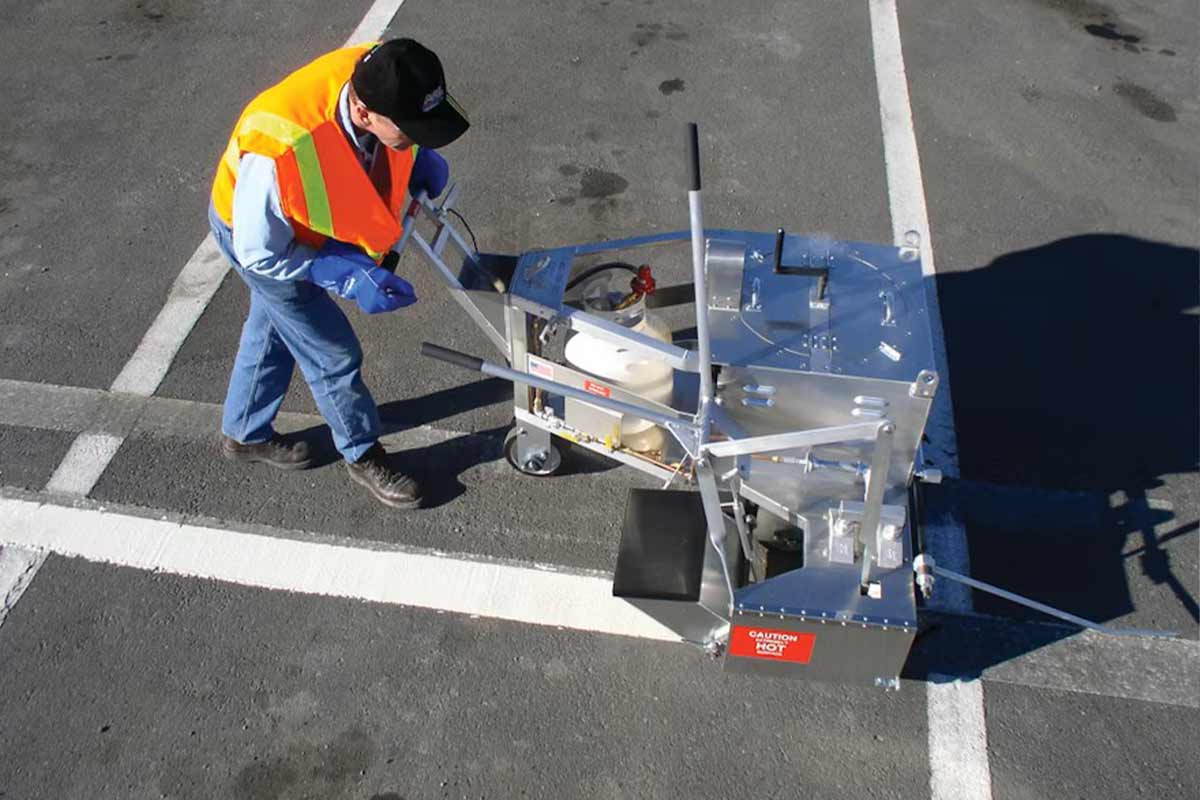
1-800-STRIPER provides professional thermoplastic striping in Greenville, SC — heat-applied stop bars, crosswalks, directional arrows, and fire lane markings in a thick retroreflective material that bonds into the pavement instead of drying on top of it, per AASHTO M 249.
1-800-STRIPER® of Greenville PROVIDes Thermoplastic Striping Services NEAR YOU
Want to reduce the maintenance requirements for your parking lot?
Thermoplastic pavement markings are a durable, weather and vehicle-resistant striping option for your parking lot or facility.
You can utilize them for stop bars, ADA stalls, no-parking zones, directional arrows, crosswalks, or your entire parking lot.
Benefits:
What Thermoplastic Striping Includes
Thermoplastic is a marking material, not a marking technique, and choosing it is a decision about where the wear is.
The scope on a commercial property covers the markings that take the most abuse: stop bars, crosswalks, directional arrows, entrance and exit legends, fire lane markings, and any symbol or wording at a point where every vehicle on the lot passes over the same square foot. It also covers surface assessment and preparation, because thermoplastic is far less forgiving of a poor substrate than paint is.
Most properties end up with a hybrid: thermoplastic at the high-wear points and waterborne acrylic paint through the parking field, where lines see far less tire contact and the economics of paint are hard to beat. Specifying thermoplastic across an entire lot is usually spending money where it will not be recovered.
Thermoplastic vs. Waterborne Paint — Comparison Table
| Thermoplastic | Waterborne acrylic traffic paint | |
|---|---|---|
| Form | Solid material applied hot, bonds into the pavement | Liquid coating that dries on the surface |
| Film thickness | Substantially thicker; a raised marking you can feel | Thin coating flush with the surface |
| Durability under tire contact | High; the reason it is used at wear points | Moderate; refreshed on a cycle |
| Retroreflectivity | Glass beads throughout the material and dropped on the surface | Beads dropped on the wet surface |
| Application speed | Slower; heating and specialist equipment required | Fast |
| Return to traffic | Cools to a solid rather than drying | Governed by the product data sheet |
| Removal | Difficult; material is bonded into the pavement | Comparatively straightforward |
| Best fit | Stop bars, crosswalks, arrows, legends, fire lane markings | Stalls, aisle lines, general parking field |
| Substrate tolerance | Demanding; sensitive to sealer, moisture and surface condition | More forgiving |
The trade-off is straightforward: thermoplastic costs more to install and much more to remove, and returns that in service life at the places where paint disappears fastest. Paint costs less, refreshes easily, and is the sensible material for the eighty percent of a lot that vehicles cross instead of tracking over.
Preformed vs. Extruded Thermoplastic
Two forms reach commercial parking lots, and they suit different work.
Preformed thermoplastic arrives as pre-cut shapes and sheets — arrows, legends, symbols, crosswalk bars, numerals — that are placed on the prepared pavement and heated in position until they bond. The advantage is precision: a preformed arrow is dimensionally identical every time, with no dependence on operator technique for its shape. It suits symbols, wording and anything where the geometry matters visually.
Extruded thermoplastic is heated to a molten state and applied through equipment that lays a continuous line at a set width and thickness. It suits long runs — crosswalk bars, stop bars, continuous lane and fire lane lines — where the value is in consistent width and thickness across distance rather than in a repeated shape.
Both are the same class of material with the same substrate demands. The choice is about the geometry of the marking and the practicalities of the site, and a single job often uses both.
Where Thermoplastic Makes Sense on a Commercial Lot
The test is simple: does every vehicle cross this marking in the same place?
Strong candidates. Entrance and exit aprons, where all traffic funnels through one line. Stop bars at internal intersections and at the exit to the public road. Crosswalks, particularly between a parking field and a building entrance. Directional arrows in drive aisles. Fire lane markings, which the fire code requires to be maintained clean and legible at all times and which therefore benefit from a material that stays legible. Loading dock approaches with heavy vehicle traffic.
Weak candidates. Standard stall lines in the parking field, which vehicles park between and do not drive along. Any marking on pavement scheduled for resurfacing, since the thermoplastic will be lost with the surface. Markings on a layout that is likely to change — reconfiguring a lot with thermoplastic in it is significantly harder than reconfiguring one striped in paint.
That last point is worth weighing early. Thermoplastic is a commitment to a layout as much as to a material.
Retroreflectivity and Glass Beads
Retroreflectivity is what makes a marking visible in headlights at night, and it is one of thermoplastic’s real advantages.
Glass beads return light from a vehicle’s headlights back toward the driver instead of scattering it. In thermoplastic, beads are both mixed through the body of the material and dropped onto the surface during application. That matters over time: as the surface beads wear away under traffic, beads within the material are progressively exposed, so the marking keeps returning light instead of going dark the moment the top layer is gone.
Paint carries surface-applied beads only. When those wear off, the marking is still white but it stops performing at night — which is why a lot can look acceptable in daylight and read poorly to a driver arriving after dark in the rain.
For a property with unlit or poorly lit areas, or one where wet-night visibility at the entrance matters, that difference is often the strongest argument for thermoplastic at the key markings.
Service Life and What Shortens It
Thermoplastic outlasts paint at the same location — that is the whole reason to specify it. What we will not do is put a number of years on this page, because service life is a function of the specific product, the traffic, the substrate and the quality of the installation, and any figure quoted without those variables is marketing, not a specification.
What we can be specific about is what shortens it.
Poor surface preparation. By a wide margin the largest cause of early failure. Thermoplastic bonds into pavement; anything between the material and the pavement is a future delamination. Sealed or freshly sealed asphalt. A sealer is a barrier by design, and it is a barrier to this too. Moisture in or on the substrate at application, which prevents the bond forming. Snow plows. A raised marking gives a blade something to catch, and a plow with a hard edge can lift material at the leading edge. Pavement failure underneath. Thermoplastic bonded to a surface that is cracking, raveling or delaminating goes wherever the surface goes. On a marginal pavement, addressing the pavement first is the only sequence that works.
Surface Requirements and Substrate Limits
Thermoplastic is demanding about what it goes onto, and understanding the limits prevents an expensive disappointment.
Asphalt is the natural substrate. It should be sound, clean, dry and — for new asphalt — given time to cure before marking, because residual surface oils interfere with the bond. Sealed asphalt is a problem: the sealer is what the material would bond to, and it is not attached to the pavement as firmly as the pavement is to itself.
Concrete is more complicated, which is why it comes up in almost every quote. Concrete is far less porous than asphalt, so the mechanical bond thermoplastic relies on is weaker. It can be done, and it is done routinely, but it requires the substrate to be assessed and prepared and, in most cases, primed to the material manufacturer’s specification. Applying thermoplastic straight onto untreated concrete and hoping is how markings end up lifting in sheets.
What rules it out. Pavement that is actively failing. Surfaces that cannot be got properly dry. Areas scheduled for resurfacing. In those cases paint is the correct answer, and we will say so.
Our thermoplastic work references AASHTO M 249 as the material designation. We assess the pavement before quoting, never after, because on this material the assessment decides whether the job should happen at all.
Removing or Replacing Thermoplastic Markings
Removal is the cost people do not price in at the start.
Because the material bonds into the pavement rather than sitting on it, removal is a genuinely different operation from removing paint, and it carries a real risk of scarring the surface. On asphalt, aggressive removal can leave a depression or a texture change that remains visible after the marking is gone — a ghost that a driver can see at night, which defeats the purpose.
Where a marking has to change, the options are removal, overmarking, or resurfacing that area. Removal suits a small marking on sound pavement. Overmarking — applying a new marking over the old — suits some cases but not those where the old geometry would still read through. Resurfacing the affected area is sometimes the cleanest answer where several markings are moving at once.
Replacement is simpler than removal: worn thermoplastic can usually be re-marked in place once the existing material is assessed and prepared, provided the bond to the pavement is still sound. Where the original has begun delaminating, the old material comes off first — putting new material on top of a failing layer inherits the failure.
We assess and tell you which of these applies before quoting, because the three cost very different amounts.
For a full list of our pavement marking services, visit our parking lot striping in Greenville page.
Businesses We Serve



How it Works

GET A FREE ESTIMATE
Contact us today and we’ll have a quote to you in 24 hours

SCHEDULE AN INSTALLATION
We’ll have your installation scheduled restriped in less than 7 days, without affecting your business hours

GET A PARKING LOT THAT POPS
For a budget-friendly price, you’ll get a parking lot that looks like new
We proudly work with:


We proudly work with:

Frequently Asked Questions About Thermoplastic Striping in Greenville, SC
What is thermoplastic line striping?
A marking material applied hot as a solid instead of painted on as a liquid. It bonds into the pavement instead of drying on top of it, and it is laid down substantially thicker than paint — thick enough to feel underfoot. Glass beads run through the body of the material as well as being dropped on the surface, which is what keeps it returning headlight at night as it wears. On commercial lots it is normally specified at high-wear points such as stop bars, crosswalks, arrows and fire lane markings, not across a whole lot.
How long do thermoplastic markings last?
Considerably longer than paint at the same location, which is the reason to use it — but we will not put a number of years on it, because service life depends on the specific product, the traffic over that exact marking, the substrate and the installation quality. What reliably shortens it is identifiable: poor surface preparation, application over sealer, moisture at the time of application, snow plows catching the raised edge, and pavement that is itself failing underneath. Any figure quoted without those variables is a guess.
How do you remove thermoplastic markings?
Not easily, and that is worth knowing before choosing the material. Because it bonds into the pavement rather than sitting on it, removal is a different operation from paint removal and carries a real risk of scarring, particularly on asphalt, where aggressive removal can leave a texture change visible at night after the marking is gone. Depending on the situation the answer is removal, overmarking, or resurfacing the affected area. We assess which applies and price it against what the pavement needs, not against the cheapest guess.
Thermoplastic or paint — which fits a commercial lot?
Usually both. Thermoplastic goes where every vehicle crosses the same square foot — entrance aprons, stop bars, crosswalks, arrows, fire lane markings, dock approaches. Waterborne acrylic paint goes through the parking field, where stall lines see far less tire contact and paint’s cost and easy refresh win. Specifying thermoplastic lot-wide generally spends money where it will not be recovered. One thing to weigh early: thermoplastic commits you to a layout, because reconfiguring it later is much harder than reconfiguring paint.
Can thermoplastic go on concrete?
Yes, and it is done routinely, but it needs more work than asphalt does. Thermoplastic relies on a mechanical bond into the pavement, and concrete is far less porous than asphalt, so that bond is weaker by default. The substrate has to be assessed, prepared and in most cases primed to the material manufacturer’s specification. Applied straight onto untreated concrete it can lift in sheets. We assess the slab before quoting, because on concrete the preparation decision is effectively the whole job.
Why do thermoplastic markings contain glass beads?
For night visibility. Glass beads retroreflect — they send light from a vehicle’s headlights back toward the driver instead of scattering it, which is what makes a marking readable after dark. In thermoplastic the beads are mixed through the body of the material as well as dropped onto the surface during application, so as surface beads wear away, beads inside the material get exposed and the marking keeps performing. Paint carries surface beads only, which is why paint can look white in daylight yet read poorly at night once worn.