Sports Court Striping
In Greenville, SC
Multi-Sport Court Line Marking
1-800-STRIPER provides professional sports court striping in Greenville, SC — laying out pickleball courts to USA Pickleball specifications, basketball and tennis courts, and playground game markings in durable acrylic and traffic paint for commercial and institutional properties across the Upstate.
1-800-STRIPER® of Greenville PROVIDes Sports Court Striping Services NEAR YOU
Want to get people to come out to play?
Brighten up your faded sport courts or turn your playground into a safe, colorful, and engaging space that entices people to come out and play.
Sport Court Specialties:
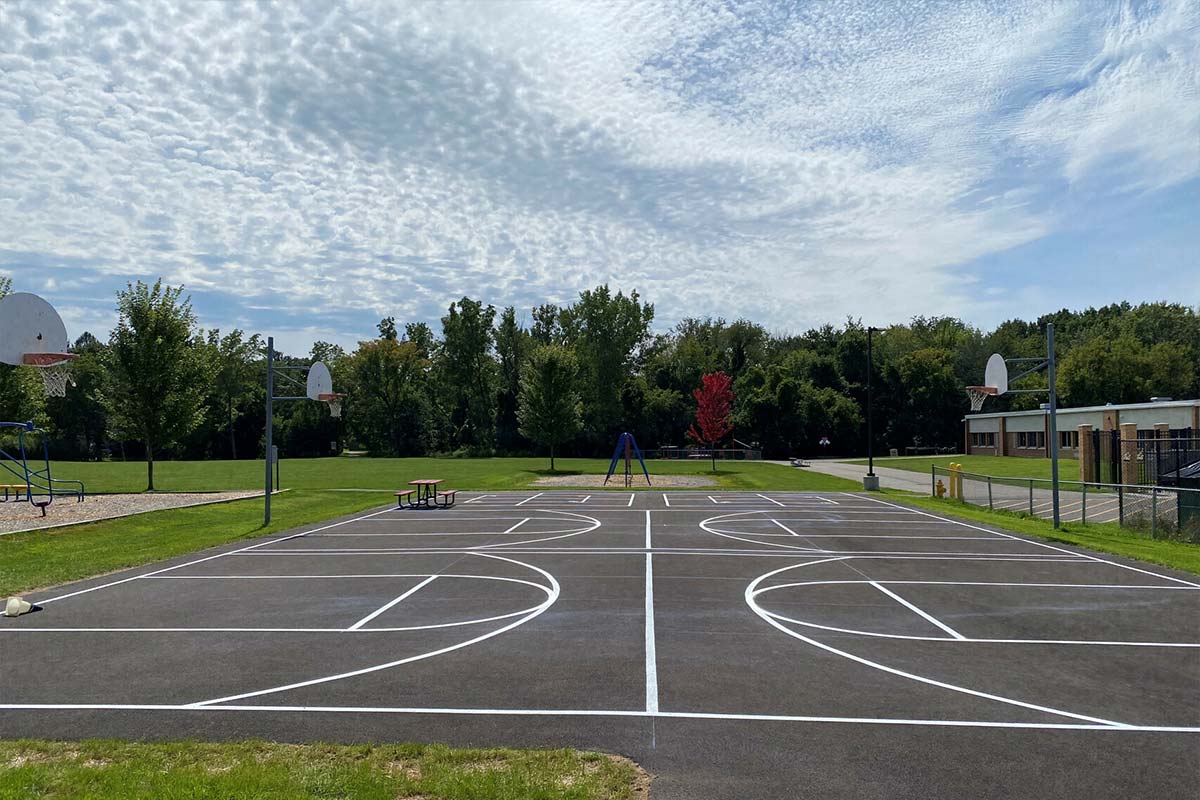
What Sports Court Striping Includes
Sports court striping is layout work with an unforgiving tolerance. A parking stall that lands an inch off is still a parking stall; a court line that lands an inch off changes whether a ball was in or out for the next decade.
The scope on a commercial or institutional property in the Upstate covers surface assessment and preparation, measuring and squaring the court from fixed control points, laying out the playing lines to the governing body’s published dimensions, masking and applying line paint in the correct sequence, and marking any secondary game lines the facility wants on the same slab.
Typical clients here are apartment and condominium communities, schools and colleges, churches, municipal parks, hotels, HOAs and corporate campuses — anywhere a slab of asphalt or concrete is doing double duty as a recreation asset.
Color and contrast are part of the design, not an afterthought. Where two or more games share one surface, the line colors have to be distinguishable at playing speed, which is a different bar from distinguishable while standing still and looking down.
Pickleball, Basketball, and Tennis Court Layouts
Pickleball has taken over most of the multi-court conversations we have in Greenville, so start there — and the published dimensions are unusually clear.
USA Pickleball states that a pickleball court measures 20 feet wide by 44 feet long for both singles and doubles, that each side has a 7-foot non-volley zone at the net, and that the net is 36 inches high at the sidelines and 34 inches at the center. Separately, on court construction, USA Pickleball states that a total playing surface of 30 feet by 60 feet is the minimum size recommended and that a total size of 34 feet by 64 feet is preferred, while the actual playing lines measure 20 feet by 44 feet.
That gap between the lines and the surface is the number that decides projects. People measure a 20 by 44 rectangle onto their slab, find it fits, and are then surprised that the finished court plays badly — because a player chasing a lob needs the run-out, and the run-out is what the 30 by 60 minimum is describing.
| Element | Dimension | Source |
|---|---|---|
| Pickleball playing lines | 20 ft wide by 44 ft long, singles and doubles | USA Pickleball |
| Pickleball non-volley zone | 7 ft on both sides of the net | USA Pickleball |
| Pickleball net height | 36 in at the sidelines, 34 in at the center | USA Pickleball |
| Pickleball total playing surface, minimum recommended | 30 ft by 60 ft | USA Pickleball |
| Pickleball total playing surface, preferred | 34 ft by 64 ft | USA Pickleball |
| Basketball court dimensions | Set by the governing body for the level of play | Confirm against your facility’s specification |
| Tennis court dimensions | Set by the governing body for the level of play | Confirm against your facility’s specification |
| Playground game markings | No governing dimension | Facility’s own layout |
Basketball and tennis are deliberately left open in that table, and we would rather say so than publish a number. Court dimensions for those two differ by level of play and governing body, and we lay them out from the specification the facility is building to — a school athletic association’s, a university’s, a municipal parks standard — rather than from a figure copied off a web page. Tell us which standard applies and we will mark to it.
Converting a tennis court to pickleball. This is the most common request we get on this page, and it is arithmetic, not opinion. The question is not whether a 20 by 44 rectangle fits inside a tennis enclosure — several will. The question is how many courts fit once each one is given the 30 by 60 minimum recommended playing surface, plus circulation between courts and clearance to the fence. That answer comes from measuring your actual enclosure, including the fence line and any net post footings, because tennis facilities vary in total fenced area even when the playing lines match.
Two ways to do it. Overlay keeps the tennis lines and adds pickleball lines in a contrasting color on the same surface, which is cheap and reversible but produces a busy court. Conversion removes or covers the tennis layout and dedicates the surface to pickleball, which plays far better and is what most communities end up wanting once the courts get busy. We will lay out both options against your measured slab before you decide.
Playground Markings and Game Lines
Playground markings are the other half of this page, and they are governed by imagination, not by a rulebook.
Common layouts on Upstate school and church properties include hopscotch, four square, kickball diamonds, tetherball circles, running tracks around the perimeter, number grids and alphabet snakes, compass roses, and map or world outlines. Where a governing dimension exists — a basketball key on a school court, for instance — we mark to the facility’s specification. Where none exists, which is most of the time, the layout is set by the space, the age group and what the staff want to run.
Two practical points decide whether these last. The first is surface: playground markings go onto asphalt or concrete that is sound and clean, and the same bond rules apply as anywhere else — grit, pollen and standing dirt cost more markings than traffic does. The second is placement: a game line painted across a route children run every day wears out first, so laying out the games against the traffic pattern rather than into the middle of it buys years.
For durability, high-wear elements can be marked in a longer-life material while the decorative work stays in standard court paint, which keeps the budget where the wear actually is.
For a full list of our pavement marking services, visit our parking lot striping in Greenville page.
Businesses We Serve




How it Works

GET A FREE ESTIMATE
Contact us today and we’ll have a quote to you in 24 hours

SCHEDULE AN INSTALLATION
We’ll have your play space restriped in less than 7 days, without affecting your playtime

GET A PARKING LOT THAT POPS
For a budget-friendly price, you’ll get a parking lot that looks like new
We proudly work with:


We proudly work with:


Frequently Asked Questions About Sports Court Striping in Greenville, SC
What are the dimensions of a pickleball court?
USA Pickleball gives the playing lines as 20 feet wide by 44 feet long, the same for singles and doubles, with a 7-foot non-volley zone on both sides of the net and a net 36 inches high at the sidelines and 34 inches at the center. For construction, USA Pickleball states that a total playing surface of 30 feet by 60 feet is the minimum recommended and 34 feet by 64 feet is preferred. The gap between the lines and the surface is the run-out, and it is what makes a court playable instead of merely legal.
Can a tennis court be converted to pickleball courts?
Yes, and it is one of the most common jobs on this page. How many courts you get depends on your enclosure, not on a standard answer, because the constraint is the 30 by 60 minimum recommended playing surface per court plus circulation and fence clearance, not the 20 by 44 playing lines. We measure the actual fenced area, net post footings included. You can either overlay pickleball lines in a contrasting color and keep the tennis court, or convert the surface fully — we will show you both against your measurements.
How are basketball court lines painted?
Surface first: the slab is cleaned and assessed, and any repair or resurfacing happens before layout. Then the court is squared from fixed control points and measured to the dimensions of whichever governing body’s standard your facility is building to, and not to a generic figure. Lines are masked and applied in sequence so colors do not bleed, with each coat given the dry time its data sheet calls for. We confirm which standard applies before laying anything out, because the dimensions differ by level of play.
What paint is used for sports court and playground markings?
Court line paints are formulated for the surface they go on and for the wear a court takes, and the specific product is chosen against the slab — asphalt, concrete, an existing acrylic sport surfacing system, or a coated surface each behave differently. Where a court already carries a color-coating system, the line paint has to be compatible with that system, not merely with concrete. We identify what is on the surface before quoting, because on a coated court the compatibility question is the whole job.
How long do outdoor court and playground markings last?
Longer than parking lot markings, because there are no tires on them, but it depends on the surface, the exposure and the traffic. Sun, standing water and freeze-thaw work at the bond over time; the heaviest wear shows on baselines, service lines and any playground element that sits on a route children run daily. A court that is cleaned occasionally and kept free of standing water holds its lines far longer than one that is not. Call for a free estimate and we will assess your surface.