Fire Lane Striping
In Greenville, SC
Code-Compliant Fire Lane Markings
1-800-STRIPER provides professional fire lane striping in Greenville, SC — marking fire apparatus access roads, curbs, and no-parking zones with the approved signs and legends the South Carolina Fire Code requires, maintained clean and legible for commercial properties across the Upstate.
1-800-STRIPER® of Greenville PROVIDes Fire Lane Striping Services NEAR YOU
Is your parking lot ready for first responders?
Our team is well-versed in local fire regulations and will parter with you to design a fire lane striping plan that creates unobstructed emergency access to protect your customers and property.
Core Services:
What Fire Lane Striping Includes
Fire lane striping is the marking that keeps a fire apparatus access road usable on the day it is needed. It is the one set of markings on a commercial property where the consequence of illegibility is measured in minutes of response time.
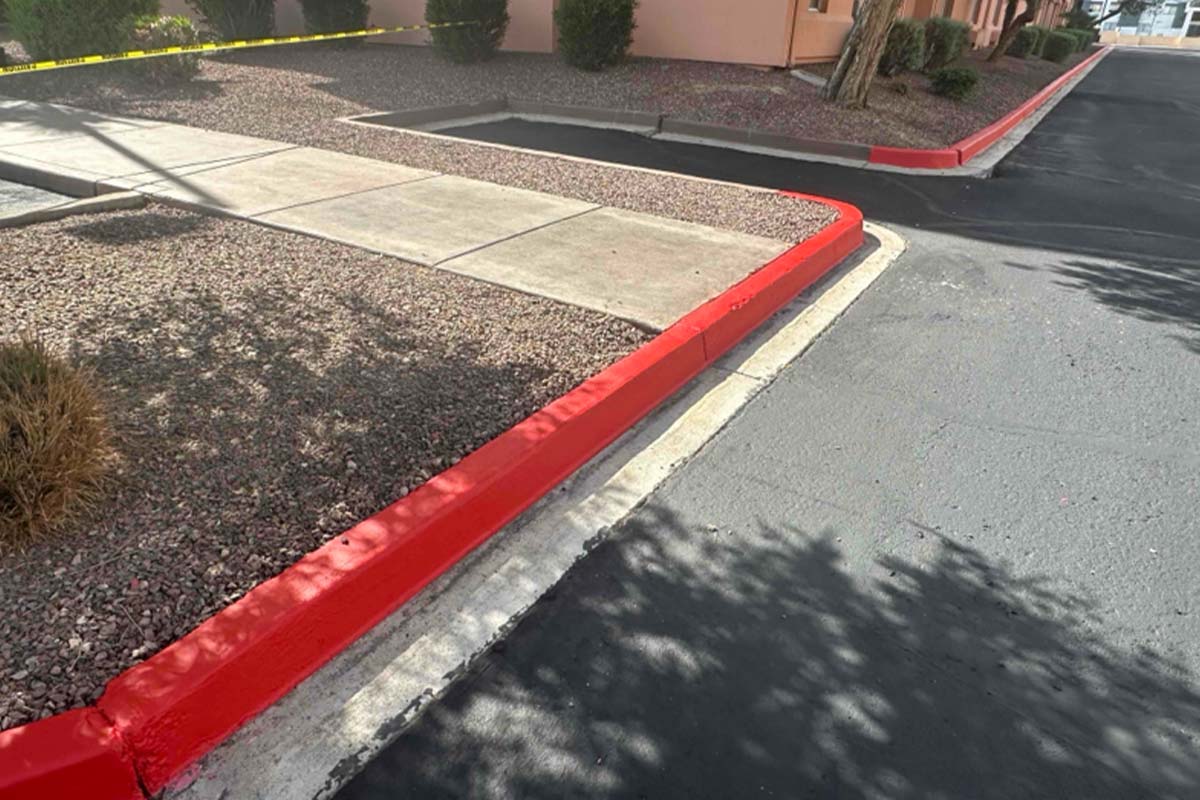
A fire lane scope on an Upstate commercial property covers the boundary striping that defines the access road, curb painting along the designated length, the NO PARKING—FIRE LANE legend repeated at the intervals the fire code official specifies, hatching or diagonal marking in no-parking zones, hydrant clearance markings, and the mounted signage that accompanies the pavement work. Where a property has a dedicated turnaround for a dead-end access road, that gets marked too.
We also handle the part that is easy to overlook: re-marking what has faded. The code treats maintenance of the designation as an ongoing duty, not a one-time installation.
The South Carolina Fire Code Governs Fire Lanes Here
Fire lanes on a Greenville commercial property are governed by the 2021 South Carolina Fire Code. The City of Greenville Fire Department states on its own Fire Prevention Code References page that it enforces the 2021 South Carolina Fire Code, which sets rules for fire safety in building design, construction and operation. Local adoption sits in the City of Greenville Code of Ordinances at Chapter 6, Article IX, Section 6-441, and the fire code official is the fire marshal under Section 6-443.
The 2021 SCFC is the 2021 International Fire Code as amended for South Carolina, effective 1 January 2023.
One correction worth stating plainly, because it circulates widely in this trade: NFPA 1 is not the governing fire code for a South Carolina property. The City of Greenville Fire Department does reference NFPA documents, but as standards referenced *within* the adopted SCFC — tanks, mains, alarms — and NFPA 1 is not among them. If a specification, a consultant or a contractor’s web page tells you your Greenville fire lane must comply with NFPA 1, that citation is wrong for this jurisdiction. The code that applies is the SCFC, and the person who applies it is your fire code official.
Properties outside the city limits fall to the county or municipal authority having jurisdiction, and the same principle holds: the adopted code plus the local fire code official, not a national standard picked off the internet.
What the Code Requires: Approved Signs, Notices, or Markings
Section 503.3 of the 2021 South Carolina Fire Code is the marking provision, and it reads:
> Where required by the fire code official, approved signs or other approved notices or markings that include the words “NO PARKING—FIRE LANE” shall be provided for fire apparatus access roads to identify such roads or prohibit the obstruction thereof. The means by which fire lanes are designated shall be maintained in a clean and legible condition at all times and be replaced or repaired when necessary to provide adequate visibility.
Four things are mandated there, and it is worth separating them from the things people assume.
The words. The designation has to include the words NO PARKING—FIRE LANE. That is the one piece of content the code specifies.
Approval. The signs, notices or markings must be *approved* — meaning approved by the fire code official, not merely purchased and installed.
The trigger. Marking is required *where required by the fire code official*. The code does not automatically mark every access road on every property; it empowers the official to require it.
Maintenance. The designation must be maintained clean and legible at all times, and replaced or repaired when necessary to provide adequate visibility. A faded fire lane is a live code issue, not a deferred maintenance item.
Section 503.4 backs this up from the other direction: fire apparatus access roads shall not be obstructed in any manner, including the parking of vehicles, and the minimum widths and clearances must be maintained at all times.
What the Code Leaves to Your Fire Code Official
Read Section 503.3 again and notice what is not in it. There is no color. No stripe width. No letter height. No spacing interval between legends. No specification for whether the marking goes on the curb, on the pavement, or on a post.
That silence is deliberate, and it is the single most useful thing a property owner can know about fire lane marking. Those decisions belong to the fire code official — in the City of Greenville, the fire marshal.
The code hands the official broad discretion elsewhere in the same section, which reinforces the point. Section 503.2.2 gives the fire code official authority to require or permit modifications to the required access widths. Section 503.2.4 puts the required turning radius entirely in the official’s hands. Section 503.2.7 and 503.2.8 do the same for grade and for angles of approach and departure. Section 503.1.2 lets the official require more than one access road based on congestion, terrain or climate.
So when a contractor tells you South Carolina requires a 6-inch red stripe with 4-inch white lettering every 50 feet, they are describing a local practice — possibly the correct one for your jurisdiction — and presenting it as a code requirement. It is not. The right move is to get the marking specification from the fire code official in writing, then mark to it. That is what we do, and it is why our fire lane quotes ask which jurisdiction the property sits in before they price anything.
Fire Apparatus Access Road Dimensions and Reach
The dimensions the code *does* fix are the ones about the road itself, not the paint on it.
Under Section 503.2.1, a fire apparatus access road must have an unobstructed width of not less than 20 feet and an unobstructed vertical clearance of not less than 13 feet 6 inches. Security gates are the stated exception, handled under Section 503.6.
Under Section 503.1.1, an approved fire apparatus access road must be provided for every facility or building, and it must extend to within 150 feet of all portions of the facility and all portions of the exterior walls of the first story, measured by an approved route around the exterior. The fire code official may increase that 150-foot dimension where a building is fully sprinklered to one of the recognized standards, where an access road cannot be installed because of property location, topography, waterways or grades and an approved alternative means of protection is provided, or where there are not more than two Group R-3 or Group U occupancies.
Under Section 503.2.5, a dead-end fire apparatus access road longer than 150 feet must have an approved area for turning fire apparatus around. Under Section 503.2.3, the road must be designed and maintained to carry the imposed loads of fire apparatus and surfaced to provide all-weather driving capability.
These dimensions matter to a striping scope for a simple reason: the paint has to define a lane that meets them. Marking a 16-foot lane and calling it a fire lane creates a document trail showing the property believed it had compliant access when it did not.
Curb Painting, Legends, and No-Parking Zones
On most commercial properties the fire lane designation is delivered through three coordinated elements.
Curb painting runs the designated length of the access road and is the marking drivers register from inside the vehicle. Color is the fire code official’s call, and the practical requirement is contrast against the concrete plus enough film to survive the sweeper.
Pavement or curb legends carry the NO PARKING—FIRE LANE wording that Section 503.3 requires. Letter height and repeat interval come from the jurisdiction. Legends are applied so they read from the approaching direction rather than being upside down to half the traffic.
No-parking zones and hatching mark the areas adjacent to the lane where standing vehicles would narrow it below the 20-foot minimum. Diagonal hatching communicates “not a space” faster than a sign does, particularly to a delivery driver looking for somewhere to pull in for five minutes.
The mounted signage that accompanies these is covered on our parking lot sign installation page, and the two scopes are usually quoted together because the fire code official approves them as one designation.
Fire Hydrant Clearance Markings
Hydrant access is a separate provision with its own number, and it is the one property owners most often get wrong.
Section 507.5.4 of the 2021 South Carolina Fire Code requires that unobstructed access to fire hydrants be maintained at all times, that the fire department not be deterred or hindered from gaining immediate access to fire protection equipment or hydrants, and — the specific one — that no parking be allowed within 15 feet of a fire hydrant.
Section 507.5.5 adds that a 3-foot clear space must be maintained around the circumference of fire hydrants, except as otherwise required or approved.
On a striped lot the practical answer is to mark the 15-foot no-parking zone on both sides of the hydrant so it is visibly not a parking space, instead of relying on a driver to estimate 15 feet. Where a hydrant sits at the end of a stall row, that frequently means one stall has to come out of the count — which is exactly the sort of thing a layout review catches before it becomes an enforcement conversation.
Where hydrants are subject to vehicle impact, Section 507.5.6 requires guard posts or other approved means. Bollards are the usual answer, and we install those too.
Fire Lane Marking Specification Table
| Item | Requirement | Source |
|---|---|---|
| Required wording | Must include the words NO PARKING—FIRE LANE | 2021 SCFC 503.3 |
| Who triggers marking | Where required by the fire code official | 2021 SCFC 503.3 |
| Approval | Signs, notices or markings must be approved | 2021 SCFC 503.3 |
| Maintenance | Maintained clean and legible at all times; replaced or repaired for adequate visibility | 2021 SCFC 503.3 |
| Stripe color, width, letter height, spacing | Not specified in the code | Fire code official’s determination |
| Access road width | 20 ft minimum unobstructed | 2021 SCFC 503.2.1 |
| Vertical clearance | 13 ft 6 in minimum unobstructed | 2021 SCFC 503.2.1 |
| Reach to building | Within 150 ft of all portions of the facility and first-story exterior walls | 2021 SCFC 503.1.1 |
| Dead-end turnaround | Required where the road exceeds 150 ft | 2021 SCFC 503.2.5 |
| Turning radius | Determined by the fire code official | 2021 SCFC 503.2.4 |
| Width modifications | Fire code official may require or permit | 2021 SCFC 503.2.2 |
| Obstruction | No obstruction in any manner, including parked vehicles | 2021 SCFC 503.4 |
| Hydrant clearance | No parking within 15 ft of a hydrant | 2021 SCFC 507.5.4 |
| Hydrant circumference | 3 ft clear space around the hydrant | 2021 SCFC 507.5.5 |
| Plan submission | Construction documents for fire apparatus access and fire lane locations submitted to the fire department for review and approval before construction | 2021 SCFC 501.3 |
For a full list of our pavement marking services, visit our parking lot striping in Greenville page.
Businesses We Serve




How it Works

GET A FREE ESTIMATE
Contact us today and we’ll have a quote to you in 24 hours

SCHEDULE AN INSTALLATION
We’ll have your installation scheduled in less than 7 days, without affecting your business hours

GET A PARKING LOT THAT POPS
For a budget-friendly price, you’ll get a parking lot that looks like new
We proudly work with:


We proudly work with:


Frequently Asked Questions About Fire Lane Striping in Greenville, SC
Which fire code applies to fire lanes in Greenville, SC?
The 2021 South Carolina Fire Code. The City of Greenville Fire Department states on its Fire Prevention Code References page that it enforces the 2021 SCFC, which is the 2021 International Fire Code as amended for South Carolina, effective 1 January 2023. Local adoption is at Chapter 6, Article IX, Section 6-441 of the City Code of Ordinances, and the fire code official is the fire marshal under Section 6-443. NFPA 1 is not the governing code here, despite how often it is cited in this trade.
What wording does a fire lane marking have to carry?
Section 503.3 of the 2021 South Carolina Fire Code requires approved signs, notices or markings that include the words NO PARKING—FIRE LANE, where required by the fire code official, to identify fire apparatus access roads or prohibit their obstruction. The wording is the one piece of content the code fixes. The same section requires that the means of designation be maintained in a clean and legible condition at all times and be replaced or repaired when necessary to provide adequate visibility.
What color and width does a fire lane stripe have to be?
The code does not say. Section 503.3 specifies the words NO PARKING—FIRE LANE and requires the marking to be approved and maintained legible, but it sets no color, no stripe width, no letter height and no spacing between legends. Those are the fire code official’s determination for your jurisdiction. Anyone quoting you a state-wide color-and-width specification is describing local practice as though it were code. We get the specification from the official in writing and mark to it.
How wide does a fire apparatus access road have to be?
Section 503.2.1 of the 2021 South Carolina Fire Code requires an unobstructed width of not less than 20 feet and an unobstructed vertical clearance of not less than 13 feet 6 inches, with approved security gates as the stated exception. Section 503.2.2 lets the fire code official require or permit modifications where those widths are inadequate for fire or rescue operations. Section 503.4 requires those minimum widths and clearances to be maintained at all times, which is what no-parking marking along the lane exists to protect.
Who decides whether our property needs a marked fire lane?
Your fire code official — in the City of Greenville, the fire marshal. Section 503.3 conditions the marking requirement on “where required by the fire code official,” and the code gives that official wide discretion over access width modifications, turning radius, grade, and whether more than one access road is needed. Section 501.3 also requires construction documents for proposed fire apparatus access and the location of fire lanes to be submitted to the fire department for review and approval before construction.
How close can vehicles park to a fire hydrant?
Section 507.5.4 of the 2021 South Carolina Fire Code states that no parking shall be allowed within 15 feet of a fire hydrant, and requires unobstructed access to hydrants to be maintained at all times so the fire department is not deterred or hindered. Section 507.5.5 additionally requires a 3-foot clear space around the circumference of the hydrant. On a striped lot the practical step is marking that 15-foot zone visibly so drivers are not left to estimate it — which sometimes means losing a stall at the end of a row.