
Bollard Installation
In Greenville, SC
Safety and Security Bollards
1-800-STRIPER provides professional bollard installation in Greenville, SC — setting concrete-filled steel pipe bollards and removable posts at storefronts, drive-throughs, loading docks, and utility equipment to stop vehicle impact for commercial properties across the Upstate.
1-800-STRIPER® of Greenville PROVIDes Bollard Installation Services NEAR YOU
Want to prevent accidents and protect your property?
Bollards provide physical protection for your customers and your property.
Safety and security:
Bollards create a physical barrier between vehicles and pedestrians, protecting people in walking areas from accidental or intentional vehicle intrusions.
Bollards act as a protective barrier around storefronts, gas stations, and other vulnerable areas, minimizing the risk of costly damage from vehicle impacts.
Strategic Placement Locations:
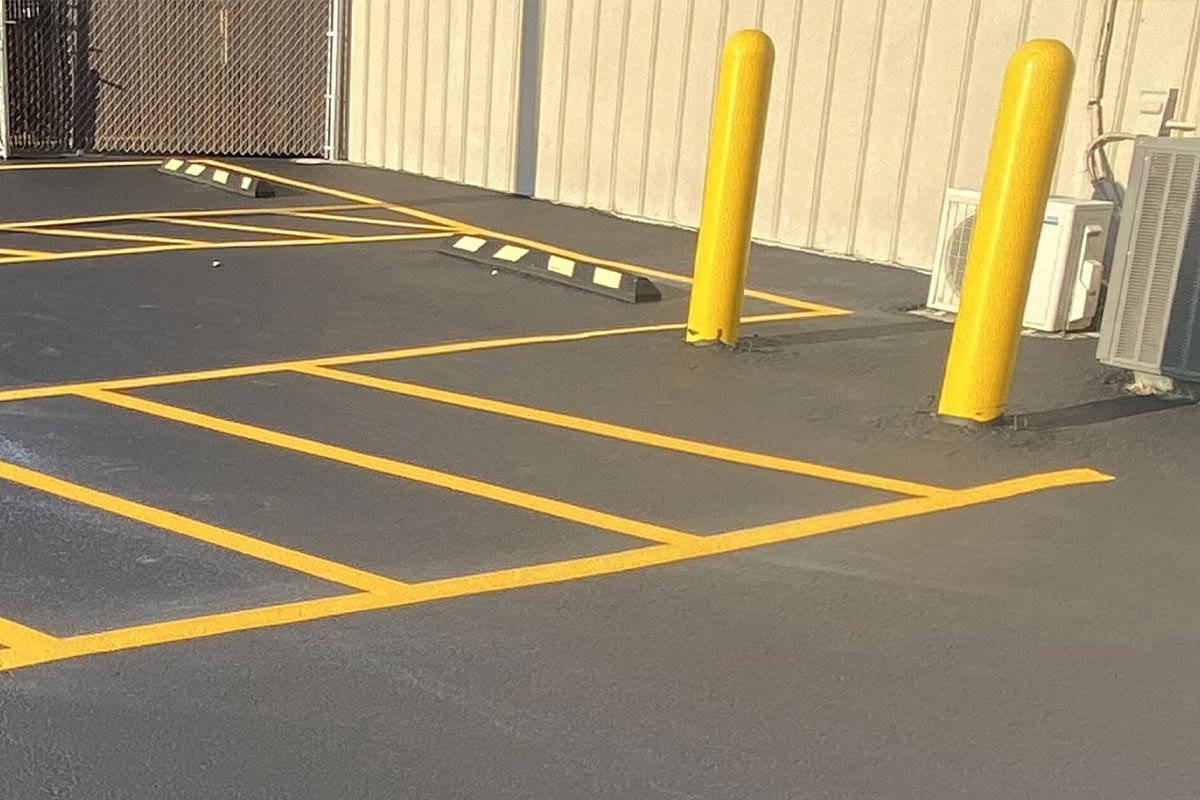
What Bollard Installation Includes
A bollard is a vehicle barrier. That framing matters, because it is what separates a bollard from a wheel stop, a curb or a planter — those manage where a vehicle parks, while a bollard is there for the vehicle that does not stop.
Installation covers assessing what is being protected and from what approach, selecting the bollard type and diameter for that job, coring or excavating the location, setting the pipe or post to the manufacturer’s specification, filling and capping where applicable, and finishing with paint or a sleeve for visibility.
The most common jobs on Upstate commercial properties are storefront glazing protection, drive-through lanes and order points, loading dock corners and dock equipment, gas meters and utility cabinets, electrical panels and transformer pads, fire hydrants and fire department connections, air and vacuum stations at fuel sites, and equipment inside warehouses.
Replacement is a real share of the work. A bollard that has been struck and is now leaning, or one whose base has separated from the pavement, is providing far less protection than it appears to.
Fixed, Removable, and Retractable Bollards Compared
| Fixed | Removable | Retractable | |
|---|---|---|---|
| How it works | Permanently set in the ground | Lifts out of a ground sleeve, sleeve capped when empty | Retracts into a below-grade housing |
| Access when open | None; the barrier is always there | Full, once removed and the cap is fitted | Full, at the press of a control |
| Typical use | Storefronts, utility equipment, dock corners, hydrants | Fire lane access points, service and delivery routes, event access | Controlled entrances where access changes frequently |
| Below-grade work | Footing or core, per the manufacturer | Sleeve set in a footing | Housing plus, for powered units, drainage and power |
| Ongoing maintenance | Repaint or replace sleeve; check for lean after impact | Keep the sleeve clear of grit; secure the cap | Housing drainage, mechanism and controls |
| Trade-off | Highest protection, no flexibility | Flexibility, but protection depends on it being reinstalled | Convenience at the highest cost and maintenance burden |
Most commercial properties need fixed bollards for the protection points and a handful of removable units where the fire department or a delivery route requires access through a line that is otherwise closed. Retractable units make sense where access genuinely changes several times a day; where it changes twice a year, removable is the better value.
Embedment Depth and Concrete Footing
This is the question that brings most people to this page, and the answer is that there is no universal number — which is more useful than a made-up one.
Embedment depth and footing size for a bollard depend on the bollard’s diameter and wall thickness, the impact it is intended to resist, the soil and subgrade, and whether it is being set in a new footing, cored into existing concrete, or surface-mounted to a flange. A 4-inch decorative post protecting a planter and an 8-inch concrete-filled pipe protecting a storefront from a vehicle at speed are not the same installation, and no single depth serves both.
The specification that governs your install is the bollard manufacturer’s installation instruction. Where the bollard is being installed to resist a defined impact, that instruction is what the product’s performance is based on — deviate from it and the performance claim no longer applies. On new construction or where structural loads are involved, the footing may be an engineered detail, not a catalog one.
The test method most often cited for this class of product is ASTM F3016/F3016M-19, Standard Test Method for Surrogate Testing of Vehicle Impact Protective Devices at Low Speeds. It is a test method — it describes how such a device is tested at low speed, not a universal installation depth. Where a property needs a bollard that has been tested instead of one that merely looks substantial, that designation is the right thing to ask a supplier about.
What we do on every job is install to the manufacturer’s published instruction for the product specified, and tell you when a location needs an engineered detail instead of a standard one.
Where Bollards Are Required or Recommended
Where a code points at them. The 2021 South Carolina Fire Code, Section 507.5.6, provides that where fire hydrants are subject to impact by a motor vehicle, guard posts or other approved means shall comply with Section 312 of the code. That is the clearest local hook: a hydrant sitting exposed at the head of a stall row or beside a drive aisle is a candidate, and the fire code official decides.
Where the risk is obvious. Storefront glazing facing a parking row head-on — the classic vehicle-into-storefront exposure. Drive-through order points and menu boards. Loading dock corners, dock levelers and dock equipment. Gas meters, electrical panels, transformer pads and utility cabinets. Fire department connections and sprinkler risers. Air and vacuum stations at fuel and service sites. Pedestrian queuing areas beside vehicle circulation.
Where a wheel stop is not enough. A wheel stop halts a vehicle rolling into a stall at parking speed. It does nothing about a vehicle under power. If the consequence of a vehicle continuing past the stall is glass, gas, electricity or people, the answer is a bollard.
Where they should be checked, not added. Existing bollards that lean, that have separated from the pavement at the base, or that have been struck hard enough to deform. Those look like protection and often are not.
Do You Need a Permit to Install a Bollard in Greenville?
It depends on the property, the location and what the bollard is attached to, and the only correct answer is one confirmed with the authority having jurisdiction for that address.
The variables that decide it are consistent, though. Whether the property is in the City of Greenville, in another municipality, or in unincorporated Greenville, Spartanburg, Anderson, Pickens or Oconee County — the jurisdictions are not identical. Whether the installation involves excavation near utilities, which raises a utility-location requirement regardless of permitting. Whether the bollard is part of a larger site alteration already under review, in which case it is normally covered by that review. Whether the bollard is being installed to satisfy a code requirement — protecting a hydrant under Section 507.5.6 of the fire code, for instance — since that engages the fire code official whether or not a building permit is separately needed.
What we will not do is tell you no permit is required so the job can start sooner. We identify the jurisdiction at the estimate, confirm the requirement before scheduling, and factor the answer into the timeline. Call for a free estimate and we will start that check with your address.
For a full list of our pavement marking services, visit our parking lot striping in Greenville page.
Businesses We Serve




How it Works

GET A FREE ESTIMATE
Contact us today and we’ll have a quote to you in 24 hours

SCHEDULE AN INSTALLATION
We’ll have your installation scheduled in less than 7 days, without affecting your business hours

GET A PARKING LOT THAT POPS
For a budget-friendly price, you’ll get a parking lot that looks like new
We proudly work with:


We proudly work with:


Frequently Asked Questions About Bollard Installation in Greenville, SC
How deep should a bollard be buried?
There is no single answer, and anyone giving you one without asking what bollard you are installing is guessing. Embedment and footing size depend on the bollard’s diameter and wall thickness, the impact it is meant to resist, the soil and subgrade, and whether it is set in a new footing, cored into existing concrete, or flange-mounted. The specification that governs is the bollard manufacturer’s installation instruction — and where a product’s impact performance is being relied on, deviating from that instruction voids the basis for it.
Do you need a permit to install a bollard?
It depends on the jurisdiction, the location and what the installation involves, so we confirm with the authority having jurisdiction for your address instead of assuming. Four things drive the answer:
- Whether the property sits in the City of Greenville, another municipality or unincorporated county.
- Whether excavation near utilities is involved, which triggers utility location regardless.
- Whether the work is part of a larger site alteration already under review.
- Whether the bollard satisfies a code requirement, such as hydrant impact protection under the fire code.
What type of contractor installs bollards?
Bollard installation sits with contractors who already work on parking lots and commercial site elements — the same trade that handles striping, signage and wheel stops — because the work is coring or excavating pavement, setting a post to specification and finishing it for visibility. Where a bollard is part of a structural element or an engineered barrier for a specific impact rating, an engineer specifies the detail and the contractor installs to it. We handle bollards alongside striping and signage on the same mobilization.
Fixed, removable, or retractable — what’s the difference?
Fixed bollards are permanently set and give the most protection with no access flexibility; they suit storefronts, utility equipment and dock corners. Removable bollards lift out of a ground sleeve that is capped when empty, which suits fire lane access points and delivery routes that must open occasionally — their protection depends on someone reinstalling them. Retractable bollards drop into a below-grade housing at the press of a control, which suits entrances where access changes several times a day and carries the highest cost and maintenance burden.
What diameter bollard actually stops a vehicle?
Diameter alone does not answer it. Stopping performance comes from the combination of diameter, wall thickness, whether the pipe is concrete filled, the embedment and footing, and the speed and mass of the vehicle. That is why tested products exist: ASTM F3016/F3016M-19 is the Standard Test Method for Surrogate Testing of Vehicle Impact Protective Devices at Low Speeds, and asking a supplier whether a product has been tested under it is far more informative than comparing pipe diameters across catalogs.
Do bollards have to be filled with concrete?
Not always — it depends on the product and its intended performance. Concrete filling is common in steel pipe bollards and adds mass and stiffness, and many manufacturers specify it as part of the installation. Others are designed to perform without it, and some decorative or removable units are not intended to be filled at all. The manufacturer’s installation instruction for the specific bollard is the governing document, and where a product’s tested impact performance is being relied on, filling to that instruction is part of what the performance depends on.