Parking Lot Restriping
In Greenville, SC
Restripe Existing Lines and Markings
1-800-STRIPER provides professional parking lot restriping in Greenville, SC — refreshing faded stalls, ADA access aisles, fire lanes, crosswalks, and directional arrows with fast-dry waterborne traffic paint for commercial properties across Greenville and Spartanburg counties.
1-800-STRIPER of Greenville PROVIDes Parking Lot Restriping Services NEAR YOU
Need to brighten up your faded parking lot?
Keep your parking lot safe and attractive by restriping annually to freshen up lines and symbols that have faded from the sun, weather, and traffic. Nothing beats a fresh coat of paint!
Benefits:
What Parking Lot Restriping Includes
Restriping is the refresh of markings that already exist. The layout stays; the paint comes back.
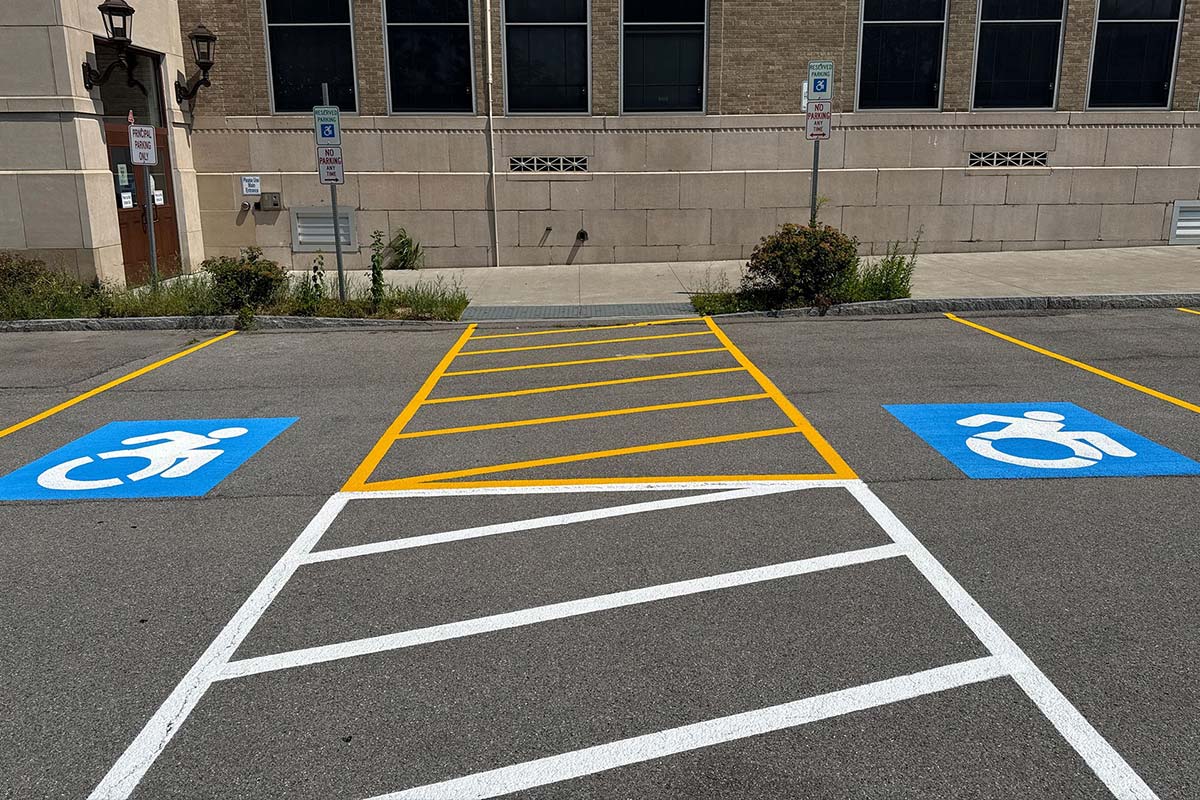
On a typical commercial property in Greenville that means standard stalls, accessible stalls and their access aisles, the International Symbol of Accessibility, directional arrows, stop bars, crosswalks, fire lane markings and legends, loading zone boundaries, no-parking hatching, curb painting and any numbering or reserved-space lettering the property uses.
It also means the parts nobody photographs: sweeping and blowing the surface so paint bonds to pavement and not to grit, treating oil spots at stall heads where vehicles drip, laying out cones and barricades so the lot keeps working while sections cure, and walking the finished job with the property manager.
What restriping is not is a chance to quietly correct a layout problem. If the existing pattern has accessible stalls that are too narrow, an access aisle that overlaps the drive lane, or a fire lane that has crept, repainting the same geometry preserves the problem in fresh paint. We flag that at the estimate rather than after.
When a Parking Lot Needs Restriping
The trigger is visibility, not a calendar interval. A marking has done its job while a driver arriving at dusk in the rain can read it, and has stopped doing its job when they cannot.
Practical signs that a lot is due: stall lines that have gone from white to gray and are only visible from directly above; accessible symbols worn through to the pavement; arrows that read ambiguously enough that drivers take an aisle the wrong way; fire lane legends that are legible in patches; curb paint flaking off in sheets; and the giveaway one — drivers parking crooked or straddling lines, which usually means the lines stopped guiding them a while ago.
Wear is not even across a lot. Entrance aprons, drive aisles and the head of every stall row go first because that is where tires track. Perimeter stalls that rarely get used can look fine while the working half of the lot is finished. That is why a walk beats a photo.
Restriping vs. a New Layout
Restriping follows the existing pattern. A new layout replaces it. The cost, the disruption and the preparation are different, and so is the decision that drives them.
Choose restriping when the layout works, the space count is right, the accessible parking is correct and current, and the pavement is sound. Choose a new layout when a tenant change has altered how traffic moves, when the accessible parking does not meet the current standard, when you want more spaces out of the same pavement, or when the lot has just been resurfaced and there is nothing to follow.
There is a middle case that comes up often: the layout is fine but a handful of elements are wrong. An access aisle that is 48 inches instead of the 60-inch minimum. A van space with no vertical clearance route. Accessible stalls at the far end of the lot instead of on the shortest accessible route to the entrance. Those get corrected as part of the restripe, with the old lines removed, not painted over, while the rest of the pattern is just refreshed.
Surface Preparation and Old-Line Removal
Paint fails at the bond, not in the can. Preparation is where a restripe is won.
The baseline on every job is mechanical cleaning: sweeping and blowing the marking corridors so the paint contacts pavement instead of dust, sand and pollen. Oil and fuel spots get treated, because paint applied over a saturated spot will lift regardless of how well it went down.
Removal is the other half. Where a line is moving — a stall being narrowed, an access aisle being widened, an arrow being re-aimed — the old marking has to come off rather than be hidden. Painting a black-out box over an obsolete line leaves a shadow that reappears as the top coat wears, and on a wet night a driver sees two conflicting lines. Removal methods are chosen against the pavement: what is acceptable on sound concrete is not always acceptable on a thin asphalt overlay, where aggressive removal can scar the surface worse than the line did.
Where the surface is contaminated across a wide area and not just in spots, pressure washing before striping is the right sequence, and we handle that too.
Paint Types and Dry Times in Upstate SC Weather
Two questions decide the material: how long the marking has to last, and how soon the lot has to reopen.
Waterborne acrylic traffic paint is the standard choice for commercial parking lots. It goes down fast, reopens to traffic quickly and is straightforward to refresh on the next cycle. Thermoplastic is the durable alternative for high-wear locations — stop bars, entrance aprons, crosswalks and fire lane legends — and has its own page on this site. Removable water-based paint covers temporary and event striping.
On dry time, the number belongs to the product, not to the trade. Every traffic paint carries a manufacturer’s data sheet stating its minimum application temperature and its dry-to-traffic time, and both shift with surface temperature, humidity, film thickness and airflow across the pavement. A lot that reopens in an hour in dry, warm, breezy conditions will not reopen in an hour on a humid, still morning after overnight rain. We schedule to the data sheet and the forecast, we tell you the reopening window before we start, and we keep cones on the sections that are not ready.
Accessible Stalls Must Meet Current Standards When You Restripe
This is the part of a restripe that carries legal weight rather than just appearance.
Under 28 CFR 36.211(a), a public accommodation must maintain in operable working condition those features of facilities and equipment that are required to be readily accessible to and usable by persons with disabilities. Accessible parking spaces, access aisles and the markings that identify them are such features. A worn-off accessible symbol or an access aisle whose hatching has disappeared is not a cosmetic issue — it is an accessible feature that has stopped working. The same regulation notes that isolated or temporary interruptions for maintenance or repairs are not prohibited, which is exactly what a scheduled restripe is.
The second half matters as much. When accessible stalls are repainted, they should come back to the current geometry, not to whatever was there. That means a 96-inch minimum car space or a 132-inch minimum van space, a 60-inch minimum access aisle running the full length of the space, the aisle marked to discourage parking, the aisle not overlapping the vehicular way, and the surface level to within a 1:48 slope. If the existing stalls do not meet those dimensions, the restripe is the moment to correct them — repainting the old geometry just renews a defect.
Our Restriping Process, Step by Step
- Site walk and marking inventory. We count stalls, photograph the accessible parking, note fire lanes and legends, and check for anything that should not be repainted as-is.
- Written scope and reopening plan. You get the marking schedule, materials, sequence and the sections-and-timing plan in writing. Estimates are free and come back within 24 hours.
- Corrections flagged before paint. Anything not meeting current accessible-parking geometry is identified, priced separately and agreed — never quietly repainted.
- Traffic control. Cones, barricades and signage stage the lot so sections stay open while others cure.
- Surface preparation. Sweeping and blowing along every marking corridor; oil-spot treatment; pressure washing where contamination is widespread.
- Old-line removal. Only where geometry is changing, with the method matched to the pavement so the surface is not scarred.
- Layout verification. Measured and snapped against the existing pattern, with accessible spaces re-measured, never traced.
- Application. Waterborne acrylic traffic paint at the film thickness the data sheet calls for, thermoplastic where specified.
- Cure and reopen. Sections release as they reach the data sheet’s dry-to-traffic condition.
- Walkthrough. We walk the finished lot with you before the last cone comes up.
For a full list of our pavement marking services, visit our parking lot striping in Greenville page.
Businesses We Serve



How it Works

GET A FREE ESTIMATE
Contact us today and we’ll have a quote to you in 24 hours

SCHEDULE AN INSTALLATION
We’ll have your installation scheduled in less than 7 days, without affecting your business hours

GET A PARKING LOT THAT POPS
For a budget-friendly price, you’ll get a parking lot that looks like new
We proudly work with:


We proudly work with:

Frequently Asked Questions About Parking Lot Restriping in Greenville, SC
How often should a parking lot be striped?
There is no fixed interval that holds across properties, and any contractor quoting one is guessing. Wear depends on traffic volume, whether the surface is asphalt or concrete, sun exposure, plow and sweeper contact, and the material used last time. The workable test is legibility: if a driver arriving at dusk in the rain cannot read a stall line, an arrow or an accessible symbol, that marking is past due. Entrance aprons and drive aisles wear first, so check those first; the quiet perimeter tells you little.
What causes parking lot lines to fade in the Upstate?
Tire abrasion does most of it, which is why the head of each stall row and the drive aisles go first. Ultraviolet exposure breaks down the binder over time. Standing water and freeze-thaw cycles work at the bond between paint and pavement. Sweepers, plows and power scrubbers take material off mechanically. Oil and fuel drips undermine paint from below at stall heads. On a resurfaced asphalt lot, residual surface oils can also stop the first coat bonding properly if the pavement was not given time to cure.
Can you restripe over old lines, or do they have to be removed?
If the geometry is not changing, we restripe directly over the existing lines after cleaning — that is the normal and correct approach. Removal is needed when a line is moving: a stall being narrowed or widened, an access aisle being brought up to the 60-inch minimum, an arrow being re-aimed, a fire lane being relocated. Blacking out an obsolete line instead of removing it leaves a shadow that resurfaces as the top coat wears, and at night a driver then sees two conflicting markings.
How long before we can drive on fresh lines?
The reopening window comes from the paint manufacturer’s data sheet, not from a rule of thumb, and it moves with surface temperature, humidity, film thickness and airflow. Warm, dry, breezy conditions reopen far faster than a humid, still morning after rain. We tell you the expected window before work starts, stage the lot in sections so part of it stays usable throughout, and leave cones on anything not yet ready. Driving on paint before it releases is the fastest way to ruin a fresh restripe.
Do restriped accessible stalls have to meet current ADA standards?
They should come back correct rather than come back the same. Under 28 CFR 36.211(a) a public accommodation must maintain accessible features in operable working condition, and a worn accessible symbol or vanished access-aisle hatching is a feature that has stopped working. When those stalls are repainted we build them to the current 2010 ADA geometry — 96-inch minimum car space, 132-inch minimum van space, 60-inch minimum access aisle running the full length, aisle marked to discourage parking and clear of the vehicular way. Existing stalls that miss those dimensions get flagged before painting.
Are faded markings a code problem, not just a cosmetic one?
For some markings, yes. Accessible parking is covered by the maintenance duty in 28 CFR 36.211(a). Fire lane markings are covered by the 2021 South Carolina Fire Code, which requires that the means by which fire lanes are designated be maintained in a clean and legible condition at all times and be replaced or repaired when necessary to provide adequate visibility. Standard stall lines and arrows carry no equivalent federal duty, but a lot where drivers cannot read the traffic pattern is a liability exposure regardless of which code does or does not name it.