Sports Court Striping
In East Louisville, KY
Multi-Sport Court Line Marking
1-800-STRIPER provides professional sports court striping in East Louisville, KY — laying out pickleball courts to USA Pickleball rulebook dimensions, basketball courts, and tennis courts in durable, contrasting acrylic line paint for schools, apartment communities, and commercial properties.
1-800-STRIPER of East Louisville PROVIDes Sport Court and Playground Markings Services NEAR YOU
Want to get people to come out to play?
Brighten up your faded sport courts or turn your playground into a safe, colorful, and engaging space that entices people to come out and play.
Sport Court Specialties:
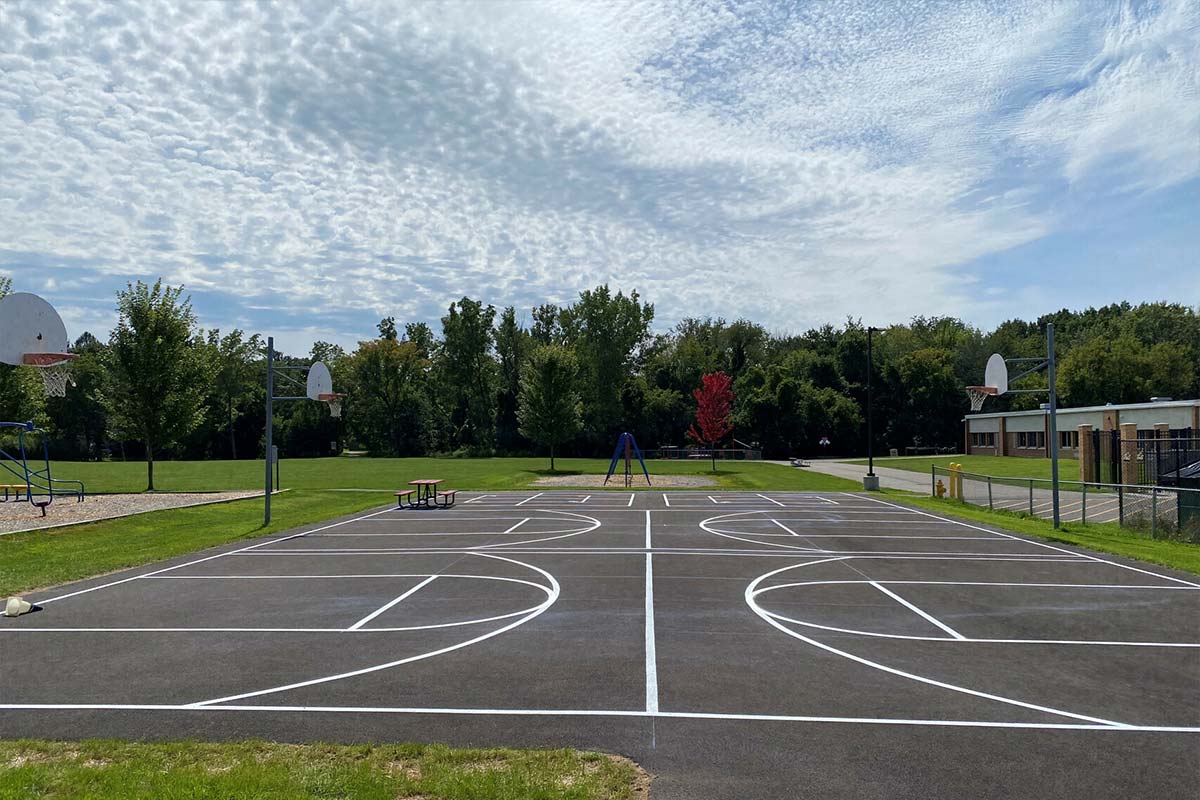
Sports Court Striping in East Louisville, KY
Court striping is layout work first and painting second. The lines are the specification — get the geometry wrong and you have a surface that looks finished and plays wrong, which is worse than an unpainted slab.
We lay out and stripe pickleball, basketball and tennis courts on hard surfaces for schools, apartment and condominium communities, homeowner associations, churches, community centers and commercial properties across the region. That covers fresh layouts on new or resurfaced surfaces, refreshing lines that have faded, and conversions where an existing court is being adapted to hold a different game.
Pickleball conversions are the majority of what we are asked for now. A tennis court that sits unused most of the week converts into a surface that gets used every day, and it does not require rebuilding anything — it requires knowing exactly where the lines go.
Court Dimensions We Lay Out
These figures come from the governing rulebooks, not from convention.
| Playing area | Line width | |
|---|---|---|
| Pickleball court | 20 ft × 44 ft, the same for singles and doubles — USA Pickleball rule 3.A.1 | 2 in wide, all lines the same color, clearly contrasting with the surface — rule 3.A.4.e |
| Pickleball minimum playing surface | 30 ft × 60 ft — rule 3.A.3 | — |
| Pickleball playing surface, new construction (recommended) | 34 ft × 64 ft — rule 3.A.3 | — |
| Pickleball non-volley zone | 7 ft × 20 ft at each end — rule 3.A.4.c | — |
| Tennis court | 78 ft × 27 ft for singles, 36 ft wide for doubles — ITF Rules of Tennis, Rule 1 | 1–2 in, baselines up to 4 in |
The row that decides most projects is the second one. The pickleball court is 20 by 44 feet. The minimum playing surface is 30 by 60 feet, and for new construction the rulebook recommends 34 by 64. That difference is run-off space — room to chase a ball without hitting a fence, a wall or the next court — and it is what determines whether a conversion actually works. Plan the space from the 30 by 60, not the 20 by 44.
Basketball is a service we provide, and we are not publishing a dimension table for it. The NCAA and NFHS court diagrams we could obtain carry their own disclaimers — one states it is not drawn to scale, the other that it is suggestive only and not required by the rules — and the rulebook text itself is not available without purchase. We lay out basketball courts to the specification your league or facility works to, and we would rather ask you which that is than publish a number we could not verify first-party.
How We Stripe a Court
- Measure the surface. Overall dimensions, obstructions, fence and wall positions, slope and drainage direction, and the condition of the surface itself.
- Confirm what fits. Not just the court, but the run-off around it. This is where a conversion either works or gets redesigned.
- Prepare the surface. Clean and dry, with existing lines assessed. On a conversion, whether old lines get removed or left visible is a decision worth making on purpose instead of by default.
- Chalk the layout. Every line, measured and squared, before any paint. Diagonals get checked — a court that is right on all four sides and wrong on the diagonal is not square.
- Mask and paint. Court paint applied to the marked layout in the line widths the governing specification calls for.
- Cure before play. The surface stays closed until the paint has set properly.
For a full list of our pavement marking services, visit our parking lot striping in East Louisville page.
Businesses We Serve




How it Works

GET A FREE ESTIMATE
Contact us today and we’ll have a quote to you in 24 hours

SCHEDULE AN INSTALLATION
We’ll have your play space restriped in less than 7 days, without affecting your playtime

GET A PARKING LOT THAT POPS
For a budget-friendly price, you’ll get a parking lot that looks like new
We proudly work with:


We proudly work with:


Frequently Asked Questions About Sports Court Striping in East Louisville, KY
What size is a pickleball court, and how much space do I actually need around it?
The court itself is 20 by 44 feet, identical for singles and doubles, under USA Pickleball rule 3.A.1. But the minimum playing surface is 30 by 60 feet, per rule 3.A.3, and that larger figure is the one that decides whether your space works. The extra area is run-off — room to move for a ball without running into a fence or a wall. Plan from the 30 by 60, not the 20 by 44.
Can you fit pickleball courts onto an existing tennis court?
Usually yes, and it is the most common request we get — but the number that decides it is the fenced area, not the court lines. The tennis playing area itself is 78 by 36 feet for doubles, which holds exactly one 20 by 44 pickleball court with usable run-off around it: two side by side would need 40 feet of width against the 36 you have, and two end to end would need 88 feet against 78. Most tennis courts sit inside a considerably larger fenced enclosure, and that is where additional courts come from. We measure the actual enclosure, fence to fence rather than line to line, and show you the arrangements that fit with the run-off each one leaves.
What paint is used on a sports court?
Acrylic court coatings formulated for hard sports surfaces, applied so the lines contrast clearly with the playing surface. USA Pickleball rule 3.A.4.e calls for lines to contrast with the surface, which matters more than the specific color — a line that is technically correct and visually indistinct is a line players cannot use. On conversions we also consider how the new lines will read against whatever lines are already there.
How long does a court layout take to cure before play?
It depends on the coating, the temperature and the humidity, so we give you the actual window for the product we are using instead of a generic figure. Court coatings generally need longer than you would expect, and playing on a surface before it has cured leaves marks that do not come out. We keep the surface closed until it is ready, and we would rather tell you that up front than have you schedule play too early.
Can you stripe multiple sports on one surface?
Yes, and it is common on school and community surfaces where one slab has to serve several uses. The design question is legibility: two or three sets of lines on one surface can get confusing fast, and the answer is deliberate color separation and a clear visual hierarchy, with the primary sport’s lines reading strongest. We lay out the combination on paper first so you can see how busy the finished surface will look before it is painted.
How often do court lines need repainting?
It depends on use and exposure. Lines on a heavily used outdoor surface fade from a combination of foot traffic, UV and weather, and they usually go gradually enough that nobody notices until a player points out that a line is hard to see. That is the practical trigger — when contrast has dropped to where players are unsure, the lines have stopped doing their job. On lightly used surfaces the interval stretches considerably.