
Wheel Stop Installation
In East Louisville, KY
Concrete and Rubber Parking Stops
1-800-STRIPER provides professional wheel stop installation in East Louisville, KY — anchoring concrete, recycled-rubber, and plastic-composite stops at stall heads so parked cars and vans cannot overhang the accessible routes the 2010 ADA Standards for Accessible Design require to stay clear.
1-800-STRIPER of East Louisville PROVIDes Wheel Stop Installation Services NEAR YOU
Need to protect vehicles or walls from accidental damage?
Wheel stops (also called parking blocks) protect your property, enhance safety, and improve parking lot organization.
Benefits:
Wheel stops prevent vehicles from parking too far into a space or overextending into other spots, pedestrian walkways, and other areas, while also helping with vehicle alignment. They can prevent damage to buildings, curbs, or landscaping. Wheel stops also serve as clear visual cues for proper parking and are sometimes used on slopes to prevent cars from rolling.
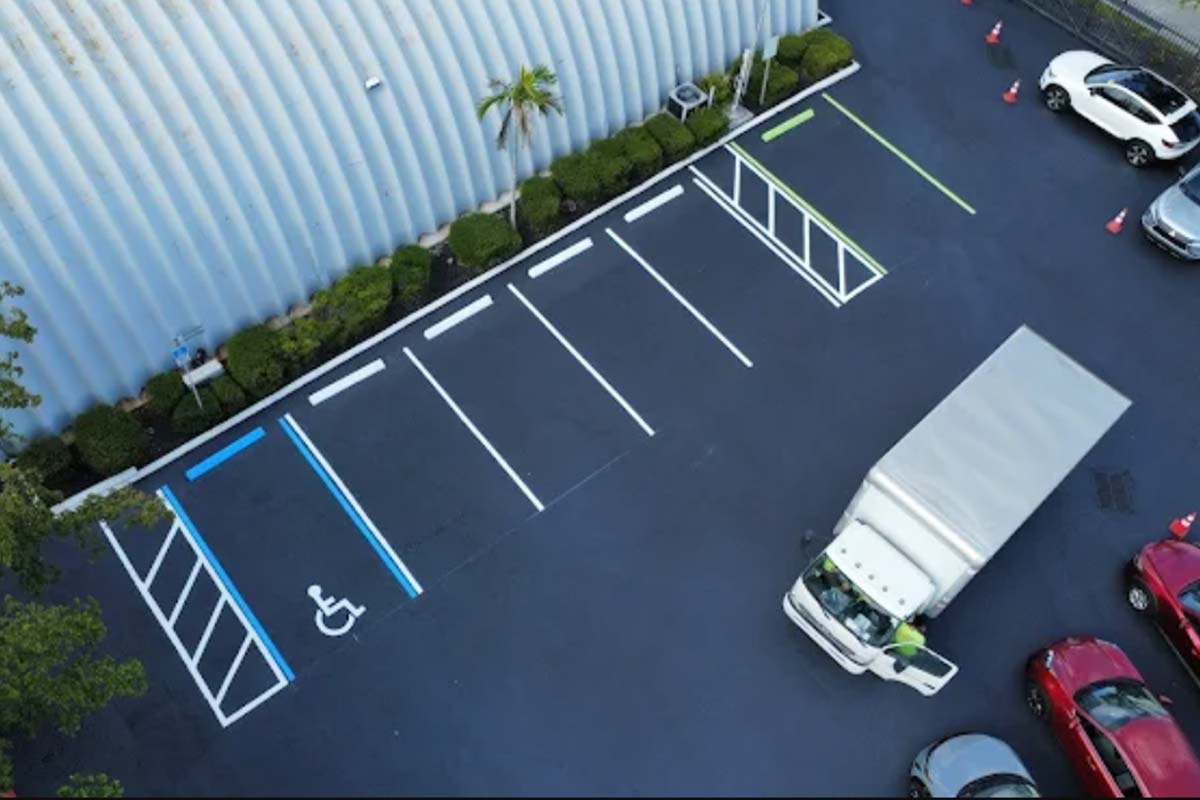
Wheel Stop Installation in East Louisville, KY
Wheel stops look like the least interesting thing in a parking lot. They are also the item most often installed in the wrong place, and the one federal accessibility guidance names by product.
We install and replace them on commercial properties across the region: at the head of stalls that face a walkway, along accessible routes where an overhanging bumper would narrow the path, at the edges of parking areas that abut landscaping or a building face, and in front of storefronts where a curb alone is not stopping anyone.
Most of our wheel-stop work rides along with a striping or restriping visit, because the layout decision and the anchor points are the same conversation.
Concrete, Rubber, and Plastic-Composite Wheel Stops Compared
| Concrete | Recycled rubber | Plastic composite | |
|---|---|---|---|
| Weight class | Heaviest | Light | Light |
| Handling | Two-person, equipment on larger units | One person | One person |
| Fasteners | Rebar pins into asphalt, anchor bolts into concrete | Spikes or lag anchors | Spikes or lag anchors |
| Impact behavior | Chips and spalls at corners | Flexes and rebounds | Flexes; can become brittle with age and UV |
| Freeze-thaw behavior | Vulnerable — porous, and water freezing inside it spalls the corners | Flexes rather than fracturing, so the cycle does not crack it | Flexes rather than fracturing; embrittles with age and UV, which is a separate wear path |
| Plow interaction | Heavy, but chips when struck | Light enough to be displaced if struck squarely | Light enough to be displaced if struck squarely |
| Visibility | Painted surface, repaint periodically | Molded-in reflective inserts common | Molded-in reflective inserts common |
| Replacement | Individual units, heavier logistics | Simple swap | Simple swap |
We are not publishing service-life figures for any of these. The numbers circulating online come from manufacturer marketing, not from a standard, and what any given stop survives in your lot depends on plowing, on how hard people park, and on whether it was anchored properly in the first place. What we will do is look at your lot and tell you which material we would specify and why.
No brand names on this page either, for the same reason.
Where Wheel Stops Go — the Vehicle-Overhang Rule
This is the part with a federal answer, and it is the reason wheel stops matter beyond aesthetics.
Section 502.7 of the 2010 ADA Standards for Accessible Design addresses the relationship between parking spaces and accessible routes: parking spaces and access aisles have to be designed so that cars and vans, when parked, cannot obstruct the required clear width of adjacent accessible routes.
Then Advisory 502.7 names the remedy explicitly: “Wheel stops are an effective way to prevent vehicle overhangs from reducing the clear width of accessible routes.”
That is federal accessibility guidance naming this specific product as the fix for this specific problem.
The practical failure it describes is everywhere. A sidewalk runs along the head of a row of stalls. On paper the walk is wide enough. In practice the front two feet of every parked pickup hangs over it, and the usable width drops to something a wheelchair cannot pass. Nothing is out of compliance on the drawing. Everything is out of compliance in the parking lot at eleven in the morning.
Wheel stops set at the correct depth into the stall stop the overhang before it reaches the walk. Where they go is a measurement, not a habit: it depends on stall depth, on the width of the walk behind it, and on how much clear width the route has to keep.
How We Anchor Wheel Stops
The anchoring method follows the surface, and getting it wrong is why loose wheel stops are such a common sight.
On asphalt, stops are pinned with steel rebar driven through the cast-in holes and into the base. The pins need enough embedment to hold against a repeated bumper strike, and the holes need to be drilled rather than hammered through, because a driven pin that splits the stop has already failed.
On concrete, mechanical anchors or adhesive anchors set into drilled holes. Slab thickness and reinforcement matter here — a stop bolted into a thin topping slab will pull the topping up with it.
For rubber and composite units the fastener is lighter but the principle is identical: the stop transfers load into the pavement, and the pavement has to be sound enough to take it.
What we check before installing anything: the pavement’s condition at the anchor points, drainage across the row, whether the site gets plowed and from which direction, and whether the stop is going to sit where a plow blade will find it.
Wheel Stops vs. Bollards
Different problems, routinely confused.
A wheel stop limits how far a vehicle rolls forward into a stall. It is a positioning device. It is low, it does not obstruct a person walking, and it stops a car creeping at parking speed. It does not stop a vehicle that is under way.
A bollard is a vertical post set into the ground, designed to physically block a vehicle from reaching something — a storefront, a gas meter, a pedestrian area, a dock door. It handles impact, and the ones rated for it are engineered and installed accordingly.
If the problem is bumpers overhanging a walkway or cars nosing into landscaping, that is a wheel stop. If the problem is protecting a structure, a utility or a person from a vehicle that is moving, that is a bollard, and a wheel stop is not a substitute for one.
One more consideration in this territory: wheel stops sit in the plow path. On sites that get plowed, placement and material choice have to account for the blade, and we ask about the snow-clearing plan before we set anything.
For a full list of our pavement marking services, visit our parking lot striping in East Louisville page.
Businesses We Serve




How it Works

GET A FREE ESTIMATE
Contact us today and we’ll have a quote to you in 24 hours

SCHEDULE AN INSTALLATION
We’ll have your installation scheduled restriped in less than 7 days, without affecting your business hours

GET A PARKING LOT THAT POPS
For a budget-friendly price, you’ll get a parking lot that looks like new
We proudly work with:


We proudly work with:


Frequently Asked Questions About Wheel Stop Installation in East Louisville, KY
Where should wheel stops be placed in a parking stall?
Set back from the head of the stall by enough distance that the vehicle’s front overhang stops before it reaches whatever is behind — usually a walkway, a building face or landscaping. The correct setback is a measurement, not a habit, because it depends on stall depth and on how much clear width the walkway behind has to keep. Along accessible routes this matters most, since an overhanging bumper is exactly what section 502.7 of the 2010 ADA Standards addresses.
What is the difference between a wheel stop and a bollard?
A wheel stop is a low positioning device that limits how far a car rolls forward at parking speed. A bollard is a vertical post set into the ground to physically block a moving vehicle from reaching a storefront, a utility, a dock door or a pedestrian area. They solve different problems. A wheel stop will not stop a vehicle that is actually in motion, so it is not a substitute for a bollard where impact protection is the requirement.
Concrete or rubber — which holds up better here?
Rubber generally handles this climate better, and freeze-thaw is the reason. Concrete is porous, and water that freezes inside it expands and cracks it, which is why concrete stops in this region tend to spall at the corners over a few winters. Rubber and composite stops flex instead of fracturing, so the same cycle does not open cracks in them. Concrete’s advantage is mass — it stays where you put it. Rubber’s is that it survives being struck and does not crack.
How are wheel stops anchored to asphalt versus concrete?
On asphalt, steel rebar pins are driven through the cast-in holes into the base material, with enough embedment to resist repeated bumper contact. On concrete, mechanical or adhesive anchors are set into drilled holes, and slab thickness matters — a stop bolted into a thin topping slab can pull the topping up with it. Either way the pavement has to be sound at the anchor point, which we check before we install, not after the stop is already down.
Do wheel stops help with ADA compliance?
They can, and federal guidance says so by name. Section 502.7 of the 2010 ADA Standards requires that parking spaces and access aisles be designed so vehicles cannot obstruct the required clear width of adjacent accessible routes, and Advisory 502.7 states that wheel stops are an effective way to prevent vehicle overhangs from reducing that clear width. They are not required equipment, but where an overhanging vehicle is narrowing an accessible route, they are the named remedy.
Do wheel stops crack in freeze-thaw winters?
Concrete ones can, and here they often do. The mechanism is straightforward: concrete takes on water, the water freezes and expands, and repeated cycles open cracks and spall the corners. Louisville runs three consecutive winter months whose normal daily lows sit at or within a tenth of a degree of freezing, with normal daily highs well above, so the cycle happens repeatedly each season. Recycled rubber and plastic composite stops flex rather than fracture, so the same cycle does not crack them.