
Warehouse Line Painting
In East Louisville, KY
OSHA-Compliant Safety Markings
1-800-STRIPER provides professional warehouse line painting in East Louisville, KY — marking permanent aisles, pedestrian walkways, staging bays, and equipment zones in durable floor coatings, the marking duty OSHA sets where mechanical handling equipment is used.
1-800-STRIPER of East Louisville PROVIDes Warehouse Floor Markings Services NEAR YOU
Want your indoor space to operate more efficiently?
Warehouse and interior markings ensure clear traffic lanes, organized storage zones, and designated spaces designed to help your business operate safely and efficiently.
Benefits:
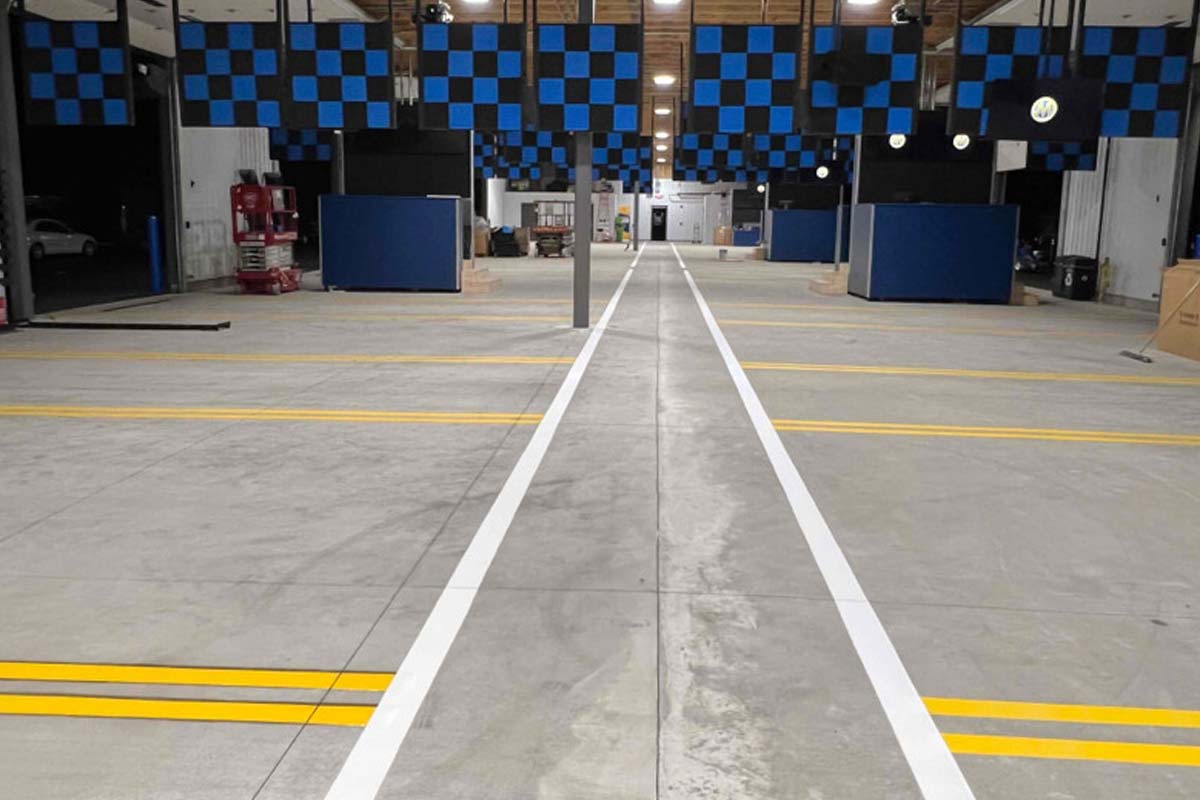
Warehouse Line Painting in East Louisville, KY
Warehouse floors get marked for two reasons that pull in different directions. One is safety — keeping people and forklifts out of each other’s path. The other is throughput — making a building legible so that staging, picking and dock operations happen in the right places without anyone thinking about it.
We do both, on distribution centers, manufacturing floors, 3PL facilities and back-of-house areas across the region. Permanent aisle lines, pedestrian walkways, crosswalks at aisle intersections, staging and dock-approach zones, equipment and battery-charging areas, keep-clear boxes at panels and exits, and the numbering and lettering that makes a rack layout navigable.
What follows is the part of this subject where almost every page on the internet, including pages from very large companies, states something that is not in the standard.
What OSHA Actually Requires — and What It Doesn’t
The marking duty is in 29 CFR 1910.176(a), a paragraph titled “Use of mechanical equipment” inside the section on handling materials. It does three things: it requires sufficient safe clearances at aisles, loading docks and doorways; it requires aisles and passageways to be kept clear and in good repair; and it closes with the marking sentence — “Permanent aisles and passageways shall be appropriately marked.”
Note the two conditions built into that last sentence. The section opens with “Where mechanical handling equipment is used,” which is the trigger, and it applies to permanent aisles. A temporary staging lane rearranged every quarter is not what the sentence is about.
Now the correction. The citation you will see everywhere for this is “OSHA 1910.22(b).” The word “aisle” appears zero times in 29 CFR 1910.22. After that standard was rewritten in November 2016, paragraph (b) is titled “Loads” and concerns the load-bearing capacity of walking-working surfaces. The universally repeated citation points at a paragraph about floor loading.
Two more things the standard does not say:
No federal general-industry provision sets an aisle marking line width. The familiar “two-inch lines, four-foot aisles” figures trace back to a 1972 OSHA interpretation letter that the agency has since archived under its own banner stating that it may no longer represent OSHA policy — and it was advisory guidance even when it was current.
No federal provision assigns a color to aisle marking. 29 CFR 1910.144 is the safety color code, and it assigns exactly two colors: red for fire protection equipment, danger and emergency stops, and yellow for caution and for marking physical hazards such as striking against, stumbling, falling and tripping. It says nothing about aisles. The neighboring standard on signs and tags, 29 CFR 1910.145, does use more colors than those two — but it governs signs and tags, not floors, and the word “aisle” appears in it zero times as well.
Aisles, Pedestrian Walkways, and Equipment Zones
With the regulatory picture straight, here is what a well-marked floor contains.
Permanent aisle lines defining travel lanes for powered equipment, continuous through the run and squared at intersections.
Pedestrian walkways kept physically separate from equipment travel wherever the building allows it, with marked crossings where separation is impossible. This is where most of the real safety benefit lives.
Staging and outbound zones so pallets land where they belong instead of creeping into the aisle.
Dock approach markings at the doors, where forklift and trailer movement overlap and visibility is worst.
Keep-clear zones at electrical panels, eyewash stations, fire extinguishers, sprinkler risers and exit doors. These have their own clearance obligations independent of anything about aisles.
Equipment and battery-charging areas, and rack-end lettering and aisle numbering where the layout warrants it.
Color Conventions and Where They Come From
Since the standard does not assign colors to aisles, what should you use?
Convention — and we will name it as convention and not dress it up as a mandate. The widely used floor-marking color schemes are industry practice, not a published floor-marking standard, because there isn’t one. ANSI Z535.1 defines the safety colors themselves, but its own scope limits it to safety signs, labels and tags; no part of the Z535 series addresses floors. What circulates as a floor-marking color chart is convention that borrowed those color values. It is sensible, it is what your staff and your visiting auditors will expect, and following it is a good idea. It is not federal law, and those charts are not “the OSHA color code” no matter how often they are labeled that way. OSHA’s own archived guidance went the other way: the 1972 letter states that the lines delineating aisles “may be any color so long as they clearly define the area considered as aisle space.”
The two colors that genuinely do trace to the regulation are red and yellow, through 29 CFR 1910.144, for fire protection equipment and for physical hazards respectively.
Our practical approach: follow the convention your facility already uses if it has one, because consistency inside a building is worth more than conformity to somebody’s chart. Where there is no existing scheme, we will propose one and tell you exactly which parts are regulatory and which are convention.
Scheduling Around Your Operation
Almost every warehouse job we do is phased, because almost no warehouse can stop.
We work aisle by aisle or zone by zone, on off-shifts, weekends or shutdown windows. The sequence is layout, surface preparation, masking, application and cure. Preparation is the step that gets skipped and the step that decides whether the marking survives — a concrete floor with dust, tire rubber or an old sealer on it will shed a coating in weeks regardless of what was applied.
Cure time is the real scheduling constraint. Foot traffic returns well before forklift traffic does, and the gap between the two is what we plan around. We will give you the specific windows for the coating we are proposing before the work starts, not after.
For a full list of our pavement marking services, visit our parking lot striping in East Louisville page.
Businesses We Serve




How it Works

GET A FREE ESTIMATE
Contact us today and we’ll have a quote to you in 24 hours

SCHEDULE A STRIPING
We’ll have your space restriped in less than 7 days, without affecting your business hours

GET A PARKING LOT THAT POPS
For a budget-friendly price, you’ll get a parking lot that looks like new
We proudly work with:


We proudly work with:

Frequently Asked Questions About Warehouse Line Painting in East Louisville, KY
Does OSHA require warehouse aisles to be marked?
Yes, with two conditions. The requirement is 29 CFR 1910.176(a), which states that permanent aisles and passageways shall be appropriately marked. It sits under the opening condition “Where mechanical handling equipment is used,” so it attaches to facilities operating forklifts and similar equipment, and it applies to permanent aisles, not to temporary staging lanes. The much-cited “1910.22(b)” is not the right citation — that paragraph is about load-bearing capacity.
What color should warehouse floor markings be?
No federal general-industry standard assigns a color to aisle marking. 29 CFR 1910.144 assigns red to fire protection equipment, danger and emergency stops, and yellow to caution and physical hazards, and it does not address aisles. The multi-color floor-marking charts you see online are industry convention, not regulation and not a floor-marking standard — no consensus standard assigns colors to floors. ANSI Z535.1 defines safety color values, but only for signs, labels and tags. Yellow for aisles is sensible convention. It is not a legal requirement.
How wide do aisle marking lines have to be?
There is no federal general-industry number. The widely quoted two-inch line width traces to a 1972 OSHA interpretation letter that the agency has since archived with a notice that it may no longer represent OSHA policy, and it was advisory even then. In practice we use two to four inches depending on the aisle width, equipment size and sightlines, and wider lines where a lane needs to read from a distance. What matters legally is that permanent aisles are appropriately marked.
What coating holds up to forklift traffic?
On concrete, our experience is that a two-component epoxy or a polyurethane holds up considerably better than a single-component floor paint under forklift wheels, particularly at turns and stops where the shear load is worst. The bigger variable is surface preparation. An excellent coating on a dusty, sealed or oil-contaminated slab fails quickly, while a modest coating on a properly prepared slab holds up. We will tell you which of those two your floor is before quoting the coating.
Can you paint while the warehouse stays in operation?
Almost always. We phase the work by aisle or by zone so the building keeps running, and we schedule around your shifts — nights, weekends, or a shutdown window if you have one. The section being marked is closed off while the coating cures, and everything else stays live. Tell us your operating pattern when you call and we will build the sequence around it instead of asking you to work around us.
How long before we can drive on new floor markings?
It depends on the coating and on the conditions in the building, and foot traffic returns well before wheeled traffic does. We give you the specific cure windows for the product we are using before the job starts, and we barricade the section until it can take the load it needs to take. Rushing forklift traffic onto a coating that has not fully cured is the fastest way to ruin a marking you have just paid for.