Parking Lot Restriping
In East Louisville, KY
Restripe Existing Lines and Markings
1-800-STRIPER provides professional parking lot restriping in East Louisville, KY — refreshing faded stalls, ADA spaces, fire lanes, and directional arrows worn down by the freeze-thaw winters and traffic loads that commercial lots across the Louisville area carry.
1-800-STRIPER of East Louisville PROVIDes Restriping Services NEAR YOU
Need to brighten up your faded parking lot?
Keep your parking lot safe and attractive by restriping annually to freshen up lines and symbols that have faded from the sun, weather, and traffic. Nothing beats a fresh coat of paint!
Benefits:
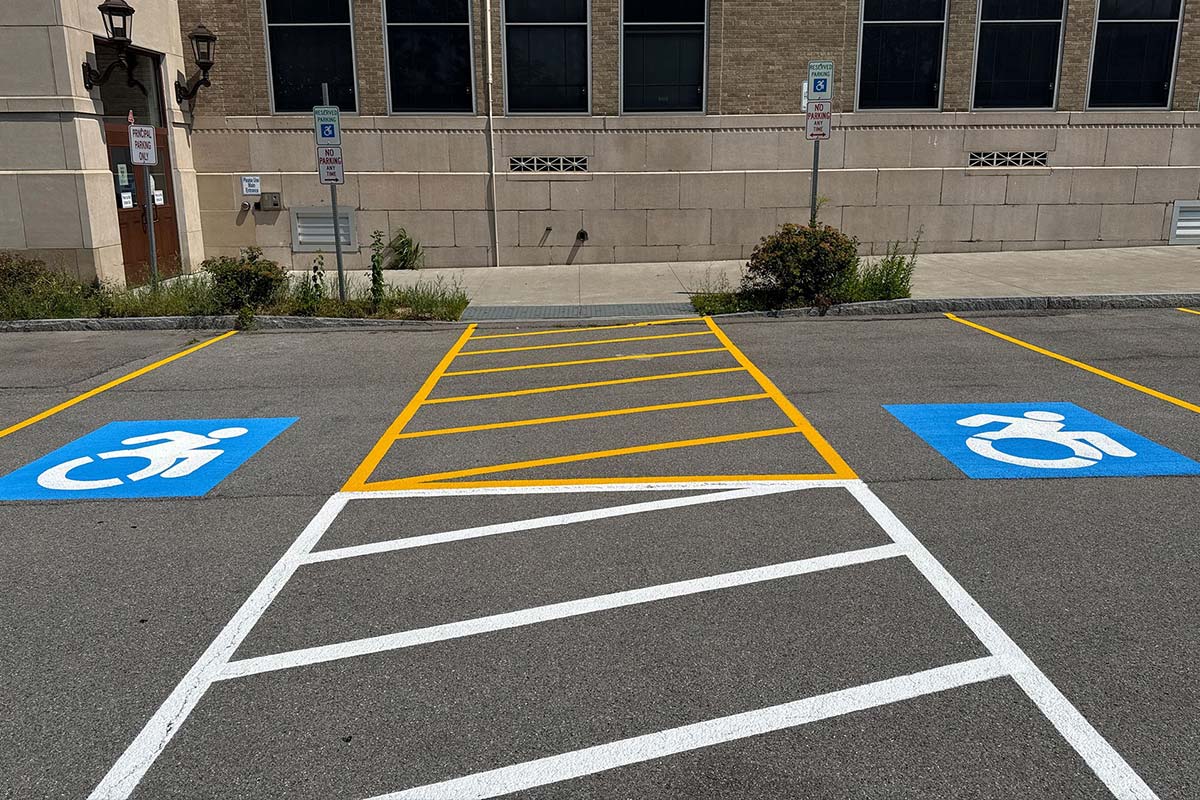
Parking Lot Restriping in East Louisville, KY
Restriping is the job most commercial properties need and fewest schedule. Lines fade gradually, nobody notices on a daily walk, and then a tenant complains or an inspector points at something and it becomes urgent.
We restripe retail centers, office parks, apartment communities, industrial sites, schools, churches and medical campuses across the Kentucky counties east and north of the metro and the Indiana counties across the river. A restripe covers stall lines, accessible spaces and their access aisles, fire lanes, directional arrows, crosswalks, loading zones, numbering and any hatching or keep-clear areas the lot carries.
Most restriping jobs are a single day, phased so the property never fully closes. What sets the schedule is not how long the paint takes to go down. It is how long it has to be left alone afterward.
When to Restripe — Freeze-Thaw and Traffic Load
Two things wear a parking lot’s markings: what drives on them, and what the weather does to the pavement underneath them.
The traffic side is intuitive. Turning tires scrub paint far harder than straight-line travel, so entrance aprons, aisle intersections and drive-through lanes always go first while the far corner of the lot still looks new. High-turnover retail wears faster than long-dwell office parking.
The weather side is specific to here, and it is worth showing instead of asserting. These are the National Weather Service normals for Louisville, 1991 to 2020, with the period printed on the source document:
| Month | Normal daily maximum | Normal daily minimum |
|---|---|---|
| December | 47.2 °F | 32.1 °F |
| January | 43.6 °F | 27.8 °F |
| February | 48.3 °F | 30.7 °F |
Three consecutive months whose normal daily low sits at or within a tenth of a degree of freezing, while the normal daily high runs fifteen to eighteen degrees higher. That gap is the freeze-thaw cycle, shown directly: water works into the pavement surface, freezes, expands and thaws, and does it again. Add annual precipitation of 48.34 inches and 13.4 inches of snow — which means plow blades scraping the marking and deicing salt sitting on it — and the marking has a harder winter here than the calendar suggests.
Practically, most commercial lots in this territory need attention somewhere between every year and every three years. We would rather look at yours and tell you it can wait than sell you a job you do not need this season.
Our Restriping Process
- Assess. We walk the lot, photograph what is faded, count what is there, check pavement condition, and note anything that reads as a compliance problem — short accessible-space counts, missing van designations, illegible fire lane markings.
- Clean. Sweep, blow and where necessary pressure-wash. Paint applied over grit, oil or loose material fails early, and this is the step that separates a three-year restripe from a one-year one.
- Lay out. For a straight refresh we follow the existing layout, snapping to what is there. Where the layout is changing, chalk and string go down first and get checked before anything permanent happens.
- Mask and protect. Curbs, adjacent surfaces and anything that should not catch overspray.
- Apply. Stall lines, symbols, arrows, hatching and legends, in sequence.
- Cure and reopen. The section stays barricaded until it can take traffic. We walk the finished work with you.
We do not name paint brands or equipment models on this page, because the material we use is selected per job and per surface, and a brand name in a web page is a marketing claim, not a specification.
For a full list of our pavement marking services, visit our parking lot striping in East Louisville page.
Businesses We Serve



How it Works

GET A FREE ESTIMATE
Contact us today and we’ll have a quote to you in 24 hours

SCHEDULE AN INSTALLATION
We’ll have your installation scheduled in less than 7 days, without affecting your business hours

GET A PARKING LOT THAT POPS
For a budget-friendly price, you’ll get a parking lot that looks like new
We proudly work with:


We proudly work with:

Frequently Asked Questions About Parking Lot Restriping in East Louisville, KY
What does restriping a parking lot mean?
Repainting the markings that are already there — stall lines, accessible spaces and access aisles, fire lanes, directional arrows, crosswalks, loading zones, numbering and hatched keep-clear areas. It is distinct from a new layout, where the arrangement itself changes. A straight restripe follows the existing geometry, which makes it faster and cheaper. Most jobs also include a compliance look at the accessible parking, because faded markings and short counts tend to travel together.
How often should a lot in this climate be restriped?
Most commercial lots here need attention every one to three years, and the spread is wide because traffic matters as much as weather. Louisville’s winters push the interval down: December, January and February all sit at or within a tenth of a degree of freezing overnight, with normal daily highs fifteen to eighteen degrees higher, so the pavement cycles through freeze and thaw repeatedly, and plowing and deicing salt add mechanical wear. High-turnover retail lots run at the short end of that range.
How long does the paint need to cure before cars return?
It varies with the product, the temperature and the humidity, so we give you the specific window for the material we are using rather than a generic figure. In practice the section stays barricaded until the marking can take traffic without tracking, and we plan the phasing around that rather than around how fast we can apply. Driving on a marking before it has set is the fastest way to ruin work you have just paid for.
Can you restripe in winter?
Sometimes, and it depends on the day, not the month. Pavement marking materials have minimum air and surface temperature requirements, and the pavement itself has to be dry. A mild, dry stretch in December is workable; a damp week in the thirties is not. The practical constraint here is that our winter normals sit close to the working threshold, so winter work gets scheduled with flexibility built in and sometimes gets moved.
Do you follow the existing layout or can it change?
Either. A straight restripe follows what is there, which is the right call when the layout works and you want the lot refreshed. If you want more capacity, better circulation, or an accessible-parking arrangement that will hold up to scrutiny, that is a layout design job and we handle it as one — measured, tested against the applicable dimensional requirements, and laid out in chalk before anything gets painted.
Do faded ADA markings create a compliance problem?
They are worth taking seriously. Accessible spaces are identified by their markings and signage, and a space whose symbol and access-aisle striping have worn away is not doing the job the 2010 ADA Standards describe. We are not the right people to give you a legal conclusion, but we can tell you what your lot currently has against what the space count requires — and in our experience a restriping cycle is the natural moment to close whatever gap that audit turns up.