Parking Lot Sign Installation
In NW Chicago, IL
ADA, Fire Lane, and Directional Signage
1-800-STRIPER® provides professional parking lot sign installation in NW Chicago, IL — setting accessible-space R7-8 signs, fire lane no-parking signs, directional and stop signs, and private-property tow-away warnings per the 2010 ADA Standards for Accessible Design and the Illinois Vehicle Code.
1-800-STRIPER® of NW Chicago PROVIDes Parking Lot Sign Installation Services NEAR YOU
Are you communicating clearly?
We install new signs in adherence with local regulatory standards and can repair or replace damaged signs so you can clearly communicate your parking requirements.
What Parking Lot Sign Installation Covers
Sign installation is the vertical half of a parking lot’s markings. The paint on the surface tells drivers where to put the vehicle; the signs tell them the rules that apply once they are there, and on several categories of space the sign — not the paint — is the element the standards actually require.
We install the signs a commercial lot needs: accessible parking signs and their van-accessible plaques, fire lane and no-parking signs, directional and one-way signs, stop signs, speed and pedestrian-crossing signs, reserved and visitor space signs, loading zone signs, and private-property tow-away warnings. We install new posts, replace damaged or faded faces, re-set signs that have been knocked down, and correct mounting heights that do not meet requirements.
Accessible Parking Signs
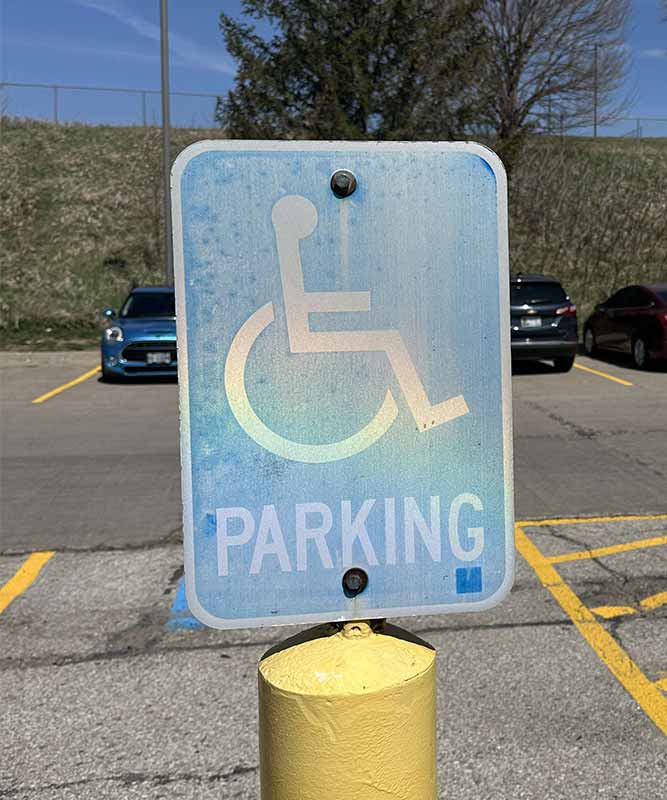
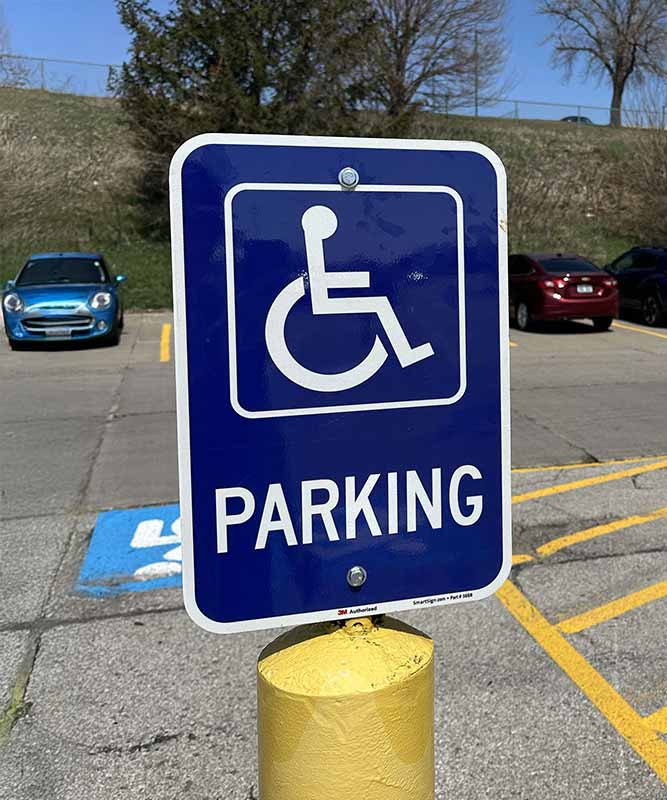
This is the category with the most specific requirements and the one most often found non-compliant. Under section 502.6 of the 2010 ADA Standards for Accessible Design, each accessible space needs a sign carrying the International Symbol of Accessibility. Signs identifying van spaces must additionally carry the designation “van accessible”. And the sign must sit at least 60 inches above the finished floor or ground, measured to the bottom of the sign.
The mounting height is where existing lots fail most often, and usually for mundane reasons: the sign was installed on a short bollard, or it was knocked down by a vehicle or a plow and reinstalled at whatever height was convenient. A space with correct paint, correct width and a correct access aisle is still non-compliant if its sign is low or missing its van designation. When we are on a property for any reason, checking these is part of the visit.
Illinois also maintains its own accessibility code alongside the federal standards, and where the two differ the more stringent requirement is the one that applies to your property.
Fire Lane and No-Parking Signs
Fire lane signage is set by your local fire official rather than by a national rule, and in this territory that means it genuinely varies. The suburbs we serve adopt editions of the International Fire Code with their own local amendments; the City of Chicago runs its own Fire Prevention Code instead. Wording, letter size, spacing between repeated signs, sign type and whether curb painting accompanies the signs are all local determinations.
Under the model code, where the fire code official requires it, approved signs, notices or markings carrying the words NO PARKING — FIRE LANE identify the apparatus access road or prohibit its obstruction. What that means for you is that we confirm the requirement with your jurisdiction before fabricating and installing, rather than applying one template across forty-six towns. No-parking signage at hydrants, doorways, loading areas and clearance zones is usually specified alongside it.
Directional, Stop, and Speed Signs
Circulation signage keeps traffic moving predictably through a lot and is the category where sensible design matters more than compliance:
| Sign type | Where it belongs | Notes |
|---|---|---|
| One-way and directional arrows | Entrances, aisle heads, angled-stall lots | Essential wherever stall angle forces one-way circulation |
| Stop signs | Aisle-to-drive and lot-to-street exits | Placement matters more than quantity |
| Speed limit | Long aisles, mixed pedestrian and vehicle areas | Set to what the property actually needs |
| Pedestrian crossing | Marked crosswalks between lot and entrance | Pairs with the painted crosswalk |
| Do not enter | Exit-only lanes | Prevents wrong-way entry at multi-entrance sites |
| Reserved, visitor, EV | Assigned or designated spaces | Paired with stall marking |
| Clearance and height | Canopies, decks, drive-throughs | Prevents strike damage |
Sign face design for regulatory signs follows the conventions in the Manual on Uniform Traffic Control Devices, which is the right reference for what a stop sign or a one-way sign should look like. It is worth being precise about the limit of that: the MUTCD does not govern the striping of a private parking lot, because parking areas and their driving aisles are not treated as maintained for public travel. We follow it for sign face convention, not as authority over your lot’s layout.
Private-Property Tow-Away Warning Signs: What Illinois Requires
If you intend to have vehicles towed from your property, Illinois conditions that on signage, and the statute is section 4-203(f) of the Illinois Vehicle Code, 625 ILCS 5/4-203(f). Getting this wrong is expensive in a way that is easy to avoid: an unposted or improperly posted property generally cannot have vehicles removed, and the exposure lands on the property owner rather than on the towing company.
The statute’s requirements fall into four groups. Placement — a sign at each driveway access or curb cut that allows vehicular access to the property, set within 5 feet of the public right-of-way line; where a lot has no curbs or access barriers, the statute instead sets a minimum of one sign for each 100 feet of lot frontage. Legibility — letters not less than 2 inches high, light-reflective, on a contrasting background, so the sign reads at night. Mounting — the bottom of the sign not less than 4 feet above ground level. Content — the name and current telephone number of the towing service, and a clear statement that unauthorized vehicles will be towed away at the owner’s expense. The sign must also have been continuously maintained on the property for not less than 24 hours before any vehicle is removed.
We install to the statute and to whichever local towing ordinance your municipality adds on top of it, taking the stricter of the two. Statutory detail like this does get amended, so we confirm the current requirement at the time of installation rather than working from a number somebody wrote down years ago — and we would suggest your property manager or counsel confirm it too before you rely on it for an actual tow.
Signs Installed With the Striping Job
Most of our sign work happens on the same visit as the striping, and that is the efficient way to do it. The accessible space, its access aisle, the painted symbol and the sign are one requirement rather than four, and having one crew handle all of it means nothing falls between two trades.
- Survey during the striping walk-through. Every existing sign is checked for face condition, mounting height, correct designation and whether it still matches what is painted below it.
- Reconcile paint and signs. Spaces marked accessible on the ground but unsigned, or signed but no longer marked, get flagged. Mismatches between the two are common and they are the ones that fail inspections.
- Specify. Faces, posts, mounting method and heights, confirmed against the applicable requirement.
- Install with the striping. New posts set, damaged faces replaced, knocked-down signs re-set to the correct height, and the paint below them applied on the same visit.
For a full list of our pavement marking services, visit our parking lot striping in NW Chicago page.
Businesses We Serve




How it Works

GET A FREE ESTIMATE
Contact us today and we’ll have a quote to you in 24 hours

SCHEDULE AN INSTALLATION
We’ll have your installation scheduled in less than 7 days, without affecting your business hours

GET A PARKING LOT THAT POPS
For a budget-friendly price, you’ll get a parking lot that looks like new
We proudly work with:


We proudly work with:


Frequently Asked Questions About Parking Lot Sign Installation in NW Chicago, IL
How high does a handicap parking sign have to be?
At least 60 inches above the finished floor or ground, measured to the bottom of the sign, under section 502.6 of the 2010 ADA Standards. The sign must carry the International Symbol of Accessibility, and signs for van spaces must also carry the “van accessible” designation. Low mounting is the most common failure we find, usually because a sign was knocked down and reinstalled at whatever height was convenient at the time.
Do we need signs to tow cars from our private lot?
Yes. Illinois conditions towing from private property on proper signage under 625 ILCS 5/4-203(f) — signs posted conspicuously at entrances, with reflective lettering on a contrasting background, a minimum mounting height, the towing service’s name and current phone number, and a minimum period posted before a vehicle is removed. Your municipality may add its own towing ordinance on top. We install to whichever is stricter.
Can you replace signs without restriping the whole lot?
Yes. Sign replacement, re-setting knocked-down posts and correcting mounting heights are all standalone work, and we do them on their own regularly. That said, if we are already coming out, it is worth having us check the paint under each sign at the same time — mismatches between what is signed and what is marked are common, and they are exactly what an inspection picks up.
Who decides what our fire lane signs have to say?
Your local fire official. The suburbs in this territory adopt their own editions of the International Fire Code with local amendments, and the City of Chicago uses its own Fire Prevention Code instead — so wording, letter size, spacing and sign type all vary by municipality. We confirm the requirement with your jurisdiction before fabricating anything rather than installing the same sign in all forty-six towns.
Do you install the signs and do the striping, or just one?
Both, and usually on the same visit. Parking lot sign installation and pavement marking are two halves of the same requirement on accessible spaces and fire lanes, and having one crew do both is what keeps them consistent with each other. We will survey the existing signs during the striping walk-through and flag anything that no longer matches what is painted on the ground.