
Fire Lane Striping
In NW Chicago, IL
Code-Compliant Fire Lane Markings
1-800-STRIPER® provides professional fire lane striping in NW Chicago, IL — marking fire lanes, curbs, and no-parking zones to the clear-width and signage requirements your local fire official enforces under the International Fire Code, or under the Chicago Fire Prevention Code inside the city limits.
1-800-STRIPER® of NW Chicago PROVIDes Fire Lane Striping Services NEAR YOU
Is your parking lot ready for first responders?
Our team is well-versed in local fire regulations and will parter with you to design a fire lane striping plan that creates unobstructed emergency access to protect your customers and property.
Core Services:
What Fire Lane Striping Covers
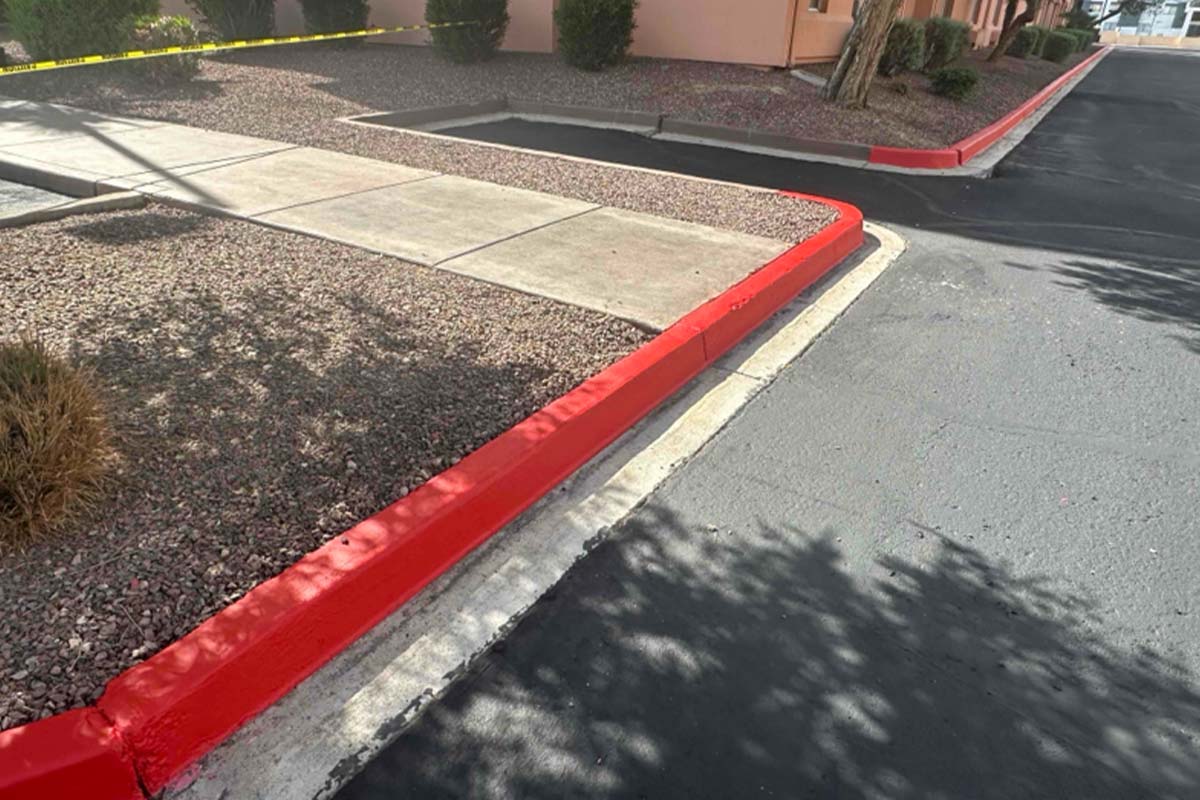
Fire lane striping is the set of markings that keep an emergency access route open: the boundary lines that define the lane, the painted curbs along it, the lettering inside it, the no-parking hatching at hydrants and building entrances, and the signs that accompany all of it. On most commercial properties it is a small part of the total striping work and by far the most consequential part, because it is the only marking on the lot whose purpose is to keep a fire truck moving.
This is also the marking most often done wrong, for a structural reason rather than a careless one. The requirements come from your local fire official, not from a national rulebook, and a contractor working across several towns has to actually check each one. We do, because in this territory the answer genuinely changes depending on which side of a municipal line your property sits.
What a Compliant Fire Lane Looks Like
Four things have to be right, and they are separable — a lot can pass on three and fail on the fourth.
- Clear width. The access road has to stay unobstructed to the width the fire code requires. Nothing may encroach on it: not a stall, not a dumpster enclosure, not seasonal storage.
- Boundary marking. The lane needs to be visibly defined so a driver can see where it starts and stops.
- Lettering and signage. The wording, the letter size, the spacing between repeats, and the sign type and mounting are set by the local fire official.
- Legibility over time. Faded is the same as unmarked. Maintaining the marking is an explicit ongoing duty, not a discretionary refresh.
Curb color is the one that surprises people. Red curbs are the convention across most of this area, but the color is a local requirement rather than something the model fire code specifies — which is exactly why we ask your fire official rather than assuming.
Who Sets the Rules on Your Property: Your Village Fire Official, or the City of Chicago
Illinois has no statewide fire code governing fire lane marking. The Office of the Illinois State Fire Marshal adopts NFPA 101, the Life Safety Code, at the state level, but apparatus-access marking on a private lot is adopted municipality by municipality. That leaves this territory running two different families of code at once, and the distinction is not academic:
In the suburbs, it is the International Fire Code as your village adopted it. Arlington Heights — where we are based — publishes it plainly: the Village adopted the 2018 International Fire Code effective March 1, 2020, with the local amendments in Chapter 27, Fire Regulations, of the Arlington Heights Municipal Code, and enforcement sits with the Village’s Building and Life Safety Department. You can read Chapter 27 on the Arlington Heights Municipal Code. Neighboring towns are not on the same edition — Wheeling, a few miles east, runs the 2021 IFC — so across Cook, Lake and McHenry the edition year and the local amendments both matter.
Inside the City of Chicago, the International Fire Code does not apply at all. The City runs its own Chicago Fire Prevention Code under Title 15 of the Municipal Code. Eight of the fifty-eight ZIP codes we serve are City of Chicago, so a property on one side of a boundary and a property on the other are under different documents with different requirements.
What that means for you is simple enough: before we stripe a fire lane we confirm which jurisdiction the property is in and what that jurisdiction’s fire official actually requires. Most of our competitors publish a single national answer, usually citing NFPA 1 — a model code Illinois adopts only for combustible vegetation, not for fire lane marking. For Illinois, that is simply the wrong document.
Fire Apparatus Access Road Marking Requirements
Where the International Fire Code governs, the relevant provisions sit in Chapter 5, Fire Service Features. Section 503 sets the dimensional requirements for a fire apparatus access road — an unobstructed width and an unobstructed vertical clearance, both of which the fire code official may increase for a specific property.
Section 503.3 is the marking provision, and its exact shape matters. Where required by the fire code official, approved signs or other approved notices or markings that include the words NO PARKING — FIRE LANE must be provided to identify fire apparatus access roads or prohibit their obstruction. Two things follow from that wording. First, the trigger is the fire code official’s requirement, which is why the answer to “do we need this?” is a phone call to your local bureau rather than an assumption. Second, the same section requires the means of designation to be maintained in a clean and legible condition at all times, and replaced or repaired when necessary to provide adequate visibility — the obligation does not end when the paint dries.
The Office of the Illinois State Fire Marshal is the state-level reference above all of this, and useful when you need to establish which authority applies to an unusual property type.
Fire Lane Marking and Fire Lane Painting for Existing Lots
On an existing lot, fire lane painting is usually a refresh rather than a redesign, and it runs alongside a restripe of the rest of the property. We repaint the boundary lines and curbs, restore the lettering at the required spacing, refresh no-parking hatching at hydrants and doors, and replace signage that has faded, bent or gone missing.
The redesign cases are worth knowing about, because they tend to surface during a routine repaint. If stalls have been added over the years and the lane is now narrower than the required clear width, repainting the existing lines certifies the encroachment rather than fixing it. If a building addition changed where the apparatus needs to reach, the old lane may be in the wrong place entirely. And if you have had an inspection finding, the correction is defined by the inspector’s notes, not by what was previously painted. In all three cases we will tell you what we have found before we quote the work, not after.
How a Fire Lane Job Runs, Step by Step
- Confirm the jurisdiction. Which municipality, and therefore which code family and which edition.
- Contact or reference the fire official’s requirement. Marking type, wording, lettering, spacing, signage and curb color are all local decisions.
- Measure the existing lane. Clear width first, against the requirement rather than against the old paint.
- Flag encroachments before painting. Stalls, enclosures or storage inside the lane are reported to you.
- Prepare and paint. Surface cleaned, boundary lines and curbs painted, lettering and hatching applied.
- Signage. Signs installed or replaced to the local specification where they are part of the scope.
Keeping Fire Lane Markings Legible
Maintenance is not a nicety here — it is written into the requirement. A fire lane whose lettering has worn to outlines and whose curb paint has gone pink is functionally unmarked, and it is the marking on your property most likely to be noticed in an inspection.
Winter is what drives the cycle in this territory. Plow blades scrape the raised edge off curb paint and floor lettering, deicing salt sits on the surface for months, and freeze-thaw works at every edge. In practice fire lane markings on a plowed property need attention more often than the rest of the lot, which is why we routinely quote them as a separate line item that can be refreshed on its own schedule rather than waiting for the whole lot to come due.
For a full list of our pavement marking services, visit our parking lot striping in NW Chicago page.
Businesses We Serve




How it Works

GET A FREE ESTIMATE
Contact us today and we’ll have a quote to you in 24 hours

SCHEDULE AN INSTALLATION
We’ll have your installation scheduled in less than 7 days, without affecting your business hours

GET A PARKING LOT THAT POPS
For a budget-friendly price, you’ll get a parking lot that looks like new
We proudly work with:


We proudly work with:


Frequently Asked Questions About Fire Lane Striping in NW Chicago, IL
What does the fire code require a fire lane to be marked with?
In a jurisdiction that applies the International Fire Code, and where the fire code official requires it, section 503.3 calls for approved signs, notices or markings carrying the words NO PARKING — FIRE LANE, provided to identify the apparatus access road or prohibit its obstruction. The specifics — lettering size, spacing between repeats, sign type, curb color — are set locally, which is why we confirm with your municipality before quoting rather than applying one template everywhere.
Does NFPA 1 apply to fire lanes in Illinois?
No, and this is a common error in contractor copy. Illinois incorporates NFPA 1 only in a narrow context relating to combustible vegetation. Fire lane apparatus-access marking is adopted municipality by municipality, almost always as an edition of the International Fire Code, and the City of Chicago does not use the IFC at all. If a striping quote cites NFPA 1 as your governing standard, it was written for a different state.
Who decides whether our property needs a fire lane?
Your local fire official. Under the model code, the requirement to mark is conditioned on the fire code official’s determination, and the dimensional requirements can be increased for a specific site. That is a municipal decision made about your property, not a formula. For properties in Wheeling it is the Village Fire Prevention Bureau; inside Chicago city limits it falls under the Chicago Fire Prevention Code instead.
How often do fire lane markings need repainting?
Whenever they stop being clean and legible, which the code frames as an ongoing duty rather than a fixed interval. On plowed commercial property in this area that generally means more often than the rest of the lot, because plow blades and deicing salt attack curb paint and lettering hardest. We usually quote fire lane striping refresh separately so it can be scheduled on its own cycle.
Can we park in a fire lane after hours or during deliveries?
No. The obstruction prohibition does not have an hours-of-operation exception, and a lane blocked for twenty minutes during a delivery is blocked for whatever happens in those twenty minutes. If deliveries are forcing vehicles into the lane, that is a layout problem worth solving with a marked loading zone somewhere else on the property.
Our lot failed a fire inspection. Can you fix it?
Yes, and the inspector’s findings are what define the scope. Bring us the notes. We will measure the existing lane against what is actually required for your jurisdiction, tell you whether the correction is a repaint or a layout change, and flag anything encroaching on the clear width — stalls, enclosures or storage — that painting alone will not resolve.