Parking Lot Restriping
In NW Chicago, IL
Restripe Existing Lines and Markings
1-800-STRIPER® provides professional parking lot restriping in NW Chicago, IL — refreshing faded lines, ADA stalls, fire lanes, and directional arrows with fast-dry traffic paint for commercial properties across Cook, Lake, and McHenry counties.
1-800-STRIPER of NW Chicago PROVIDes Restriping Services NEAR YOU
Need to brighten up your faded parking lot?
Keep your parking lot safe and attractive by restriping annually to freshen up lines and symbols that have faded from the sun, weather, and traffic. Nothing beats a fresh coat of paint!
Benefits:
What Parking Lot Restriping Covers
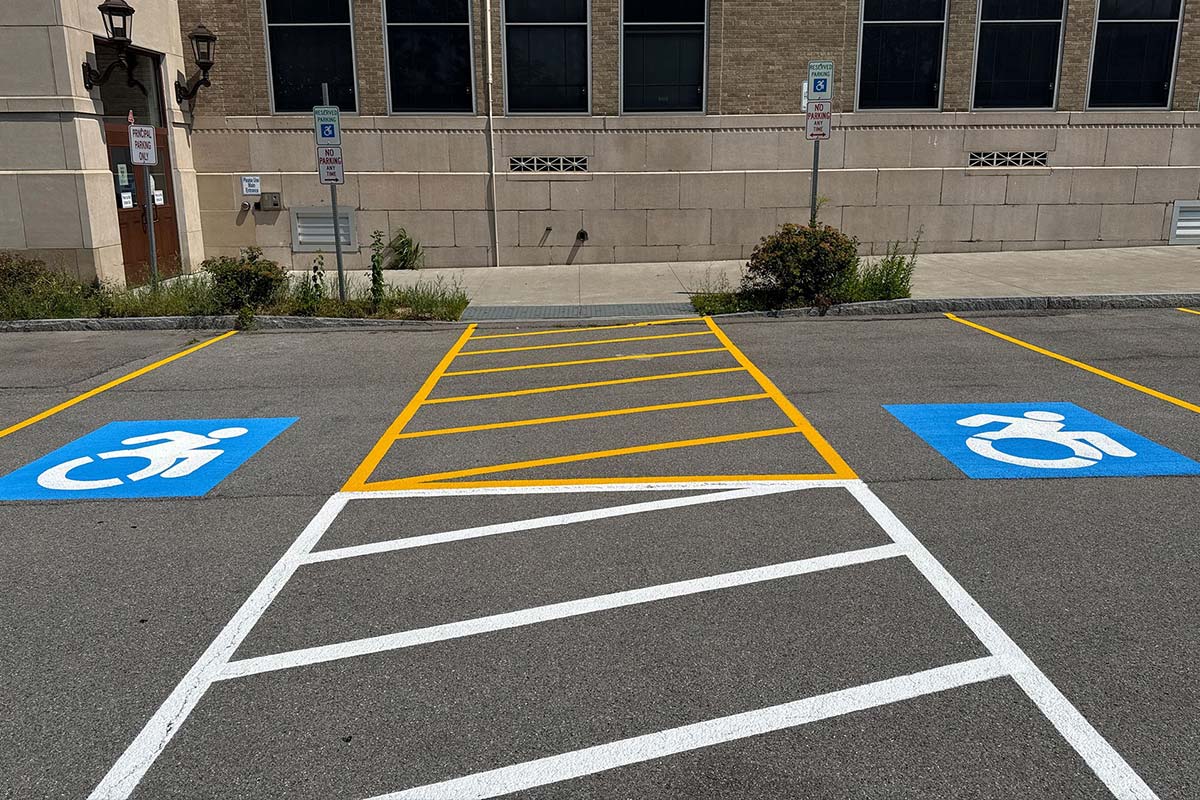
Restriping is repainting the markings a lot already has, on the layout it already has. Stalls, accessible spaces and their access aisles, fire lanes, directional arrows, crosswalks, loading zones, stall numbers, no- parking hatching, curbs — all of it goes back down in fresh traffic paint. Nothing about the geometry changes. If the lot is laid out sensibly and the only problem is that you can no longer see it, restriping is the whole job and it is finished in a day or two on most commercial properties.
That is worth separating from the other thing people mean when they call. If the layout itself is wrong — too few accessible spaces, an accessible route that does not reach the door, a fire lane that has been narrowed by a row of stalls someone added — then repainting it preserves the problem for another two years. We will say so before we quote it.
How to Tell It’s Time to Restripe
Faded paint is the obvious signal and the least useful one, because by the time a line looks faded from a standing position it has usually been unreadable from a moving car for months. Better tells:
- Drivers are parking crooked. When cars stop lining up square, the lines have stopped doing their job.
- The accessible symbols are ghosting. The blue is thin, the wheelchair symbol is patchy, or the access aisle hatching has worn to outlines. This is a compliance exposure, not a cosmetic one.
- Fire lane markings are unreadable. Legibility is an explicit maintenance duty under the fire code, not a matter of appearance.
- You are seeing pavement through the line. Traffic paint wears from the center of the wear path outward, so a line that is intact at the ends and gone in the middle has one season left at most.
- Snow removal took the tops off. Plow blades scrape the raised edge of a marking. A lot that looked fine in November can read as worn out in April.
What Gets Restriped
Everything that was marked gets restriped, but not everything is equally urgent. Standard stalls are cosmetic and operational. Accessible spaces, their access aisles and the International Symbol of Accessibility are compliance-critical. Fire lanes are life-safety. Directional arrows, stop bars and crosswalks govern circulation and are the markings most often skipped by cheap quotes.
On most jobs we also restripe items owners forget they have: loading zone boundaries, no-parking hatching in front of doors and hydrants, stall numbering on assigned-parking properties, speed bump markings, and painted curbs. If a marking was there when we arrived and it belongs there, it gets restriped.
Restriping vs. a New Layout
| Restriping | New layout | |
|---|---|---|
| What changes | Paint only | Stall positions, aisle widths, circulation |
| When it fits | Layout works, lines are worn | Capacity problem, compliance gap, new use |
| Compliance work | Correct in place where possible | Full re-check against current standards |
| Marking out | Follows existing lines | Chalked and walked before paint |
| Typical downtime | Hours to a day per section | Longer, phased |
| What it cannot fix | Wrong geometry | — |
The honest dividing line is whether the lot’s problems are visible or structural. Restriping fixes visible. It cannot fix a lot that has three accessible spaces where the standards call for five, and repainting one that is short does not make it compliant — it just makes the shortfall crisper.
How a Restripe Runs, Step by Step
- Walk the lot with you. We record what is there, flag anything non-compliant, and agree the scope.
- Clean the surface. Sweeping at minimum; pressure washing where there is oil film, tire rubber or heavy dirt. Paint bonds to pavement, not to what is sitting on it.
- Phase the work. On a live property we restripe in sections so parking stays available. Customers describe this in our Google reviews as the thing they noticed most.
- Lay the lines. Existing markings are the guide. Accessible spaces and fire lanes go down first.
- Cure and reopen. Each section stays coned until the paint has cured enough to take traffic.
- Walk it again. We check the finished work with you before we leave.
Repaint Intervals and Chicago’s Freeze-Thaw Cycle
Most commercial lots in this territory need restriping every one to three years, and where a given property falls in that band is mostly about traffic volume and about winter. Water enters a crack, freezes, expands it, and thaws — repeatedly, all season. Plow blades take the raised edge off markings. Deicing salt sits on the surface for months. A lot in Palatine or Buffalo Grove genuinely does age faster than the same lot would in a milder climate, and the National Weather Service Chicago office’s climate normals are the public record of why.
Practically, that means two things. The re-striping window here runs spring through late fall, and spring is crowded because every property manager reaches the same conclusion in the same three weeks. And a lot that was restriped in the fall will hold better through its first winter than one done in spring, because it goes into the cold season at full film thickness.
Paint, Thermoplastic, and Surface Prep
Most commercial parking lots are restriped in fast-dry waterborne traffic paint. It cures quickly enough to reopen a section the same day, it is the standard material for asphalt and concrete lots, and it is what almost every restripe in this territory uses. Thermoplastic is a heavier, longer-lived marking material used mainly on roadways and high-wear applications; it costs more, takes longer to install and is rarely the right answer for a standard commercial lot. If your property is a case where it makes sense, we will tell you, and we will tell you when it does not.
Surface preparation is the part that actually determines how long the work lasts, and it is the first thing cut from a low quote. A surface with dust, oil film or standing dirt gives the paint nothing to grip, and the line fails from underneath while still looking fine on top. The Illinois Department of Transportation’s manuals and guides publish the state’s pavement marking practice, including the Illinois Supplement to the National MUTCD, if you want the roadway reference — noting that a private parking lot is not governed by the MUTCD at all.
For a full list of our pavement marking services, visit our parking lot striping in NW Chicago page.
Businesses We Serve




How it Works

GET A FREE ESTIMATE
Contact us today and we’ll have a quote to you in 24 hours

SCHEDULE AN INSTALLATION
We’ll have your installation scheduled in less than 7 days, without affecting your business hours

GET A PARKING LOT THAT POPS
For a budget-friendly price, you’ll get a parking lot that looks like new
We proudly work with:


We proudly work with:

Frequently Asked Questions About Parking Lot Restriping in NW Chicago, IL
What does restriping a parking lot mean?
Parking lot restriping means repainting the markings your lot already has, on the layout it already has — stalls, accessible spaces and access aisles, fire lanes, arrows, crosswalks, loading zones and curbs, all reapplied in fresh traffic paint. Geometry does not change. If the layout itself needs to change, that is a new layout rather than a restripe, and it is a different job with a different scope.
How often should a parking lot be restriped?
Every one to three years for most commercial properties in this area, driven by traffic volume and by winter. A quiet office lot lasts longer than a grocery or medical lot that fills daily and gets plowed and salted all season. Rather than counting years, watch whether cars still park square to the lines and whether the accessible symbols and fire lane markings are still legible from a moving vehicle.
Is re-striping the same as sealcoating?
No, and they are frequently confused. Re-striping is the painted markings. Sealcoating is a surface treatment applied to asphalt, and it covers existing lines completely, which means anything sealcoated has to be restriped afterwards. We stripe; we do not sealcoat, pave or fill cracks. If your lot needs that work, have it done first and bring us in after — not in the reverse order.
How long does a restripe take and when can we reopen?
Most commercial lots are done in a day, larger ones in two. Because we work in sections, you never lose the whole lot at once — a section is coned while its paint cures and reopened when it will take traffic, and the crew moves on. Fast-dry traffic paint is chosen precisely so a live property can keep operating. Weather is the main variable, since we will not apply outside the product’s stated conditions.
Do you have to restripe the whole lot at once?
No. Partial restripes are common and sometimes the sensible call — the drive aisles and accessible spaces in one visit, the outer stalls the following season. The catch is appearance: fresh paint next to two-year-old paint is visibly different, and the contrast makes the older section look worse than it did before. We will tell you where that line falls on your property before you decide.
Do we need to restripe after sealcoating or repaving?
Yes, always. Both cover every existing marking, so the lot comes back as blank pavement with no stalls, no accessible spaces and no fire lanes. Schedule the striping as part of that project rather than as an afterthought, and let us see the layout before the surface work starts — once the old lines are gone, any error in the original geometry has to be measured from scratch rather than matched.