
Parking Lot Sign Installation
In Greenville, SC
ADA, Fire Lane, and Directional Signage
1-800-STRIPER provides professional parking lot sign installation in Greenville, SC — setting accessible-space signs, fire lane no-parking signs, directional signage, and the tow-away notice South Carolina law requires at commercial entrances for properties across the Upstate.
1-800-STRIPER® of Greenville PROVIDes Parking Lot Sign Installation Services NEAR YOU
Are you communicating clearly?
We install new signs in adherence with local regulatory standards and can repair or replace damaged signs so you can clearly communicate your parking requirements.
What Parking Lot Sign Installation Includes
Sign installation is the vertical half of a parking lot’s traffic control. Pavement markings tell a driver what is under the car; signs tell them what the rules are, and they keep telling them when the pavement is wet, dark or covered.
A scope on an Upstate commercial property covers accessible parking signs and their van-accessible designations, fire lane and no-parking signage, tow-away notices at entrances, directional and one-way signs, stop and yield signs at internal intersections, reserved and tenant space signs, speed and pedestrian-crossing signs, and the posts, sleeves, bases and fixings that hold all of it up.
Installation is the part that decides whether the sign survives. Post type, embedment, base detail and fixing are chosen against the location — landscaped island, asphalt, concrete walk, curb face, or wall mount — and against how the sign will be hit, because in a parking lot it eventually will be.
Signs are usually installed with a striping scope, since a sign’s position depends on the marking it identifies.
Accessible Parking Signs
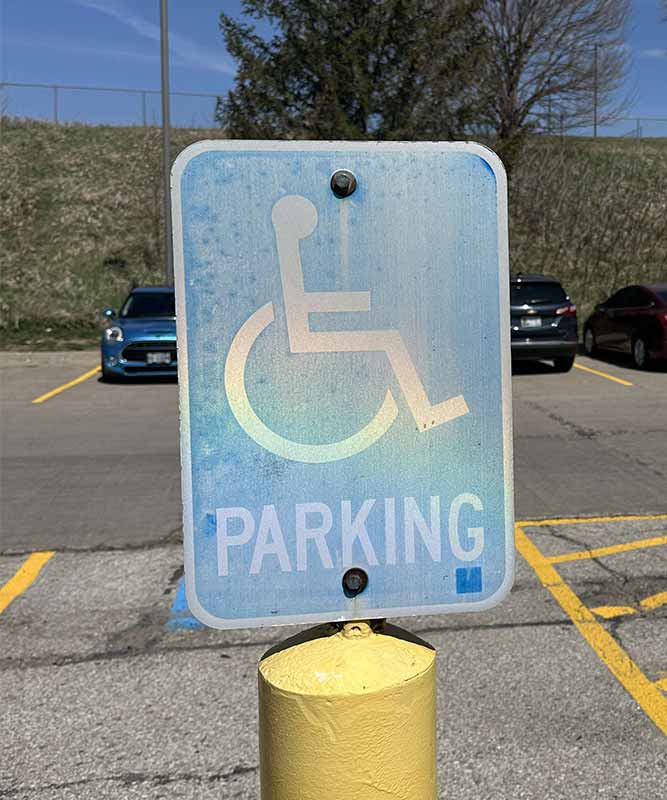
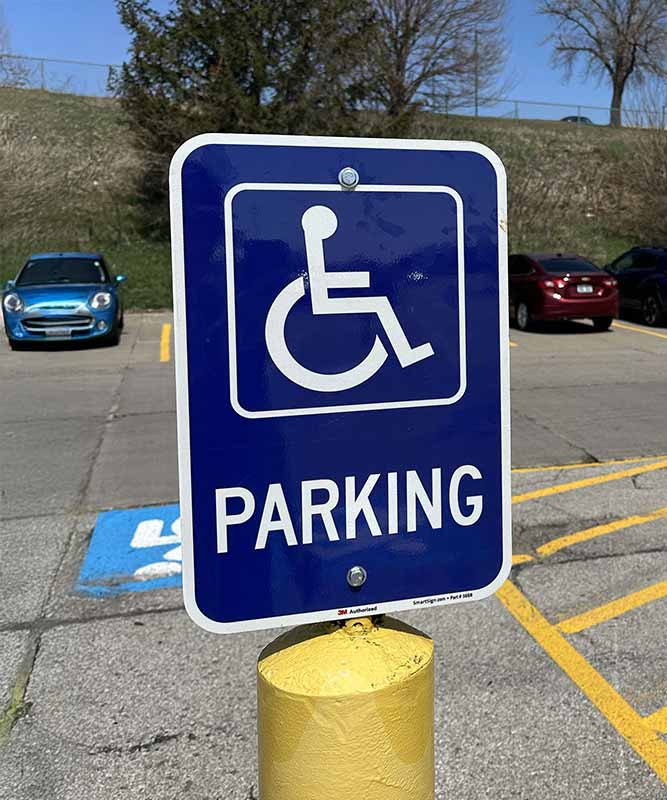
Accessible parking signage is the one category with a federal dimension attached, and it is the one we most often find installed incorrectly.
Section 502.6 of the 2010 ADA Standards for Accessible Design requires that parking space identification signs include the International Symbol of Accessibility complying with Section 703.7.2.1, that signs identifying van parking spaces contain the designation “van accessible,” and that signs be 60 inches minimum above the finish floor or ground surface, measured to the bottom of the sign.
That last requirement is where installations fail. Sixty inches is measured to the bottom edge of the sign, not to its center, not to the top of the sign, and not to the top of the post. An otherwise perfect sign whose lower edge sits at 48 inches does not comply, and that is the defect we correct most frequently on existing Greenville lots.
The Standards’ advisory to Section 502.6 makes a further point worth knowing: the “van accessible” designation is intended to be informative, not restrictive, identifying spaces better suited to van use, and enforcement of motor vehicle laws and parking privileges is a local matter. In other words, the federal standard governs how the space is identified; who may park there and what happens if they should not is state and local law.
State building code or the local authority having jurisdiction can add requirements on top of the federal minimum. We confirm the local layer before ordering signs, since Section 502.6 is not always the whole specification.
Fire Lane and No-Parking Signs
Fire lane signage on a Greenville commercial property is governed by the 2021 South Carolina Fire Code, and the requirement is more specific about wording than about hardware.
Section 503.3 requires that, where required by the fire code official, approved signs or other approved notices or markings that include the words NO PARKING—FIRE LANE be provided for fire apparatus access roads to identify them or prohibit their obstruction. It further requires that the means by which fire lanes are designated be maintained in a clean and legible condition at all times and be replaced or repaired when necessary to provide adequate visibility.
Three consequences follow. The wording is fixed. The signs must be *approved* — by the fire code official, not merely purchased. And a faded, bent or missing fire lane sign is an active code issue under the maintenance clause, not a deferred item.
What the section does not fix is equally important: it sets no sign size, no letter height, no mounting height and no spacing interval between signs. Those are your fire code official’s determination — in the City of Greenville, the fire marshal under Section 6-443 of the City Code of Ordinances. Anyone quoting you a state-wide fire lane sign specification is describing local practice as code.
Section 503.4 is the reason the signage exists at all: fire apparatus access roads shall not be obstructed in any manner, including the parking of vehicles, and the minimum widths and clearances must be maintained at all times.
Tow-Away Notice Signs on Commercial Property in South Carolina
This is the sign most South Carolina commercial properties need and most do not realize is statutory — and the statute is not where you would look for it.
South Carolina Code Section 16-11-760 sits in Title 16, the criminal code, and not in Title 56, motor vehicles. Subsection (A) makes it unlawful for a person to park a vehicle on the private property of another without the owner’s consent, and then adds the requirement that matters to a property owner: if the property is for commercial use, the owner must post a notice in a conspicuous place on the borders of the property near each entrance prohibiting parking. The same subsection states that proof of the posting is considered notice conclusive against the person making entry.
Read that carefully, because it defines the sign program.
“Near each entrance” — not one sign at the main door. Every entrance to the property needs one. “On the borders of the property” — at the perimeter where a driver enters, not deep inside the lot where they see it after parking. “In a conspicuous place” — visible on approach, at the driver’s eye line, not behind landscaping that has grown over it since installation. “Proof of the posting is considered notice conclusive” — which is why photographing each installed sign with its location, and keeping those records, is worth doing on the day of installation.
The practical failure we see is a property with a single tow-away sign at the front entrance and three other unmarked entrances. We survey the entrances first and post to what the statute asks for.
Sign Mounting Height and Post Embedment Table
| Item | Requirement | Source |
|---|---|---|
| Accessible parking sign height | 60 in minimum above the finish floor or ground, measured to the bottom of the sign | 2010 ADA Standards 502.6 |
| Accessible parking sign symbol | Must include the International Symbol of Accessibility | 2010 ADA Standards 502.6 / 703.7.2.1 |
| Van space sign wording | Must contain the designation “van accessible” | 2010 ADA Standards 502.6 |
| Fire lane sign wording | Must include the words NO PARKING—FIRE LANE | 2021 SCFC 503.3 |
| Fire lane sign approval | Must be approved by the fire code official | 2021 SCFC 503.3 |
| Fire lane sign maintenance | Clean and legible at all times; replaced or repaired for adequate visibility | 2021 SCFC 503.3 |
| Fire lane sign size, letter height, mounting height, spacing | Not specified in the code | Fire code official’s determination |
| Tow-away notice, commercial property | Notice posted in a conspicuous place on the borders of the property near each entrance | S.C. Code Section 16-11-760(A) |
| Tow-away notice, evidentiary effect | Proof of posting is conclusive notice against the person making entry | S.C. Code Section 16-11-760(A) |
| Post embedment depth | No universal published figure | Sign and post manufacturer’s installation instructions, plus local soil and wind conditions |
| Post type, base and fixing | Selected against the mounting location | Manufacturer’s instructions |
The embedment row is deliberately blunt, because it is the question people most often arrive at this page asking, and the answer is not a number. There is no single published embedment depth that applies to every sign, post and site. It is a function of the post type and section, the sign area catching wind, the soil, and whether the base is a concrete footing, a driven anchor, a surface-mounted flange or a sleeve. The specification that governs your install is the post and sign manufacturer’s installation instruction. Any contractor who quotes you a universal figure without asking what post and sign you are using is guessing.
For a full list of our pavement marking services, visit our parking lot striping in Greenville page.
Businesses We Serve




How it Works

GET A FREE ESTIMATE
Contact us today and we’ll have a quote to you in 24 hours

SCHEDULE AN INSTALLATION
We’ll have your installation scheduled in less than 7 days, without affecting your business hours

GET A PARKING LOT THAT POPS
For a budget-friendly price, you’ll get a parking lot that looks like new
We proudly work with:


We proudly work with:


Frequently Asked Questions About Parking Lot Sign Installation in Greenville, SC
How high should a sign be posted at a parking facility?
For accessible parking signs the answer is fixed: Section 502.6 of the 2010 ADA Standards requires 60 inches minimum above the finish floor or ground surface, measured to the bottom of the sign. That is the bottom edge, not the center and not the top of the post, which is the detail most commonly missed. For fire lane signs the 2021 South Carolina Fire Code sets no mounting height — that is the fire code official’s determination. For other parking signs, height is set by sightlines and local requirements.
What size are parking lot signs?
There is no single answer, because different sign types are governed by different things. Accessible parking signs must carry the International Symbol of Accessibility and, for van spaces, the “van accessible” designation, but the 2010 ADA Standards set a mounting height rather than a panel size. Fire lane signs must carry the words NO PARKING—FIRE LANE and be approved by the fire code official, who determines size and letter height locally. Tow-away notices must be conspicuous. We confirm each category with the governing authority before ordering.
How is a sign post set in concrete?
The governing specification is the post and sign manufacturer’s installation instruction, not a universal rule, because embedment depends on post type and section, the sign area catching wind, the soil, and whether the base is a poured footing, a driven anchor, a surface-mounted flange or a sleeve. Where a footing is used, the hole is dug and cleared, the post is set plumb and braced, and the concrete is placed and allowed to cure before the sign panel goes on. Setting the panel before the concrete cures is how leaning posts happen.
Does South Carolina require a tow-away sign on private commercial property?
Effectively, yes, if you want the parking prohibition to bind. S.C. Code Section 16-11-760(A) makes it unlawful to park on another’s private property without consent, and provides that where the property is for commercial use, the owner must post a notice in a conspicuous place on the borders of the property near each entrance prohibiting parking, with proof of the posting considered conclusive notice against the person entering. Note “each entrance” — one sign at the main door does not satisfy it. We survey entrances before quoting.
What signs does an accessible parking space need?
At minimum, an identification sign carrying the International Symbol of Accessibility, mounted 60 inches minimum above the ground to the bottom of the sign, under Section 502.6 of the 2010 ADA Standards. Spaces identified for van use must additionally carry the designation “van accessible.” The Standards’ advisory notes that designation is informative, not restrictive, with enforcement of parking privileges left to local law. State building code or your local authority may add requirements, so we confirm the local layer before ordering. Call for a free estimate.