Temporary Parking Lot Striping
In Greenville, SC
Event and Construction Markings
1-800-STRIPER provides professional temporary parking lot striping in Greenville, SC — short-duration event markings, construction-phase layouts, and overflow parking on grass, gravel, pavement, or any surface using removable water-based traffic paint for commercial properties across the Upstate.
1-800-STRIPER® of Greenville PROVIDes Temporary Parking Lot Striping Services NEAR YOU
Need Temporary Stripes?
Use temporary stripes to direct traffic and create parking areas at your special event or to keep construction sites safe without a long-term commitment. We paint on grass, gravel, pavement, or any other surface where temporary striping is needed.
Striping solutions for:
What Temporary Parking Lot Striping Includes
Temporary striping solves a problem permanent striping cannot: parking that needs to exist for a weekend, a season or a construction phase, on ground that may not be pavement at all.
The scope covers event and overflow parking layouts, construction-phase and phased-closure markings, short-term reconfigurations during a tenant fit-out or a resurfacing project, seasonal capacity on fields and gravel areas, and the removal or fade-out of all of it afterwards.
The materials and the method are chosen backwards from a single question: when does this need to stop existing? A layout that has to disappear after a three-day event is a different job from one that has to survive eight months of a construction schedule and then come out cleanly.
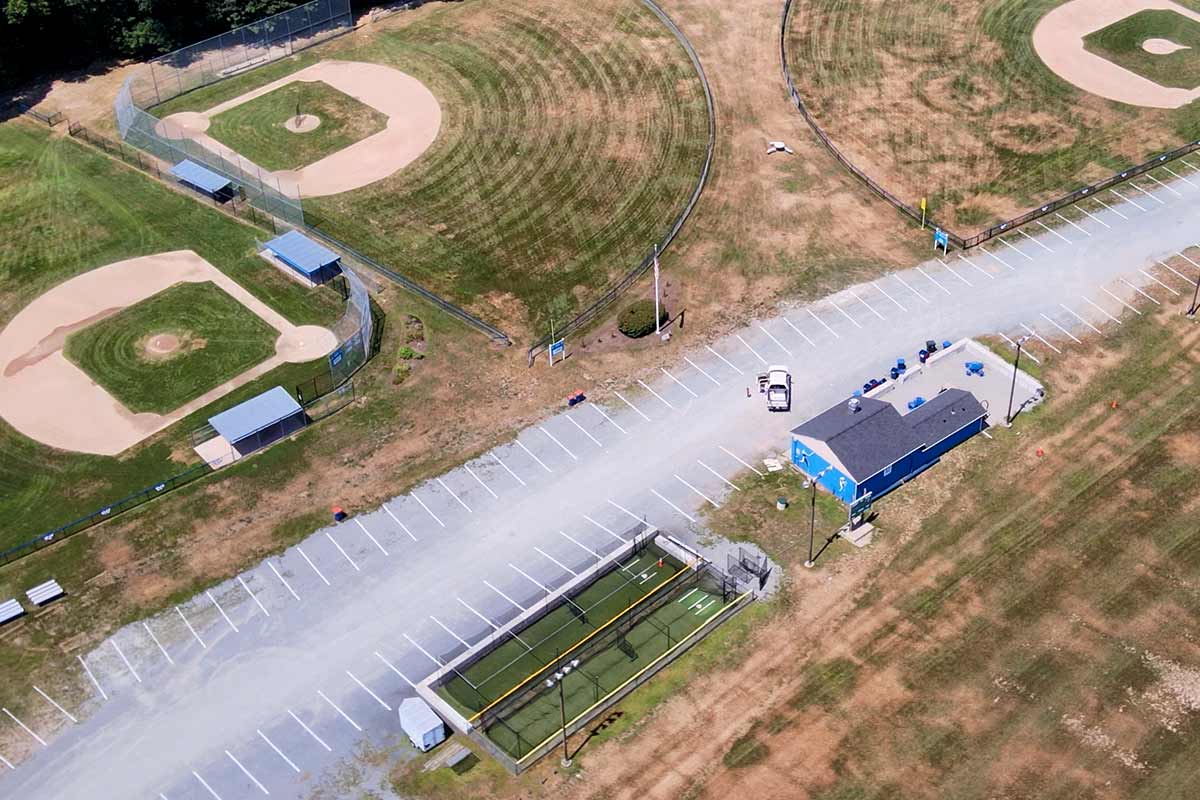
We work on grass, gravel, pavement and any surface a property has. That is not a slogan — it is the practical reality of overflow parking in the Upstate, where the spillover area is far more often a field or a gravel apron than a paved lot with room to spare.
Event and Overflow Parking on Grass
Grass is the most common overflow surface and the one people assume cannot be striped. It can.
Marking grass uses a removable water-based marking paint formulated for turf, applied in a layout laid out the same way a paved lot would be — measured rows, defined aisles, entry and exit routes, and pedestrian corridors separated from vehicle movement. The paint holds long enough for the event and then fades or mows out.
The design questions on turf are different from pavement, though, and they are where a layout earns its keep. Ground condition governs everything: a field that is fine on a dry Saturday becomes impassable after Thursday rain, so the layout needs an exit route that does not require vehicles to cross the lowest ground. Rows are usually run with the slope, not across it. Entry and exit are separated so arriving traffic does not meet departing traffic on a single track. And the pedestrian route from the parking area to the venue gets marked deliberately, because on grass there is no curb telling people where to walk.
For churches, schools, festivals, sports facilities and corporate events, that layout is the difference between a field full of cars and a field full of cars people can get out of.
Striping on Gravel and Unpaved Lots
Gravel is harder than grass, and on loose aggregate, paint is a compromise.
Marking material sits on individual stones instead of a continuous surface, so a painted line on gravel is legible from a distance but breaks up under traffic as the stones move. On a compacted, well-graded gravel surface with a fine top course, painted markings work reasonably and last through an event or a season. On loose, coarse aggregate they do not, and we will say so rather than take the job and let you discover it.
Where paint is not the right answer, layout can still be delivered physically: rope-and-stake lines, cones on measured centers, temporary wheel stops, or marker posts defining aisles and rows. Those cost more to place and remove but they actually hold on the surface.
The other option worth considering on an unpaved area that is being used repeatedly is to stabilize and pave a defined portion instead of fighting the surface annually.
Temporary Markings on Pavement
On asphalt or concrete, temporary striping is straightforward and the choice is really about removal.
Removable water-based traffic paint is the standard for short-duration work: it applies fast, reads clearly, and is designed to come off without the aggressive removal that a permanent marking needs. For a lot being reconfigured during a resurfacing project or a tenant change, it lets a layout be tested in real traffic before anything permanent is committed — a genuinely useful thing to do when a property manager and a tenant disagree about circulation.
Temporary tape is the alternative where the marking must be crisp, must go down without cure time, and must come up on a fixed date. It suits interior decks, short-duration events on structured parking, and any situation where the lot has to reopen immediately.
Where a temporary layout overlaps a permanent one, contrast matters more than color convention: a driver has to be able to tell at a glance which set of lines is currently in force. Blacking out the old pattern in the affected area is often the safest approach for a phase that lasts more than a few weeks.
Construction-Phase and Phased-Closure Striping
Construction phasing is where temporary striping does its most valuable work, because the lot has to keep functioning through a sequence of layouts that each last a few weeks.
A phasing scope typically covers the marked layout for each phase, the temporary accessible parking that has to exist in every phase, temporary pedestrian routes around the work zone, directional markings redirecting circulation, and the removal or overmarking of the previous phase’s lines at each changeover.
The accessible parking is the part that gets missed. When a phase closes the section of lot containing the accessible spaces, those spaces have to be relocated for the duration, not written off, and the temporary spaces need the same geometry and the same route to the entrance as the permanent ones. Planning that at the start of the project, when the phasing plan is drawn, is far cheaper than discovering it at phase three.
We work to the project’s phasing plan and the general contractor’s schedule, and mark each changeover as its own mobilization.
How Temporary Markings Are Removed
Removal is designed in at the start, not improvised at the end.
On turf, removable marking paint is intended to fade with weathering and mowing, so most event layouts need no removal step at all beyond time. On pavement, removable water-based paint is formulated to come off with far less aggression than a permanent marking, and the method is matched to the substrate — what is safe on sound concrete can scar a thin asphalt overlay. Tape lifts cleanly on a defined date, which is its main advantage. Physical layout elements — cones, stakes, temporary wheel stops, marker posts — are collected.
The failure mode to avoid is using permanent material for a temporary job. A permanent traffic paint applied for a three-week phase has to be removed like a permanent marking, and that removal can leave a scar on the pavement more visible than the line was. Choosing the material against the duration at quote time is what prevents that.
Surface and Duration Comparison Table
| Surface | Typical use | Method | Removal |
|---|---|---|---|
| Grass / turf | Event and overflow parking, festivals, sports days | Removable water-based turf marking paint | Fades with weathering and mowing; usually no removal step |
| Gravel, fine and compacted | Seasonal overflow, rural venues | Removable water-based paint on the top course | Weathers out; touch-up between uses |
| Gravel, loose and coarse | Overflow where paint will not hold | Physical layout: cones, stakes, marker posts, temporary wheel stops | Collected |
| Asphalt | Construction phasing, tenant changes, trial layouts | Removable water-based traffic paint | Removal method matched to the pavement; gentler than permanent removal |
| Concrete | Interior decks, structured parking, short events | Removable paint or temporary tape | Tape lifts on a fixed date; paint removed to method |
| Any surface, one weekend | Single-event parking | Paint on turf or gravel; tape or cones on pavement | Time, or collection |
For a full list of our pavement marking services, visit our parking lot striping in Greenville page.
Businesses We Serve




How it Works

GET A FREE ESTIMATE
Contact us today and we’ll have a quote to you in 24 hours

SCHEDULE A STRIPING
We’ll have your space restriped in less than 7 days, without affecting your business hours

GET A PARKING LOT THAT POPS
For a budget-friendly price, you’ll get a parking lot that looks like new
We proudly work with:


We proudly work with:

Frequently Asked Questions About Temporary Parking Lot Striping in Greenville, SC
Can parking lot lines be striped on grass or gravel?
Yes to both, with different methods. Grass takes a removable water-based marking paint formulated for turf and holds the layout through an event before fading with weather and mowing. Gravel depends on the aggregate: a compacted surface with a fine top course takes paint reasonably well, while loose coarse stone does not hold a line under traffic. On loose gravel we lay the layout out physically instead, using cones on measured centers, stakes, marker posts or temporary wheel stops.
How long does temporary striping last?
That is the design input rather than the outcome, and we choose materials backwards from your end date. Turf paint is intended to weather and mow out over a short period. Removable water-based paint on pavement holds for a construction phase and then comes off without aggressive removal. Tape holds until it is lifted on a fixed date. Tell us when the layout has to stop existing and we specify to that, because using a permanent material for a short job creates a removal problem worse than the marking.
How is temporary striping removed?
By the method the material was chosen for. Turf markings need no removal step — they fade with weathering and mowing. Removable water-based paint on pavement comes off with a far gentler method than permanent traffic paint requires, matched to the substrate, because aggressive removal that is safe on sound concrete can scar a thin asphalt overlay. Tape lifts cleanly on a defined date. Physical layout elements are simply collected. Removal is planned at quote time, not improvised at the end.
What paint is used for temporary striping?
Removable water-based traffic paint on pavement, and a removable water-based marking paint formulated for turf on grass. Both are chosen because they come off without the aggressive removal a permanent marking demands. On gravel the same water-based paint is used where the top course is fine and compacted enough to hold it. Where the marking must go down without cure time and come up on a fixed date, temporary tape replaces paint entirely. The duration drives the choice.
Can temporary striping support a construction phasing plan?
That is one of its main uses. We work to the project phasing plan and mark each phase as its own mobilization: the layout for that phase, temporary pedestrian routes around the work zone, redirected circulation, and removal or overmarking of the previous phase’s lines at changeover. The item that most often gets overlooked is temporary accessible parking — when a phase closes the section holding the accessible spaces, those spaces need relocating with the same geometry and the same route to the entrance, and planning that up front costs far less than retrofitting it mid-project.