ADA Parking Lot Striping
In NW Chicago, IL
ADA-Compliant Accessible Parking
1-800-STRIPER® provides ADA-compliant parking lot striping in NW Chicago, IL — laying out accessible spaces, van-accessible stalls, access aisles, ISA symbols, and required signage per the 2010 ADA Standards for Accessible Design and the Illinois Accessibility Code.
1-800-STRIPER® of NW Chicago PROVIDes ADA Compliance Services NEAR YOU
Need to make your property more accessible?
Upgrade your facility to become fully ADA compliant by partnering with us to create clear, accessible parking for all your visitors.
Our ADA Compliant line striping services include:
What ADA Parking Lot Striping Covers
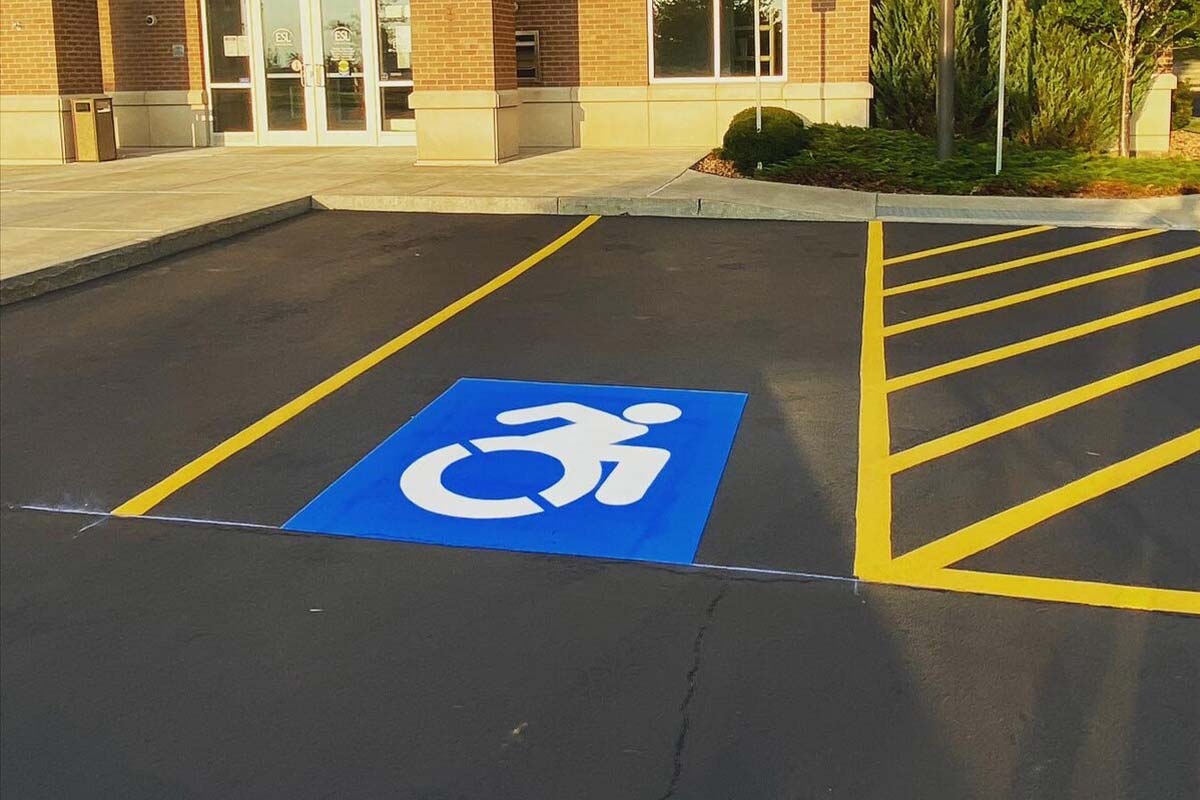
ADA parking lot striping is the accessible portion of your lot done to standard: the accessible spaces themselves, the access aisles beside them, the striping that marks both, the International Symbol of Accessibility painted on the surface, the signage that identifies each space, and the accessible route running from those spaces to the entrance they serve.
Think of it as a system rather than a paint job. An accessible space of the correct width with no compliant access aisle does not work. A correct space and aisle that sit at the far end of the lot from the door do not work. A perfect layout with a sign that is too low, or missing its van-accessible designation, does not work. Almost every non-compliant lot we are asked to look at has most of it right and one element wrong — which is also why repainting an existing layout without re-checking it is the most common way properties stay non-compliant for years.
How Many Accessible Spaces Your Lot Needs
The count comes from Table 208.2 of the 2010 ADA Standards for Accessible Design and is driven by the total number of spaces in the parking facility:
| Total spaces in lot | Minimum accessible spaces required |
|---|---|
| 1 to 25 | 1 |
| 26 to 50 | 2 |
| 51 to 75 | 3 |
| 76 to 100 | 4 |
| 101 to 150 | 5 |
| 151 to 200 | 6 |
| 201 to 300 | 7 |
| 301 to 400 | 8 |
| 401 to 500 | 9 |
| 501 to 1000 | 2 percent of the total |
| 1001 and over | 20, plus 1 for each 100 or fraction over 1000 |
On top of the count, section 208.2.4 requires that at least one in every six accessible spaces — or fraction of six — be van accessible. So a lot with four accessible spaces needs one of them to be van accessible; a lot with seven needs two.
Placement is a separate requirement and it is the one most often missed. Section 208.3.1 requires accessible spaces to sit on the shortest accessible route to the accessible entrance they serve. Counting correctly and placing them at the wrong end of the lot still fails.
Accessible Space and Access Aisle Geometry
Section 502 sets the dimensions. Accessible spaces for cars must be at least 96 inches wide; van spaces must be at least 132 inches wide, with an exception permitting a 96-inch-wide van space where its access aisle is also 96 inches wide. Both must be marked to define the width and both must have an adjacent access aisle.
The access aisle is where most existing lots come apart:
- Width. Access aisles serving car and van spaces must be at least 60 inches wide.
- Length. The aisle has to run the full length of the spaces it serves, not stop short.
- Marking. It must be marked so as to discourage parking in it — this is what the diagonal hatching is for.
- Location. An access aisle may not overlap the vehicular way, and angled van spaces must have the aisle on the passenger side.
- Sharing. Two adjacent spaces are allowed to share a single access aisle.
Two requirements are properties of the pavement rather than of the paint, and no amount of striping fixes them: section 502.4 requires surface slopes no steeper than 1:48 in all directions across the space and its aisle, and section 502.5 requires 98 inches of vertical clearance at van spaces, their access aisles, and the vehicular route serving them. We measure both, and if either fails we will tell you before we paint rather than leaving you with a compliant-looking space that is not.
ISA Symbols, Signage, and Mounting Height
Section 502.6 governs identification. Each accessible space needs a sign carrying the International Symbol of Accessibility. Signs identifying van spaces must additionally carry the designation “van accessible”. And the sign has to sit at least 60 inches above the finished floor or ground, measured to the bottom of the sign — which is why signs mounted on a low bollard, or knocked down and reinstalled lower, are such a frequent finding.
The painted symbol on the surface is what most people picture when they think of accessible parking, and it matters for legibility and for enforcement, but the sign is the element the standards actually specify. Both should be present and both should be maintained; a painted symbol that has worn to a ghost is doing none of the work it was put there to do. The U.S. Access Board’s guide to Chapter 5, Parking is the plain-language version of all of this and a reasonable thing to read before you commission the work.
The Illinois Accessibility Code — the State Layer on Top of the ADA
The ADA is the federal floor. Illinois adds its own layer on top of it: the Illinois Accessibility Code, 71 Illinois Administrative Code Part 400, administered by the Illinois Capital Development Board and published with its enabling statute on the Capital Development Board’s laws and rules page.
Two practical points follow. First, where the state code and the federal standards differ, the more stringent requirement is the one that governs your property — so checking only the ADA is checking half the question in Illinois. Second, the state code reaches a defined set of public facilities and buildings, and whether your particular property is inside that set is a question worth resolving before design rather than after construction.
We are a striping contractor, not a code consultant, and we say that plainly: on a complex or unusual property the right sequence is to have the applicable requirements confirmed by your architect or a code professional, and then have us mark the lot to that determination. On the ordinary commercial lot — an office building, a retail strip, a medical suite, a church, a restaurant — the requirements are well settled and we can lay it out against them directly.
Handicap Parking Striping for Existing Lots
Most people searching for this work call it handicap parking striping, and that is what we are describing — “accessible parking” is the current term in the standards, but the job is the same one. On an existing lot it almost always starts as a repaint request and turns into a compliance question the moment we measure.
The sequence we use: count the total spaces and derive the required accessible count from Table 208.2; check how many accessible spaces exist and how many are van accessible; measure each space and access aisle for width, length and slope; check the route from those spaces to the entrance; and check every sign for symbol, van designation and mounting height. What comes back is a list of what already complies, what can be corrected with paint, and what cannot — the slope and vertical clearance items in particular.
Correcting with paint is often cheaper and simpler than owners expect, because the most common failures are aisle width, aisle marking, and missing van designation, all of which are striping and signage work. The expensive findings are the pavement ones. Knowing which you have before you commission a restripe is the entire value of measuring first.
Working with ADA Line Striping Contractors in NW Chicago
If you are comparing ADA line striping contractors in this area, the questions worth asking are narrow. Will they measure the existing accessible spaces and aisles, or just repaint what is there? Do they check slope and vertical clearance, or only the flat dimensions? Do they know that Illinois adds a state accessibility code on top of the federal standards? Will they tell you when a finding cannot be fixed with paint?
We serve forty-six towns across Cook, Lake and McHenry counties from Arlington Heights, so accessible parking work in Des Plaines, Schaumburg, Evanston, Skokie, Palatine, Mount Prospect, Northbrook, Glenview, Wheeling and the rest of the territory is routine rather than a special trip. Call (847) 449-8501 for a free estimate, and ask us to measure the accessible spaces even if all you wanted was a repaint. Same visit either way.
For a full list of our pavement marking services, visit our parking lot striping in NW Chicago page.
Businesses We Serve




How it Works

GET A FREE ESTIMATE
Contact us today and we’ll have a quote to you in 24 hours

SCHEDULE AN INSTALLATION
We’ll have your installation scheduled in less than 7 days, without affecting your business hours

GET A PARKING LOT THAT POPS
For a budget-friendly price, you’ll get a parking lot that looks like new!
We proudly work with:


We proudly work with:


Frequently Asked Questions About ADA Parking Lot Striping in NW Chicago, IL
How many handicap parking spaces does our lot need?
It depends on the total number of spaces. Table 208.2 of the 2010 ADA Standards sets the minimum: one accessible space for a lot of 1 to 25, two for 26 to 50, three for 51 to 75, four for 76 to 100, and so on up to 2 percent of the total for lots of 501 to 1000. Separately, at least one in every six accessible spaces — or fraction of six — must be van accessible.
How wide does an accessible parking space have to be?
At least 96 inches for a car space and at least 132 inches for a van space, with an exception allowing a 96-inch van space where its access aisle is also 96 inches wide. Every accessible space needs an adjacent access aisle at least 60 inches wide, running the full length of the space, marked to discourage parking in it. Both the space and the aisle must be marked to define the width.
How do you stripe a handicap parking space?
Set the space at the required width with its access aisle alongside, mark both to define their width, hatch the aisle so it reads as no-parking, and paint the International Symbol of Accessibility in the space. Then the sign: symbol, van-accessible designation where applicable, mounted at least 60 inches above the ground to the bottom of the sign. Placement matters too — the space must sit on the shortest accessible route to the entrance.
Can you just repaint our existing accessible spaces?
We can, but ADA parking lot striping on an existing lot starts with measuring what is already there. Repainting a layout that was never compliant preserves the problem in fresh paint. The common correctable failures are access aisle width, aisle marking and missing van designation. The findings that paint cannot fix are surface slope steeper than 1:48 and insufficient vertical clearance at van spaces, since both are properties of the pavement.
Does the Illinois Accessibility Code apply as well as the ADA?
Yes, for the facilities it covers. Illinois maintains its own accessibility code — 71 Illinois Administrative Code Part 400, administered by the Capital Development Board — that sits alongside the federal standards. Where the two differ, the more stringent requirement governs. Checking only the federal standards answers half the question on an Illinois property, which is one reason we raise it before the work rather than afterwards.
Can you paint lines in a parking lot yourself, or does it need a contractor?
Nothing stops a property owner from painting their own lot, but the accessible spaces are where that goes wrong. The dimensions, aisle marking, symbol, signage and placement are all specified, the slope has to be verified rather than assumed, and a space that misses one element is non-compliant even if it looks right. That exposure is usually why owners bring in a contractor for the accessible portion at minimum.
How do we know if our lot is currently compliant?
Have it measured. We walk the property, derive the required accessible count from the total space count, check the existing count and van ratio, measure each space and aisle for width, length and slope, verify the route to the entrance, and check every sign for symbol, designation and mounting height. You get a list of what complies, what paint can correct, and what needs pavement work. Call (847) 449-8501 to arrange it.