
Wheel Stop Installation
In Myrtle Beach, SC
Concrete and Rubber Parking Stops
1-800-STRIPER provides professional wheel stop installation in Myrtle Beach, SC — anchoring concrete wheel stops, plus rubber and composite units, at stall heads so parked cars and vans cannot overhang the accessible routes the 2010 ADA Standards for Accessible Design protect.
1-800-STRIPER® of Myrtle Beach PROVIDes Wheel Stop Installation Services NEAR YOU
Need to protect vehicles or walls from accidental damage?
Wheel stops (also called parking blocks) protect your property, enhance safety, and improve parking lot organization.
Benefits:
Wheel stops prevent vehicles from parking too far into a space or overextending into other spots, pedestrian walkways, and other areas, while also helping with vehicle alignment. They can prevent damage to buildings, curbs, or landscaping. Wheel stops also serve as clear visual cues for proper parking and are sometimes used on slopes to prevent cars from rolling.
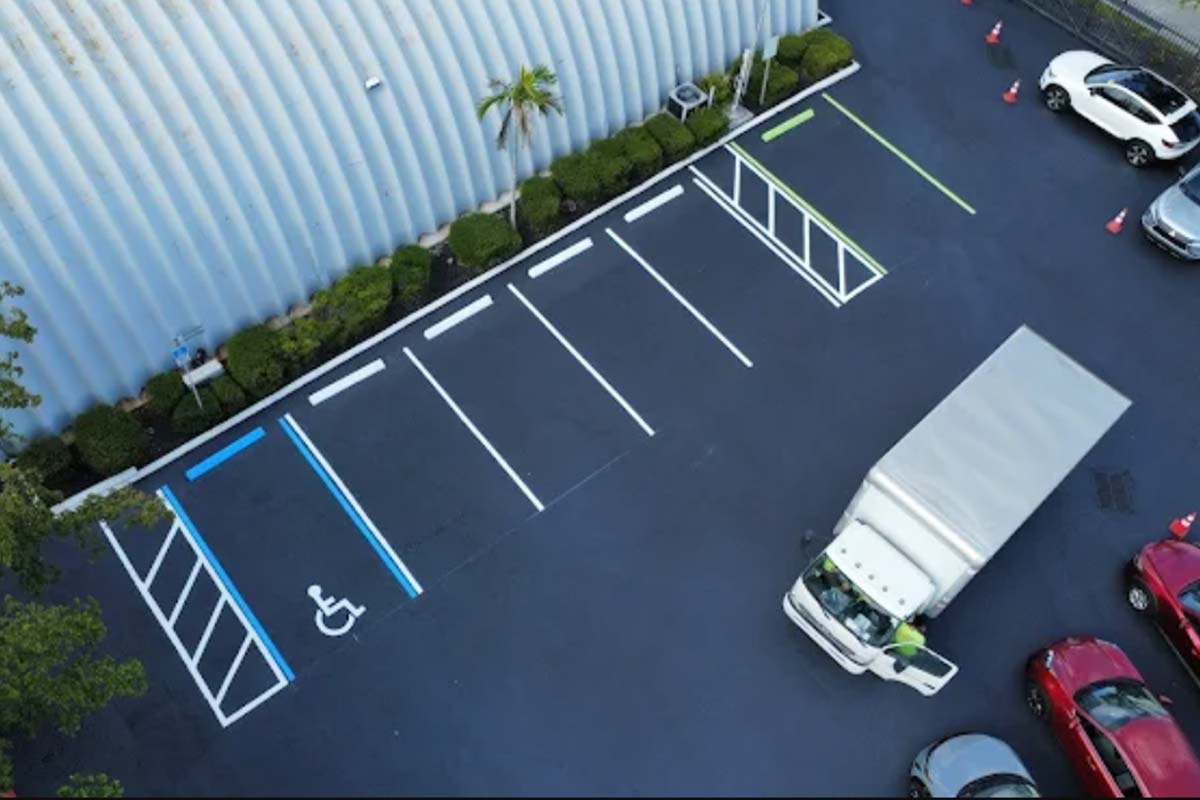
Wheel Stop Installation in Myrtle Beach, SC
Wheel stop installation in Myrtle Beach covers supplying and anchoring the barriers at the head of a parking stall that stop a vehicle before it reaches whatever is behind it: a walkway, a storefront, a landscaped bed, a neighboring stall or an accessible route. We install on new lots, retrofit existing ones, and replace units that have cracked, shifted or lost their anchors.
They are a small item that solves several problems at once, which is why they turn up in accessibility remediation, in storefront protection and in ordinary layout work.
Concrete Wheel Stops
Concrete wheel stops are the default on commercial lots and the ones most people picture. They are heavy, which is most of their value: mass alone resists displacement, and a concrete unit that is properly pinned stays where it was put through years of contact.
They are also the least forgiving. Concrete chips at the ends where vehicles clip them, exposed reinforcement corrodes, and a cracked unit is both a trip hazard and an eyesore. On the Grand Strand the corrosion clock runs faster than it does inland, which is worth factoring into a specification rather than discovering in year four.
Where a property already has concrete wheel stops and wants like-for-like replacement, that is the straightforward job. Where a property is specifying from scratch, it is worth reading the next section before defaulting to concrete out of habit.
Rubber and Composite Wheel Stops
| Concrete | Rubber | Composite / recycled plastic | |
|---|---|---|---|
| Weight | Heavy; resists displacement by mass | Light; depends on anchors | Light to moderate; depends on anchors |
| Impact behavior | Rigid; chips and cracks | Deforms and recovers | Semi-rigid; resists cracking |
| Corrosion exposure | Reinforcement can corrode if exposed | Not applicable | Not applicable |
| Handling | Requires equipment or two people | One person | One person |
| Appearance over time | Chips and staining show | Color fades under ultraviolet | Color fades under ultraviolet |
| Typical use | Standard commercial lots, permanent layouts | Retrofits, frequent-contact positions | Retrofits, coastal exposure |
There is no universally correct answer. Concrete suits permanent layouts where mass is an advantage and appearance is less critical. Rubber and composite units suit retrofits, positions that take frequent contact, and properties that expect to reconfigure a lot later, since they are far easier to lift and relocate. Both lightweight types depend entirely on their anchoring, which is where installations fail.
Where Wheel Stops Go and How Far Back They Set
A wheel stop belongs at the head of a stall, set back from the end so that the front wheels contact it before the vehicle’s front overhang reaches whatever is being protected. The setback is therefore a function of two things: the depth of the stall, and how much overhang you are guarding against — a pickup’s front overhang is not a compact car’s.
There is no single number that is correct everywhere, and any page that gives you one without asking about your stall depth is guessing. What is fixed is the test the setback has to satisfy where an accessible route is involved, and that is covered in the next section.
Wheel stops are not always the right tool. Where you want to protect a building line or a utility from an actual impact rather than from a slow overhang, a bollard is the correct answer. See bollard installation.
Protecting the Accessible Route
This is where wheel stops move from useful to specified. Section 502.7 of the 2010 ADA Standards for Accessible Design requires that “parking spaces and access aisles shall be designed so that cars and vans, when parked, cannot obstruct the required clear width of adjacent accessible routes.”
The standard’s advisory note to that section names the remedy explicitly: “Wheel stops are an effective way to prevent vehicle overhangs from reducing the clear width of accessible routes.”
That gives you the design test in plain terms. Where a sidewalk or accessible route runs along the head of a parking row, the question is not whether the route is wide enough on paper; it is whether it is still wide enough once a van is parked with its nose over the curb. If it is not, the layout has to change or the overhang has to be stopped — and a wheel stop is the standard’s own suggested way of stopping it.
Anchoring and Coastal Corrosion
An unanchored wheel stop is a hazard rather than a control. Units are pinned or bolted through into the surface beneath, and the method depends on whether that surface is asphalt or concrete and on the weight of the unit.
The Grand Strand adds a corrosion problem that inland markets can largely ignore. Salt-laden air attacks ferrous anchors, and an anchor that has corroded through leaves a heavy object sitting loose in a traffic area. The mitigation is specification rather than maintenance: choose corrosion-resistant anchors for coastal sites at the outset. It is a small cost difference at installation and a large one at replacement.
Existing wheel stops are worth walking annually. Check that each unit is still fast to the surface, that no anchor has lifted, and that cracked or displaced units are replaced rather than shuffled back into position.
For a full list of our pavement marking services, visit our parking lot striping in Myrtle Beach page.
Businesses We Serve




How it Works

GET A FREE ESTIMATE
Contact us today and we’ll have a quote to you in 24 hours

SCHEDULE AN INSTALLATION
We’ll have your installation scheduled restriped in less than 7 days, without affecting your business hours

GET A PARKING LOT THAT POPS
For a budget-friendly price, you’ll get a parking lot that looks like new
We proudly work with:


We proudly work with:


Frequently Asked Questions About Wheel Stop Installation in Myrtle Beach, SC
What is the difference between concrete, rubber and composite wheel stops?
Concrete wheel stops are heavy and resist displacement by mass, which suits permanent commercial layouts, but they chip on impact and their reinforcement can corrode once exposed. Rubber units deform on contact and recover, and composite or recycled-plastic units resist cracking; both are light enough for one person to handle and easy to relocate, which suits retrofits and lots that may be reconfigured. Both lightweight types depend entirely on their anchoring.
Where should wheel stops be installed?
At the head of stalls where a vehicle’s overhang would otherwise reach something that matters: a sidewalk, storefront, landscaped bed, utility or an accessible route. They are most valuable along rows that face a pedestrian walkway, and they are effectively required in spirit wherever a parked vehicle would reduce the clear width of an adjacent accessible route below what the 2010 ADA Standards demand. They are not a substitute for bollards where actual impact protection is needed.
What is a wheel stopper actually called?
Wheel stop is the usual term in the trade, and it is what you should search for when specifying. You will also see parking block, parking curb, parking bumper, car stop and wheel chock used for the same item, with the term varying by region and by supplier. Wheel chock properly refers to a different device used to immobilize a vehicle or trailer, so it is worth avoiding in a specification even though the usage is common.
How far back from the end of the stall should a wheel stop be installed?
Far enough that the front wheels contact it before the vehicle’s front overhang reaches whatever is being protected. That makes the setback a function of your stall depth and of the vehicles you are guarding against, since a pickup overhangs considerably more than a compact car. Where an accessible route runs behind the stall, the governing test is Section 502.7: a parked car or van must not obstruct the required clear width of that route.
What drives the cost of installing wheel stops?
The item most worth spending on is the one nobody asks about: corrosion-resistant anchors add very little at installation and save the whole unit on a coastal site. Beyond that it is the count, the material — concrete is heavier to handle and place than rubber or composite — and whether we are anchoring into asphalt or concrete. Clearing out cracked existing units adds scope. Doing it alongside striping saves a mobilization. Free estimate either way.