Sports Court Striping
In Myrtle Beach, SC
Multi-Sport Court Line Marking
1-800-STRIPER provides professional sports court striping in Myrtle Beach, SC — laying out pickleball courts to USA Pickleball specifications, plus basketball courts, tennis courts, and playground game markings, for commercial and community properties across Horry and Georgetown counties.
1-800-STRIPER® of Myrtle Beach PROVIDes Sports Court Striping Services NEAR YOU
Want to get people to come out to play?
Brighten up your faded sport courts or turn your playground into a safe, colorful, and engaging space that entices people to come out and play.
Sport Court Specialties:
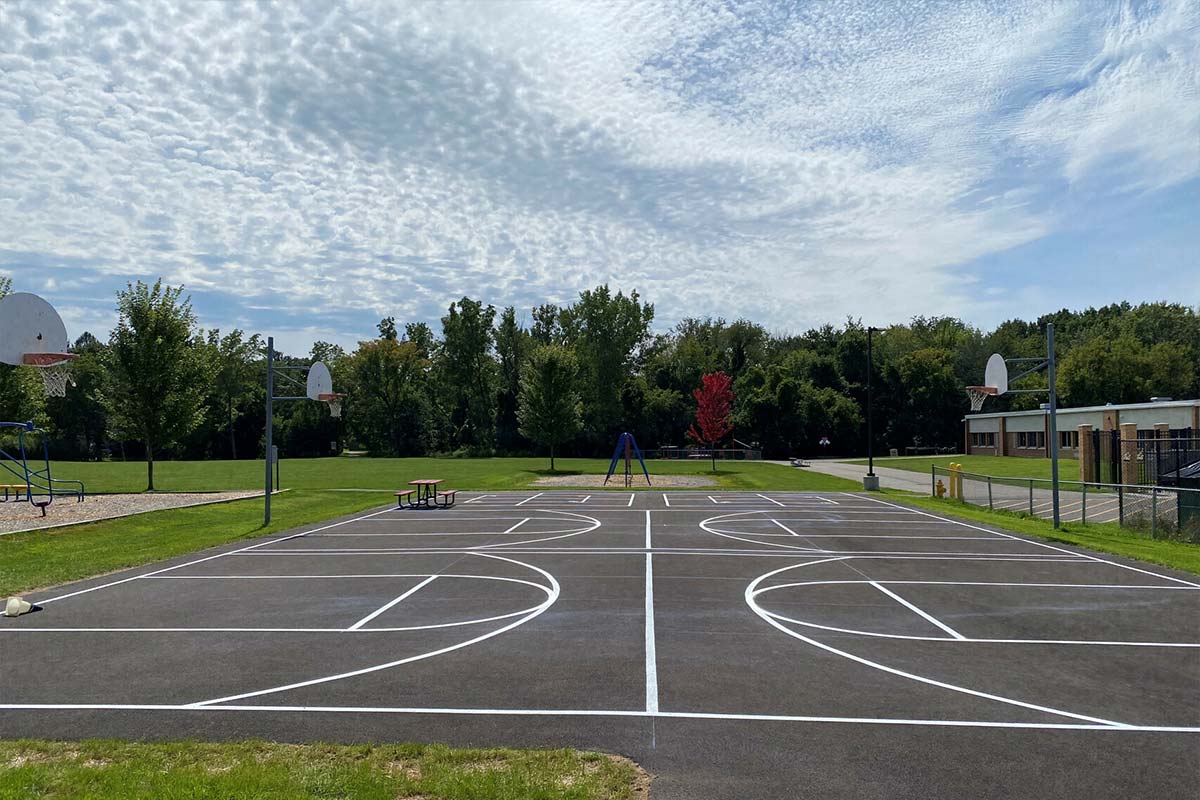
Sports Court Striping in Myrtle Beach, SC
Sports court striping in Myrtle Beach covers the layout and painting of court lines on asphalt and concrete playing surfaces: pickleball, basketball, tennis, multi-sport configurations and playground game markings. We work for HOAs and residential communities, hotels and resorts, schools, churches and municipal recreation sites across Horry and Georgetown counties.
Court striping is unforgiving in a way parking lot striping is not. A stall that is an inch narrow is a minor annoyance; a court line in the wrong place changes the game played on it. Setting out is most of the work.
Pickleball Court Layout and Dimensions
Pickleball is the sport driving most new court work on the Grand Strand, and its geometry is published by the sport’s national governing body. According to USA Pickleball:
| Element | Dimension |
|---|---|
| Court size, singles and doubles | 20 feet wide by 44 feet long |
| Net height at the sidelines | 36 inches |
| Net height at the center | 34 inches |
| Non-volley zone, each side of the net | 7 feet |
The non-volley zone, universally called the kitchen, is the detail that matters most for striping, because it is the line players argue about. USA Pickleball describes it as “the 14-foot area around the net (7 feet on each side)” — that is 7 feet measured from the net on each side, not 14 feet from one baseline.
Two practical notes. The playing surface is 20 by 44 feet, but a usable court needs run-off beyond the lines, so the paved area has to be larger than the court; how much larger depends on whether the court is recreational or intended for competitive play. And a single tennis court footprint will accommodate multiple pickleball courts, which is why so many Grand Strand conversions start with an underused tennis court.
Basketball Court Markings
A full basketball layout comprises the boundary lines, center circle and division line, the free-throw lane and free-throw line, the restricted area under each basket and the three-point arc. We lay out full courts, half courts and the single-hoop configurations that suit smaller HOA and church sites.
Court dimensions vary by governing body and by level of play — professional, international, collegiate, high school and recreational layouts differ from one another, most visibly in the three-point distance. We build to whichever standard the property specifies, and if you do not have one in mind we will walk you through what the space will actually accommodate before committing to a layout. We do not publish dimension tables for basketball here, because the numbers depend entirely on which body’s rules you are building to and we would rather confirm yours than have you work from the wrong set.
Tennis Court Lines
Tennis layouts comprise the baselines and sidelines for both singles and doubles, the service lines, the center service line and the center marks. A doubles court carries both sets of sidelines, which is what allows one surface to serve both formats.
As with basketball, the governing dimensions belong to the sport’s rules bodies rather than to us, and we build to the standard your property is working to. On the coast the more common job is not a new tennis court but a resurfaced one being relined, or an existing court being converted or shared with pickleball.
Multi-Sport and Shared-Use Courts
Most of the court work we do on the Grand Strand is shared use, because the properties are space-constrained and the demand is seasonal. The usual configurations are tennis with pickleball overlaid, basketball with pickleball, and multi-purpose recreation surfaces carrying two or three games at once.
The design problem in shared use is legibility, not geometry. Two sets of lines on one surface work when the color contrast and line weight make it obvious which set belongs to which game, and fail when they do not. The convention is a dominant color for the primary sport and a clearly distinct secondary color for the overlay, with the overlay lines often slightly lighter in weight. Deciding which sport is primary before any paint goes down is the whole job.
Playground and Game Markings
Playground and game markings are the painted games on school, daycare, church and community playground surfaces: hopscotch, four square, foursquare variants, number and alphabet grids, snakes and ladders, target circles, running tracks and compass roses.
These are the cheapest square-foot improvement most properties can make to a tired asphalt play area, and they are the work most often forgotten when a surface is resealed, because they get covered over and never reinstated. If your playground has been sealcoated since the games were last painted, they are gone. We reinstate them at the same visit as any other court work on the property.
Court Surfaces and Coatings on the Coast
Coastal conditions shorten the life of a court surface as surely as they shorten the life of a parking lot marking. Ultraviolet exposure fades line color, wind-blown sand abrades the surface, and standing water on a poorly draining court degrades both the coating and the lines beneath it.
Court lines are normally applied over an acrylic color coating rather than directly onto bare asphalt, and the condition of that coating governs how long the lines last. A court whose coating is chalking or delaminating needs the surface addressed before relining, otherwise the new lines fail with the old coating. We will tell you which of the two you are actually looking at rather than painting lines onto a surface that will not hold them.
For a full list of our pavement marking services, visit our parking lot striping in Myrtle Beach page.
Businesses We Serve




How it Works

GET A FREE ESTIMATE
Contact us today and we’ll have a quote to you in 24 hours

SCHEDULE AN INSTALLATION
We’ll have your play space restriped in less than 7 days, without affecting your playtime

GET A PARKING LOT THAT POPS
For a budget-friendly price, you’ll get a parking lot that looks like new
We proudly work with:


We proudly work with:


Frequently Asked Questions About Sports Court Striping in Myrtle Beach, SC
What are the dimensions of a pickleball court?
USA Pickleball states that a pickleball court measures 20 feet wide by 44 feet long for both singles and doubles, with the net 36 inches high at the sidelines and 34 inches at the center, and a 7-foot non-volley zone on each side of the net. The total paved area needs to exceed the court itself to allow run-off behind the baselines and beside the sidelines, and how much depends on whether the court is recreational or intended for competitive play.
Can one surface carry two sports?
Yes, and on the Grand Strand most do. Tennis with pickleball overlaid is the most common conversion, followed by basketball sharing with pickleball. The constraint is legibility rather than geometry: two sets of lines coexist happily when the primary sport has a dominant color and the overlay is clearly distinct in color and often lighter in weight. The decision to make first is which sport is primary, because everything else follows from it.
What drives the cost of painting lines on a basketball court?
It depends almost entirely on which job you actually have. Relining a sound court means setting out and painting. Reviving a court whose acrylic coating is chalking or lifting means addressing the surface first, because lines applied over a failing coating fail with it. Court size and the number of line sets scale both. So does how many sports share the surface, since each additional layout adds setting out. We will tell you which job it is, free.
How much does sports court line striping cost?
Two tiers, and they are far apart. A court that needs relining only is quick work: confirm the setting out, repaint the lines. A court needing its acrylic surface addressed first is a substantially larger job, and no amount of careful lining will rescue lines laid over a coating that is letting go. Playing area size and the number of sports sharing the surface scale whichever tier you are in. The assessment costs you nothing.
How do you calculate a striping job?
By measuring, not by estimating from a photograph. For courts that means confirming the usable paved area, checking it is square and level enough to hold the layout, and establishing where the lines can actually go before quoting. For parking lots it means the stall count the surface will genuinely support, the length of marking involved, and the amount of accessible and fire lane work required. Then material, surface condition and access constraints are priced against that measurement.