Thermoplastic Striping
In Myrtle Beach, SC
Long-Lasting Pavement Markings
1-800-STRIPER provides professional thermoplastic striping in Myrtle Beach, SC — heat-applied stop bars, crosswalks, directional arrows, and fire lane markings in a material specified under AASHTO M249 that bonds into the pavement instead of drying on top of it.
1-800-STRIPER® of Myrtle Beach PROVIDes Thermoplastic Striping Services NEAR YOU
Want to reduce the maintenance requirements for your parking lot?
Thermoplastic pavement markings are a durable, weather and vehicle-resistant striping option for your parking lot or facility.
You can utilize them for stop bars, ADA stalls, no-parking zones, directional arrows, crosswalks, or your entire parking lot.
Benefits:
Thermoplastic Striping in Myrtle Beach, SC
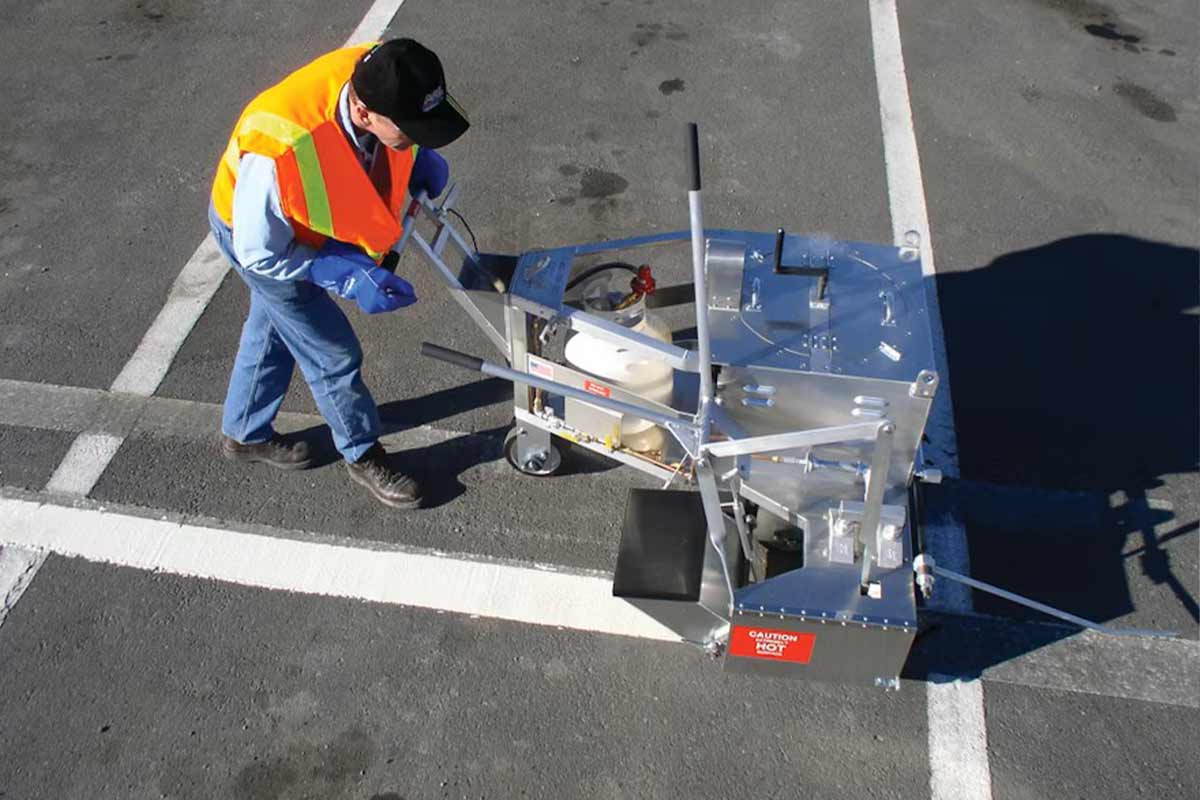
Thermoplastic striping in Myrtle Beach is the durable alternative to traffic paint for the markings that take the most wear: stop bars, crosswalks, directional arrows, lane lines and fire lane markings. It costs more to put down and it lasts substantially longer, which makes it a straightforward arithmetic question rather than a matter of preference.
On the Grand Strand that arithmetic tilts toward thermoplastic more often than it does inland, because the coastal conditions that shorten a painted line’s life — sun, salt air, wind-blown sand, standing water — press hardest on exactly the high-traffic markings thermoplastic is designed for.
What Thermoplastic Is and How It Bonds
Thermoplastic arrives as a solid and is applied hot. Heated to its application temperature and laid onto a prepared surface, it fuses with the pavement as it cools rather than curing as a film on top of it. That distinction is the whole reason it outlasts paint.
A painted line sits on the surface and wears from the top down; once the film is breached, the failure spreads underneath it. A thermoplastic marking is a thicker body of material fused into the substrate, so it wears down rather than off, and it holds its edge definition far longer. It also carries glass beads through its full depth rather than only on the surface, which matters for night visibility and is covered below.
Thermoplastic or Traffic Paint
| Thermoplastic | Water-based traffic paint | |
|---|---|---|
| Up-front cost | Higher | Lower |
| Service life | Substantially longer | Shorter, especially on the coast |
| How it fails | Wears down; edges hold | Wears through; film breaches and spreads |
| Application | Heat-applied, specialist equipment | Sprayed, standard equipment |
| Surface requirement | Clean, dry, sound pavement; more sensitive to preparation | More tolerant |
| Reflectivity | Beads through full depth | Beads on surface |
| Best suited to | Stop bars, crosswalks, arrows, fire lanes, high-traffic markings | Stall lines, large areas, frequent layout changes |
| Removal / change | Harder to alter | Easier to overpaint |
The sensible pattern on most commercial lots is a hybrid: thermoplastic on the markings that take punishment and carry safety meaning, traffic paint on the stall lines where the area is large and the wear is light. A contractor who proposes one material for the entire lot is running their equipment, not specifying your job.
What Determines How Long Thermoplastic Lasts
Four things, in roughly this order.
Surface preparation and condition. This is the big one, and it is where most premature failures originate. Thermoplastic bonds to what it is laid on; if that is dust, moisture, loose sealer or degraded asphalt, the bond is to a layer that is itself going to let go.
Traffic volume and type. A stop bar at a busy Grand Strand retail exit takes vastly more wheel contact than a lane line twenty feet away. Turning traffic is harder on a marking than straight-through traffic.
Application conditions. Substrate temperature, ambient humidity and surface moisture at the time of application all affect the bond that forms as the material cools.
Exposure. Ultraviolet, salt air, sand abrasion and standing water all shorten service life on the coast.
Notice that three of the four are decided on installation day. Thermoplastic that is put down properly on a sound, properly prepared surface substantially outlasts paint; thermoplastic put down badly can fail sooner than paint would have, which is why the preparation section below is not filler.
Where Thermoplastic Makes Sense on a Commercial Lot
Put it where the wear is and where the marking carries meaning. Stop bars and crosswalks are the clearest cases, because both sit exactly where vehicles brake and turn, and both are markings a driver needs to read correctly the first time. Directional arrows in drive aisles are next, followed by fire lane markings, which have a legibility duty attached to them and benefit from a material that holds its edges.
Where it makes less sense: stall lines across a large lot, where the area is big and the wear is light and the cost difference multiplies across every line; and any layout you expect to change, because thermoplastic is harder to alter than paint. A property planning a reconfiguration in two years should not commit its stall grid to thermoplastic now.
Retroreflectivity and Glass Beads
Retroreflectivity is what makes thermoplastic striping visible in headlights at night. It comes from glass beads, which return light toward its source rather than scattering it.
The structural advantage of thermoplastic here is that beads are distributed through the body of the material as well as applied to the surface at installation. As the marking wears, fresh beads are exposed, so night visibility degrades gradually rather than dropping away once a surface bead layer is gone. On a painted line, the beads live on the surface and the reflectivity goes with them.
On a commercial lot this matters most at the points where a driver has a decision to make in the dark: the stop bar at an exit, a crosswalk between a lot and a building entrance, an arrow at a one-way aisle. Those are the same markings where thermoplastic’s durability argument is strongest, which is convenient.
Material Specification
The material specification commonly referenced for hot-applied thermoplastic pavement marking material in the United States is AASHTO M249, published by the American Association of State Highway and Transportation Officials. State transportation agencies including the South Carolina Department of Transportation maintain their own standard specifications that reference material standards of this kind for public roadway work.
We cite M249 by designation only, deliberately. Its full text is a purchased standard rather than a public document, and this page does not paraphrase requirements from a document it cannot link you to. If your specification or your insurer requires conformance to a particular material standard, tell us at the estimate stage and we will specify to it.
Surface Preparation and Installation Conditions
Here is the thing the rest of the internet gets wrong about thermoplastic, and it is worth stating plainly because it is the most-searched question on this topic.
You will find a specific application temperature quoted confidently across contractor websites. We are not going to give you one, because there is no primary standard that sets it. Application temperature is a property of the specific product you are using, published by its manufacturer on its own datasheet, and it varies between products. Transportation agency specifications for this material generally defer to the manufacturer’s written instructions rather than fixing a temperature themselves. So a number copied from another contractor’s website is a number about a product that is probably not the one on your lot.
What is genuinely general, and worth knowing before you schedule work:
- The surface must be clean — free of dust, dirt, sand, oil and loose material.
- The surface must be dry. This is the constraint that most often moves a Grand Strand schedule, because humidity and overnight dew are real here.
- The pavement must be sound. Thermoplastic laid over failing asphalt or a delaminating sealer fails with the layer beneath it.
- Existing markings may need removal rather than overmarking, depending on their condition and material.
- Substrate temperature matters as much as air temperature, which is why the same day can be workable at midday and not at eight in the morning.
We assess all of that on site and will tell you if the honest answer is that the surface needs work before thermoplastic is worth putting on it.
For a full list of our pavement marking services, visit our parking lot striping in Myrtle Beach page.
Businesses We Serve



How it Works

GET A FREE ESTIMATE
Contact us today and we’ll have a quote to you in 24 hours

SCHEDULE AN INSTALLATION
We’ll have your installation scheduled restriped in less than 7 days, without affecting your business hours

GET A PARKING LOT THAT POPS
For a budget-friendly price, you’ll get a parking lot that looks like new
We proudly work with:


We proudly work with:

Frequently Asked Questions About Thermoplastic Striping in Myrtle Beach, SC
What is thermoplastic line striping?
Thermoplastic is a pavement marking material applied hot rather than sprayed as a liquid. It arrives solid, is heated to its application temperature, and fuses into the pavement as it cools instead of curing as a film on the surface. That bond, plus its greater thickness, is why it outlasts traffic paint. It also carries glass beads through its full depth for night reflectivity rather than only on the surface.
What is the temperature range for thermoplastic striping?
There is no single answer, and this is one of those cases where the honest reply is more useful than a confident number. Application temperature is a property of the specific product, published by its manufacturer on that product’s datasheet, and it differs between products. Transportation agency specifications generally defer to the manufacturer’s written instructions rather than fixing a figure. Any number you find quoted online describes some other product, not necessarily the one being used on your lot.
How long does thermoplastic striping last?
Substantially longer than traffic paint, but the honest answer is that it depends on four things rather than on a headline figure: how well the surface was prepared, how much and what kind of traffic the marking takes, the conditions on installation day, and coastal exposure. Well-applied thermoplastic on sound pavement gives you years more service than paint. Badly applied thermoplastic can fail sooner than paint would have, which is why preparation matters more than the material choice.
Should I use thermoplastic or paint on my parking lot?
Usually both. Thermoplastic earns its higher up-front cost on stop bars, crosswalks, directional arrows and fire lane markings, which take the most wear and carry the most safety meaning. Traffic paint remains sensible for stall lines, where the area is large, the wear is lighter and the cost difference multiplies. If you expect to reconfigure the layout within a few years, keep the stall grid in paint, because thermoplastic is harder to alter.
How long before the lot reopens after thermoplastic is applied?
Faster than most people expect. Because thermoplastic sets by cooling rather than by drying or curing, the marking is trafficable once it has cooled, which is a matter of minutes per marking rather than hours. In practice the constraint is the work sequence rather than the material, so we stripe in sections and reopen each one as it cools. That makes it well suited to properties that cannot close.
What drives the cost of thermoplastic striping?
Preparation is where thermoplastic estimates actually diverge. A surface that is clean, dry and sound is ready to go. One needing cleaning, patching, or removal of failed old markings is a materially bigger job, and skipping that step is how thermoplastic ends up failing early. Material cost then scales with the length and area you are marking. How much of the lot goes in thermoplastic rather than paint is your call, and we will price both. Estimates are free.