
Warehouse Line Painting
In Myrtle Beach, SC
OSHA-Compliant Safety Markings
1-800-STRIPER provides professional warehouse line painting in Myrtle Beach, SC — marking the permanent aisles and passageways the Occupational Safety and Health Administration requires be marked, plus pedestrian walkways, staging bays, and equipment zones, for industrial facilities across Horry County.
1-800-STRIPER® of Myrtle Beach PROVIDes Warehouse Line Painting Services NEAR YOU
Want your indoor space to operate more efficiently?
Warehouse and interior markings ensure clear traffic lanes, organized storage zones, and designated spaces designed to help your business operate safely and efficiently.
Benefits:
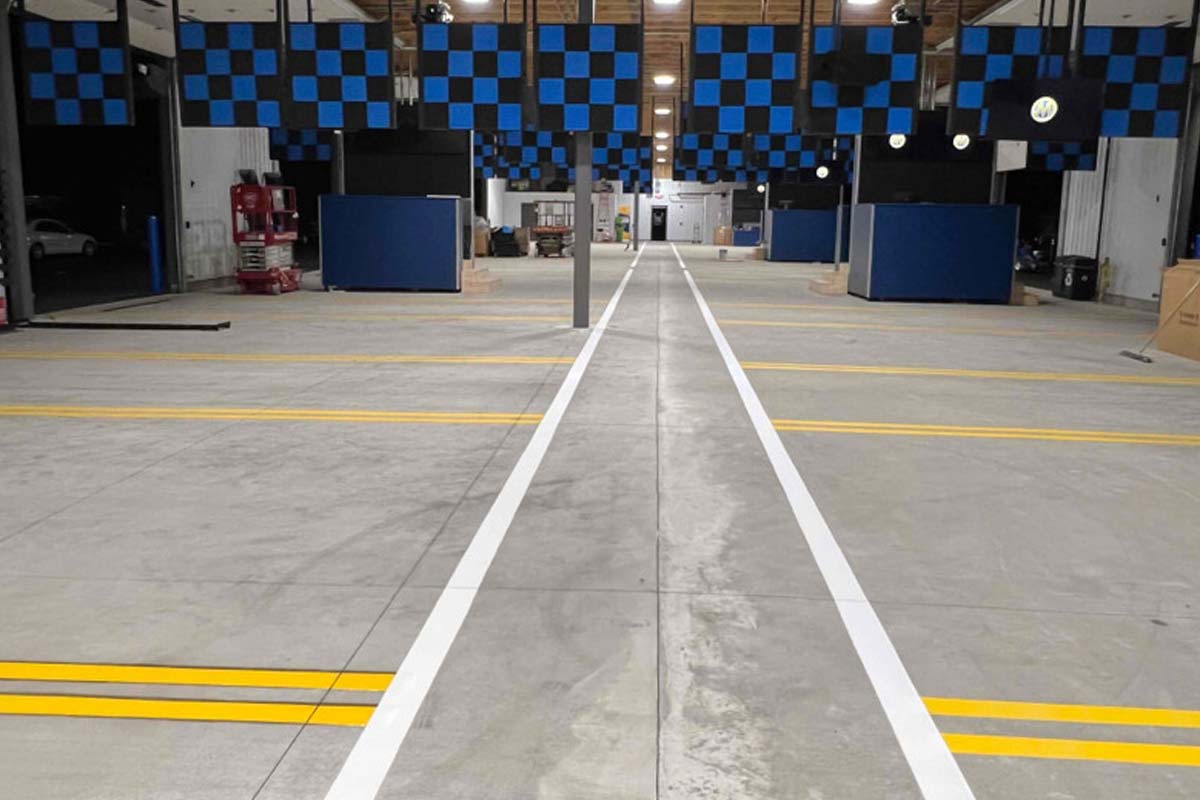
Warehouse Line Painting in Myrtle Beach, SC
Warehouse line painting in Myrtle Beach covers the markings inside a building rather than on the lot outside it: aisles, passageways, pedestrian routes, staging and storage areas, equipment zones and keep-clear areas in front of panels and exits. The work is done on sealed concrete in most Horry County facilities, and it has a different set of drivers from exterior striping — traffic here is forklifts and people, not cars.
We work in distribution warehouses, manufacturing floors, storage facilities and the back-of-house areas of larger retail and hospitality properties, of which the Grand Strand has plenty.
What OSHA Actually Requires for Aisle Marking
Most published guidance on warehouse line painting goes wrong here, so it is worth being exact. The binding federal requirement is 29 CFR 1910.176(a), a paragraph headed “Use of mechanical equipment,” and its entire marking duty is one sentence: “Permanent aisles and passageways shall be appropriately marked.” The same paragraph requires that “aisles and passageways shall be kept clear and in good repair, with no obstruction across or in aisles that could create a hazard.”
That is the whole of it. The word is “appropriately.” The rule sets no color and no width.
You will find a widely circulated OSHA letter quoting aisle marking widths of 2 to 6 inches. It is real, and it is worth reading carefully rather than citing loosely. It dates from 1972, it is filed under Section 1910.22(b) — a subsection OSHA deleted in its walking-working-surfaces rewrite — and OSHA prefaces it with a notice that it is “an OSHA Archive Document, and may no longer represent OSHA Policy.” The letter itself says interpretation letters “cannot create additional employer obligations.” What it actually says on color is the opposite of the common claim: “The lines used to delineate the aisles may be any color so long as they clearly define the area considered as aisle space.” On width it says the recommended range “varies from 2 inches to 6 inches; therefore, any width 2 inches or more is considered acceptable” — a recommendation, not a rule.
So: mark your permanent aisles, make the marking clear enough that the aisle is unmistakable, and choose color and width for legibility rather than to satisfy a specification that does not exist.
Aisle and Passageway Markings
In warehouse line painting the duty attaches to permanent aisles and passageways, which in practice means the routes that are part of how the facility works rather than temporary gaps between pallets. Marking them clearly does two things: it satisfies the federal requirement, and it makes the traffic pattern legible to a forklift operator who is reversing.
We lay aisle lines in continuous stripes on sealed concrete, sized so they stay readable under the wheel traffic they will actually take. Where an aisle turns or intersects, the corner is the part that wears first and the part that matters most, so it is worth specifying a durable material there even if the straight runs are painted.
Pedestrian Walkways and Crossings Inside the Building
Separating people from powered equipment is the single highest-value marking decision inside a warehouse. Dedicated pedestrian walkways along the wall lines, marked crossings where a walkway meets an aisle, and clearly bounded waiting areas at doors and stairs all reduce the number of places where a person and a forklift have to negotiate the same few feet of floor.
None of this is specified by federal rule, which is precisely why it is worth doing deliberately. A walkway that is obvious from thirty feet away in poor light is doing its job; one that is technically present is not.
Staging, Storage, and Equipment Zone Markings
Floor markings are how a warehouse enforces its own layout. The usual set is these five:
Inbound and outbound staging bays. The floor area each shipment occupies while it waits, bounded so the bay cannot quietly grow.
Pallet and rack footprints. The position each pallet and rack returns to, marked so a gap reads as a gap rather than as free floor.
Quarantine and hold areas. Stock that must not move onward, given a boundary rather than a label on a clipboard.
Battery charging and equipment parking zones. Where powered equipment lives when it is not in use, and where it is charged.
Keep-clear areas. The floor in front of electrical panels, fire equipment and exit doors, which has to stay empty whether or not anyone is watching.
Marked footprints are what stop a staging area from expanding into an aisle over the course of a busy quarter. On a Grand Strand distribution floor that swings hard with the season, that is worth more than it sounds.
Safety Color Conventions: What Is Convention and What Is Required
Yellow for aisles, red for fire equipment, and so on are widely used warehouse line painting conventions drawn from voluntary consensus standards. They are genuinely useful, because a convention that everyone recognizes is faster to read than one invented per site.
What they are not is a federal requirement. As set out above, OSHA’s binding rule requires only that permanent aisles and passageways be “appropriately marked,” and OSHA’s own archived guidance says the lines “may be any color.” Any voluntary standard your facility chooses to follow is worth following consistently — but follow it because you have chosen it, not because someone told you the law required a particular color. If your operation is already working to a corporate or customer-mandated color scheme, we will match it exactly.
Factory and Industrial Floor Marking
Warehouse striping, factory floor marking and industrial floor marking all describe the same work on this page. Manufacturing floors add a few requirements a pure distribution warehouse does not have: machine safety perimeters, work cell boundaries, tool and cart home positions, and clearance zones around equipment that swings or extends. Commercial and industrial facilities across Horry County are handled by the same crew and the same specification.
If you are searching for factory line painting or industrial floor striping, this is the service.
For a full list of our pavement marking services, visit our parking lot striping in Myrtle Beach page.
Businesses We Serve




How it Works

GET A FREE ESTIMATE
Contact us today and we’ll have a quote to you in 24 hours

SCHEDULE A STRIPING
We’ll have your space restriped in less than 7 days, without affecting your business hours

GET A PARKING LOT THAT POPS
For a budget-friendly price, you’ll get a parking lot that looks like new
We proudly work with:


We proudly work with:


Frequently Asked Questions About Warehouse Line Painting in Myrtle Beach, SC
Does OSHA require yellow aisle lines?
No. The binding rule, 29 CFR 1910.176(a), says only that “permanent aisles and passageways shall be appropriately marked.” It specifies no color at all. OSHA’s own archived 1972 interpretation letter says directly that the lines “may be any color so long as they clearly define the area considered as aisle space.” Yellow is a widely used convention drawn from voluntary standards, and it is a sensible default because people recognize it, but it is a convention rather than a legal requirement.
How wide does an aisle marking line have to be?
No federal rule sets a width. The 1910.176(a) requirement is that permanent aisles and passageways be appropriately marked, and it stops there. The often-quoted 2-to-6-inch range comes from a 1972 OSHA interpretation letter that describes it as a recommendation, is filed under a subsection OSHA has since deleted, and carries OSHA’s own notice that it may no longer represent policy. Choose a width that stays clearly legible under your traffic.
What does 29 CFR 1910.176(a) actually say?
It is short. Where mechanical handling equipment is used, sufficient safe clearances must be allowed for aisles, at loading docks, through doorways and wherever turns or passage must be made. Aisles and passageways must be kept clear and in good repair, with no obstruction that could create a hazard. And then the marking duty: “Permanent aisles and passageways shall be appropriately marked.” That is the complete text of the provision people cite for warehouse floor marking.
What drives the cost of having warehouse lines painted?
Surface condition dominates this one. Sealed concrete in good order takes marking readily; bare, dusty or oil-contaminated slab needs preparation first, and that single difference can outweigh everything else on the estimate. Floor area and total marking length set the baseline underneath it. Then it is a question of how many distinct zone types you need, what material the traffic justifies, how much racking we work around, and whether there is a shutdown we can use. Free estimate, as always.
What paint is used for warehouse and parking lot lines?
Different surfaces take different materials. Interior sealed concrete generally takes a hard-wearing coating chosen for abrasion resistance under forklift traffic; exterior asphalt commonly takes water-based traffic paint, with thermoplastic used where longer life justifies the higher up-front cost. The right answer depends on the substrate, the traffic and how long you need the marking to last. We specify per floor rather than running one product everywhere.