
Parking Lot Sign Installation
In Myrtle Beach, SC
ADA, Fire Lane, and Directional Signage
1-800-STRIPER provides professional parking lot sign installation in Myrtle Beach, SC — mounting accessible-space and van-accessible signs at or above the 60-inch minimum height the 2010 ADA Standards for Accessible Design set, plus fire lane, directional, and private-property tow-away notices, for commercial properties across Horry County.
1-800-STRIPER® of Myrtle Beach PROVIDes Parking Lot Sign Installation Services NEAR YOU
Are you communicating clearly?
We install new signs in adherence with local regulatory standards and can repair or replace damaged signs so you can clearly communicate your parking requirements.
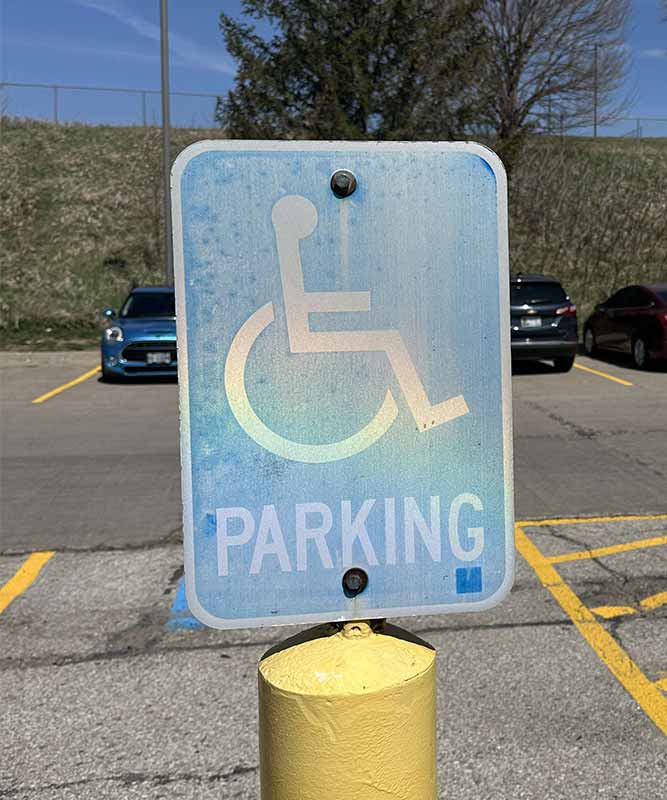
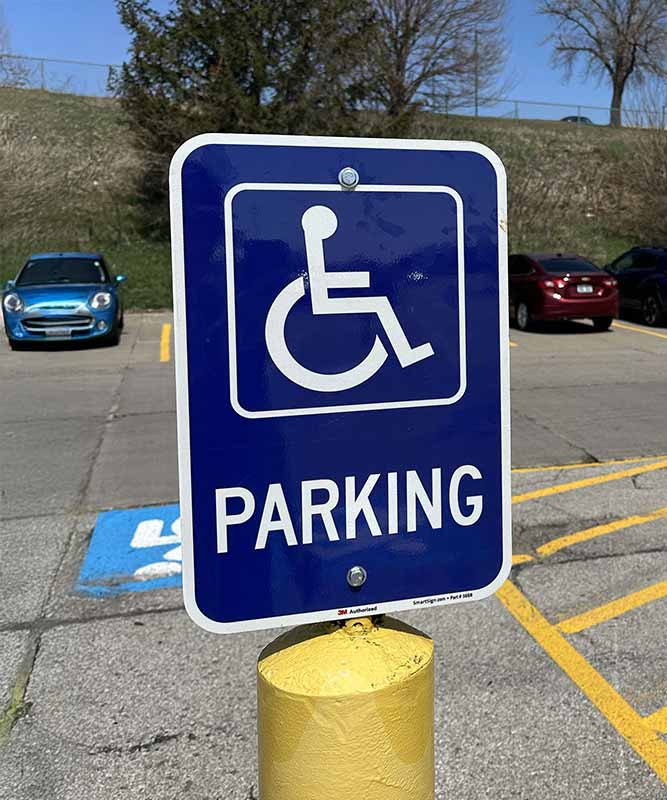
Parking Lot Sign Installation in Myrtle Beach, SC
Parking lot sign installation in Myrtle Beach covers the exterior signage a commercial property needs to make its lot work and keep it compliant: accessible space identification, fire lane and no-parking signs, tow-away notices, directional and stop signs, and reserved or visitor designations. We supply, mount and replace them, and we handle the posts and footings rather than leaving you to source them separately.
This page is about exterior parking signage only. Interior and lobby signage is a different trade and not a service this location offers.
Only some of those categories have a specification behind them, and the difference matters when you are buying. The sections below work through each one; this is the summary:
| Sign type | What it has to carry | What governs it |
|---|---|---|
| Accessible space | The International Symbol of Accessibility complying with 703.7.2.1 | 2010 ADA Standards, Section 502.6 |
| Van-accessible space | The symbol plus the “van accessible” designation — additional to the symbol, not a substitute | 2010 ADA Standards, Section 502.6 |
| Fire lane / no parking | The words NO PARKING—FIRE LANE, and it must stay clean and legible | 2021 South Carolina Fire Code, Section 503.3 — but only where the fire code official requires marking |
| Fire lane sign dimensions | Minimum 12 in wide by 18 in high, red letters on a white reflective background | SCFC Appendix D, Section D103.6 — binds only where that appendix has been adopted by letter designation |
| Private-property tow-away notice | A notice prohibiting parking, posted conspicuously on the borders near each entrance. No size, color, lettering or wording is specified | S.C. Code Section 16-11-760 |
| Directional, speed, stop | R7-series shapes, colors and layouts, followed for recognizability | MUTCD convention. Under 23 CFR 655.603(a) the Manual does not govern parking areas or their driving aisles |
| Reserved, visitor, customer-only | Nothing prescribed — these do administrative work, not regulatory work | No standard applies |
Accessible-Space Signs and the Van-Accessible Designation
Accessible parking signage is the one category with a federal specification behind it. Section 502.6 of the 2010 ADA Standards for Accessible Design requires that “parking space identification signs shall include the International Symbol of Accessibility complying with 703.7.2.1,” and that “signs identifying van parking spaces shall contain the designation van accessible.”
Two points are commonly misunderstood. First, the van accessible designation is additional to the symbol, not a substitute for it — a van space carries both. Second, the standard’s own advisory note explains that the designation “is intended to be informative, not restrictive, in identifying those spaces that are better suited for van use,” and adds that “enforcement of motor vehicle laws, including parking privileges, is a local matter.” The sign identifies the space; it does not itself create the enforcement mechanism.
Sign Mounting Height and Placement
Section 502.6 is specific about height, and it is worth quoting exactly because it is regularly got wrong: “Signs shall be 60 inches minimum above the finish floor or ground surface measured to the bottom of the sign.”
Three things follow. It is a minimum, not a specified height, so mounting higher is permitted and often sensible where a sign could be obscured by a parked vehicle. It is measured to the bottom of the sign, not to its center or its top. And the reference point is the finish floor or ground surface at the sign, which matters where the ground falls away.
Placement is the other half of the job. A sign that satisfies the height requirement but sits where a parked van hides it has not done anything useful. Signs go at the head of the space they identify, positioned so they remain visible to a driver approaching the space rather than only to one already parked in it.
Fire Lane and No-Parking Signs
Fire lane signage is governed by the same provision as fire lane pavement marking. Section 503.3 of the 2021 South Carolina Fire Code provides that, “where required by the fire code official,” approved signs, notices or markings “that include the words NO PARKING—FIRE LANE” must be provided for fire apparatus access roads, and that the means of designation must be “maintained in a clean and legible condition at all times.”
The wording is fixed; the requirement is conditional on the fire code official; and the body of the code sets no sign dimensions. The code’s Appendix D does — Section D103.6 calls for permanent signs of at least 12 inches wide by 18 inches high with red letters on a white reflective background, posted on both sides of access roads 20 to 26 feet wide and on one side of wider roads — but appendices apply only where specifically adopted by letter designation, under Section 101.2.1 and S.C. Code Section 6-9-50.
The practical advice: before you buy fire lane signs, ask your fire code official whether Appendix D is in force in your jurisdiction and what they require. It is a short conversation that avoids buying the wrong sign twice. See also fire lane striping.
Private-Property Tow-Away Notices in South Carolina
South Carolina has a statute that makes this part of parking lot sign installation more useful than most owners realize. S.C. Code Section 16-11-760 makes it unlawful to park on the private property of another without the owner’s consent, and then sets out what a commercial property owner must do to make that enforceable:
“If the property is for commercial use, the owner must post a notice in a conspicuous place on the borders > of the property near each entrance prohibiting parking. Proof of the posting is considered notice conclusive > against the person making entry.”
Read what that specifies and what it does not. It specifies placement — conspicuous, on the borders of the property, near each entrance. It specifies that the notice must prohibit parking. And the evidentiary consequence is significant: proof of posting is conclusive notice against the person who entered, so the posting is what makes the rest of the statute work.
What it does not specify is the sign itself: no size, no color, no lettering, no required wording. That is unusual and worth knowing, because it means the effort belongs in placement and legibility rather than in chasing a specification that does not exist. A notice at one entrance out of three does not satisfy a statute that says near each entrance.
The statute also addresses towing, storage and lien procedure in its later subsections, which is a matter for your towing operator and your attorney rather than your sign contractor.
Directional, Speed, and Stop Signs
Circulation signage is what keeps a lot legible to a driver who has never been there. The usual set is entry and exit designations, one-way and directional arrows, stop signs at internal intersections and at the exit to the public road, speed advisories, and pedestrian crossing warnings.
Stop signs at the point where a lot meets a public road are the ones worth getting right, because that is where a misjudgment has consequences beyond the property. Position them where an approaching driver sees them in time and where they are not obscured by landscaping in full summer growth, which on the Grand Strand is a real and seasonal problem.
Reserved, Visitor, and Customer-Only Signs
Reserved signage does administrative work rather than regulatory work: named or numbered tenant spaces, visitor parking, customer-only designations, staff areas, loading and delivery zones, electric vehicle charging bays and time-limited spaces.
These carry no code requirement, which means the design decisions are yours — but they only function alongside a properly posted tow-away notice under Section 16-11-760, since that is what gives the property owner a mechanism when a space is used by someone it was not meant for.
Sign Sizes and the R7-Series Convention
Regulatory parking signs in the United States follow conventions set out in the Manual on Uniform Traffic Control Devices, where the parking regulation series is designated R7. Using those familiar shapes, colors and layouts on a private lot is sensible, because drivers read them by habit rather than by reasoning.
But the Manual’s legal scope is narrower and stranger than it is usually described. Under 23 CFR 655.603(a) the Manual is the national standard for traffic control devices “installed on any street, highway, or bicycle trail open to public travel,” and that phrase expressly “includes toll roads and roads within shopping centers, airports, sports arenas, and other similar business and/or recreation facilities that are privately owned but where the public is allowed to travel without access restrictions.” The same paragraph then excludes “parking areas, driving aisles within parking areas.”
So a shopping center’s internal ring road is inside the Manual’s scope while its parking bays are not. The correct statement is that the Manual on Uniform Traffic Control Devices does not govern the parking area — not that it does not govern private property. We follow R7-series conventions for recognizability and will match a specific dimensional standard where your jurisdiction or your insurer requires one; we do not publish R7 sign dimensions here, because they belong to the Manual rather than to us.
Posts, Footings, and Coastal Corrosion
A sign is only as good as what holds it up, and the Grand Strand is hard on posts. Salt-laden air corrodes ferrous posts and fixings, and a corroded post fails at ground level where the damage is least visible.
That makes finish and fixing specification a real decision on coastal sites rather than a detail. Footings matter for the same reason bollard footings do: sandy soils behave differently from the ground a standard detail assumes. And sign faces themselves fade under sustained ultraviolet, with reds and blues going first, which is worth knowing for a sign whose legibility is doing evidentiary work under Section 16-11-760.
We replace posts and faces as well as installing new, and an annual walk of the lot’s signage is worth the half hour it takes.
For a full list of our pavement marking services, visit our parking lot striping in Myrtle Beach page.
Businesses We Serve




How it Works

GET A FREE ESTIMATE
Contact us today and we’ll have a quote to you in 24 hours

SCHEDULE AN INSTALLATION
We’ll have your installation scheduled in less than 7 days, without affecting your business hours

GET A PARKING LOT THAT POPS
For a budget-friendly price, you’ll get a parking lot that looks like new
We proudly work with:


We proudly work with:


Frequently Asked Questions About Parking Lot Sign Installation in Myrtle Beach, SC
How high should a sign be posted at a parking facility?
For accessible parking space identification, Section 502.6 of the 2010 ADA Standards requires signs to be 60 inches minimum above the finish floor or ground surface, measured to the bottom of the sign. That is a floor rather than a specified height, so mounting higher is permitted and often better where a parked van would otherwise obscure the sign. Other parking signs are not federally height-specified, but the same visibility logic applies.
What size are parking lot signs?
It depends entirely on which sign. Accessible space signs have no federally specified dimension, only the required symbol, the van accessible designation where applicable, and the 60-inch minimum mounting height. Fire lane signs may have a dimension where the fire code’s Appendix D has been specifically adopted in your jurisdiction, so ask your fire code official. Regulatory signs generally follow the conventions of the R7 series. We size to what your jurisdiction requires.
What does a tow-away notice have to say in South Carolina?
The statute does not specify wording, size or color. S.C. Code Section 16-11-760 requires that a commercial property owner “must post a notice in a conspicuous place on the borders of the property near each entrance prohibiting parking,” and provides that proof of that posting is conclusive notice against the person who entered. So the requirements are about placement and conspicuousness rather than about the sign’s design, and posting at only some of your entrances does not satisfy it.
Where do parking lot signs have to be posted?
It varies by sign type. Tow-away notices must be conspicuous, on the borders of the property and near each entrance, under S.C. Code Section 16-11-760. Accessible space signs go at the head of the space they identify, positioned to stay visible to an approaching driver. Fire lane signs are posted as the fire code official requires, and where Appendix D has been adopted it specifies posting on both sides of narrower access roads and one side of wider ones.
How do you create and install a parking sign?
Specify the sign first, because the requirements differ sharply by type: accessible space signs carry a federally required symbol and designation, fire lane signs carry required wording, and tow-away notices are governed by placement rather than design. Then choose face material and finish for the exposure, which on the coast means corrosion-resistant posts and fixings. Installation is post, footing and mounting height. We handle specification through installation as one job.