Parking Lot Restriping
In Myrtle Beach, SC
Restripe Existing Lines and Markings
1-800-STRIPER provides professional parking lot restriping in Myrtle Beach, SC — refreshing faded stalls, accessible spaces, directional arrows, and fire lane markings, which the 2021 South Carolina Fire Code requires be kept clean and legible at all times, for commercial properties across the Grand Strand.
1-800-STRIPER of Myrtle Beach PROVIDes Parking Lot Restriping Services NEAR YOU
Need to brighten up your faded parking lot?
Keep your parking lot safe and attractive by restriping annually to freshen up lines and symbols that have faded from the sun, weather, and traffic. Nothing beats a fresh coat of paint!
Benefits:
Parking Lot Restriping in Myrtle Beach, SC
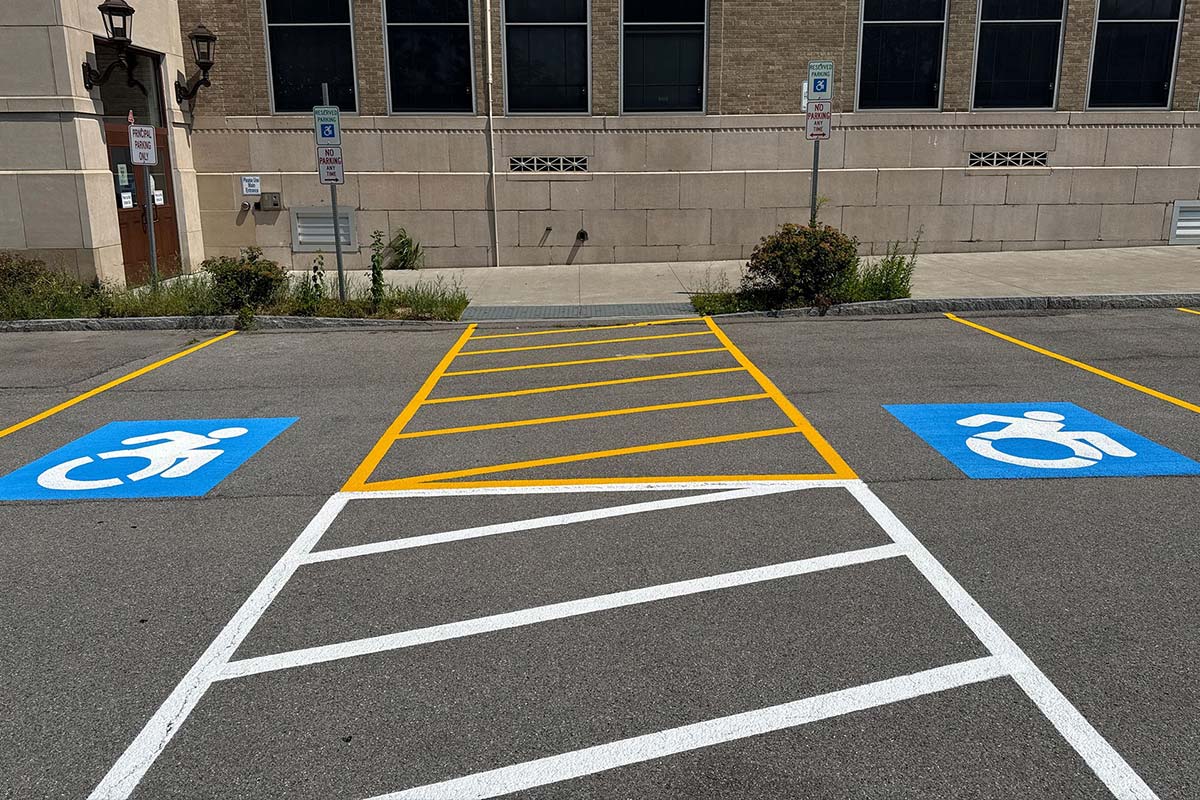
Parking lot restriping in Myrtle Beach is the repainting of an existing layout: the same stalls, the same aisles, the same accessible spaces, brought back to full visibility. It is the most common work we do on the Grand Strand, and it is far cheaper than a redesign because the existing lines do the setting out for you.
Restriping is worth treating as maintenance on a schedule rather than as a response to a complaint. Faded markings do not fail all at once; they degrade until the day someone parks across an access aisle because they could not see it, or a fire inspector notices that a fire lane designation is no longer legible.
When a Parking Lot Needs Restriping
A quick checklist. If you can answer yes to two or more of these, the lot is due:
- Stall lines are visibly thinner or patchier than they were, or have gone gray rather than white.
- Drivers are parking crookedly or straddling lines, which usually means they cannot see them clearly.
- Accessible space markings, the access aisle hatching or the accessibility symbol have faded.
- Fire lane markings or their wording are no longer clearly readable.
- Directional arrows, stop bars or crosswalks have worn through in the wheel tracks.
- The lot has been sealcoated or resurfaced, which removes the markings entirely.
- Sand or standing water has scoured or lifted paint in patches.
What a Restripe Covers
A parking lot restripe covers every marking on the surface, not just the stall lines. That means standard stalls, accessible car and van spaces with their access aisles and symbols, directional arrows, stop bars, crosswalks, loading and no-parking zones, fire lane markings, curb markings and any numbering or reserved-space lettering.
Where the original layout is still correct, we repaint it as-is. Where something has fallen out of compliance since the lot was last done — most often the accessible space count or the access aisle width — a restripe is the natural moment to correct it, because the surface is being worked anyway. We flag anything of that kind at the estimate rather than painting over a problem.
Fire Lane Markings Have to Stay Legible
This is the part of restriping that carries a legal duty rather than an aesthetic one. Section 503.3 of the 2021 South Carolina Fire Code provides that, where required by the fire code official, approved signs, notices or markings including the words NO PARKING—FIRE LANE must be provided for fire apparatus access roads. It then adds the maintenance duty: “The means by which fire lanes are designated shall be maintained in a clean and legible condition at all times and be replaced or repaired when necessary to provide adequate visibility.”
Two things follow. First, whether your property has to mark a fire lane at all is a decision for the fire code official, not something the code imposes on every lot automatically. Second, once a fire lane has been designated, keeping the designation legible is a continuing obligation with no grace period built into the wording. A faded fire lane is not merely untidy; it is a lapsed designation.
What the MUTCD Does and Does Not Cover in a Parking Area
Property managers are often told that parking lot markings must “meet MUTCD specifications.” That is not right, and the way it is usually corrected is not right either.
The federal rule at 23 CFR 655.603(a) makes the Manual on Uniform Traffic Control Devices the national standard for traffic control devices “installed on any street, highway, or bicycle trail open to public travel,” and it then defines that phrase deliberately broadly: open to public travel “includes toll roads and roads within shopping centers, airports, sports arenas, and other similar business and/or recreation facilities that are privately owned but where the public is allowed to travel without access restrictions.” The same paragraph then carves out the part that matters here: “Parking areas, driving aisles within parking areas, and private highway-rail grade crossings are also not included in this definition.”
So a Grand Strand retail center’s ring road is squarely inside the Manual’s scope, while the parking bays and the aisles between them are outside it. The correct statement is that the Manual on Uniform Traffic Control Devices does not govern the parking area, not that it does not govern private property. We design to its conventions where a driver would reasonably expect them, because consistency is what makes a stop bar or an arrow work.
Coastal Wear on Grand Strand Lots
Coastal lots wear faster, and the reasons are specific. Wind-blown sand is mildly abrasive and gets tracked across every lot within reach of the beach, scouring paint over a season the way fine grit would. Salt air attacks the bond between paint and surface. Intense summer ultraviolet fades pigment, and the whites and yellows carrying the most safety meaning fade first. Heavy rain and poor drainage leave water standing against markings, which accelerates loss of adhesion on older, more open asphalt.
The practical result is that a restriping interval borrowed from an inland market will be too long here. Lots close to the ocean, lots with heavy summer traffic and lots that drain slowly all need shorter cycles. Thermoplastic pays back faster on the coast than it does inland, because it bonds into the pavement instead of sitting on top of it.
For a full list of our pavement marking services, visit our parking lot striping in Myrtle Beach page.
Businesses We Serve




How it Works

GET A FREE ESTIMATE
Contact us today and we’ll have a quote to you in 24 hours

SCHEDULE AN INSTALLATION
We’ll have your installation scheduled in less than 7 days, without affecting your business hours

GET A PARKING LOT THAT POPS
For a budget-friendly price, you’ll get a parking lot that looks like new
We proudly work with:


We proudly work with:

Frequently Asked Questions About Parking Lot Restriping in Myrtle Beach, SC
What does restriping a parking lot mean?
Restriping means repainting the markings that are already on your lot rather than designing a new layout. The stalls, aisles, accessible spaces, arrows, stop bars, crosswalks and fire lane markings all go back where they were, at full visibility. Because the existing lines guide the setting out, restriping is quicker and cheaper than a redesign. If the layout itself has stopped working, that is a layout design job instead, and we will tell you which one you actually need.
What drives the cost of parking lot line striping?
Better question: what is being repainted, and what has to happen before paint touches it. Restriping an intact grid on sound asphalt is the cheap end. Add surface cleaning, crack repair, removal of markings that are no longer compliant, a switch to thermoplastic on the high-wear lines, or phasing around trading hours, and each one moves the number. Stall count sets the floor; those decisions set the rest. We will measure it for you free of charge.
How do you lay out a parking lot for striping?
On a restripe, the existing markings are the layout, so the work is squaring off what is already there and confirming nothing has fallen out of compliance. On bare or resurfaced asphalt you set a baseline off a fixed edge, square to it, position the accessible spaces first because their dimensions are fixed, then chalk the stall grid at the chosen angle before any paint is applied. Aisles and stalls are dimensioned together, not separately.
How often should a parking lot be restriped on the coast?
More often than an inland rule of thumb suggests. Salt air, wind-blown sand, strong summer sun and standing water all shorten the life of a marking on the Grand Strand, and the whites and yellows that carry safety meaning fade first. Rather than working to a fixed number, inspect annually and prioritize the markings that matter most for liability, meaning accessible spaces, access aisles and fire lanes. Thermoplastic lasts considerably longer than traffic paint here.
Does the MUTCD apply to my parking lot?
Not to the parking area itself. The federal rule at 23 CFR 655.603(a) applies the Manual to devices on roads open to public travel and expressly includes roads within shopping centers and similar privately owned facilities, then excludes “parking areas, driving aisles within parking areas.” So a retail center’s ring road is in scope while its parking bays are not. We still follow the Manual’s conventions for arrows, stop bars and crosswalks, because drivers read them by habit.