
Bollard Installation
In Myrtle Beach, SC
Safety and Security Bollards
1-800-STRIPER provides professional bollard installation in Myrtle Beach, SC — setting protective posts at storefronts, walkways, utility cabinets, and drive-through lanes, with impact performance rated by test methods such as ASTM F3016 for low-speed vehicle strikes.
1-800-STRIPER® of Myrtle Beach PROVIDes Bollard Installation Services NEAR YOU
Want to prevent accidents and protect your property?
Bollards provide physical protection for your customers and your property.
Safety and security:
Bollards create a physical barrier between vehicles and pedestrians, protecting people in walking areas from accidental or intentional vehicle intrusions.
Bollards act as a protective barrier around storefronts, gas stations, and other vulnerable areas, minimizing the risk of costly damage from vehicle impacts.
Strategic Placement Locations:
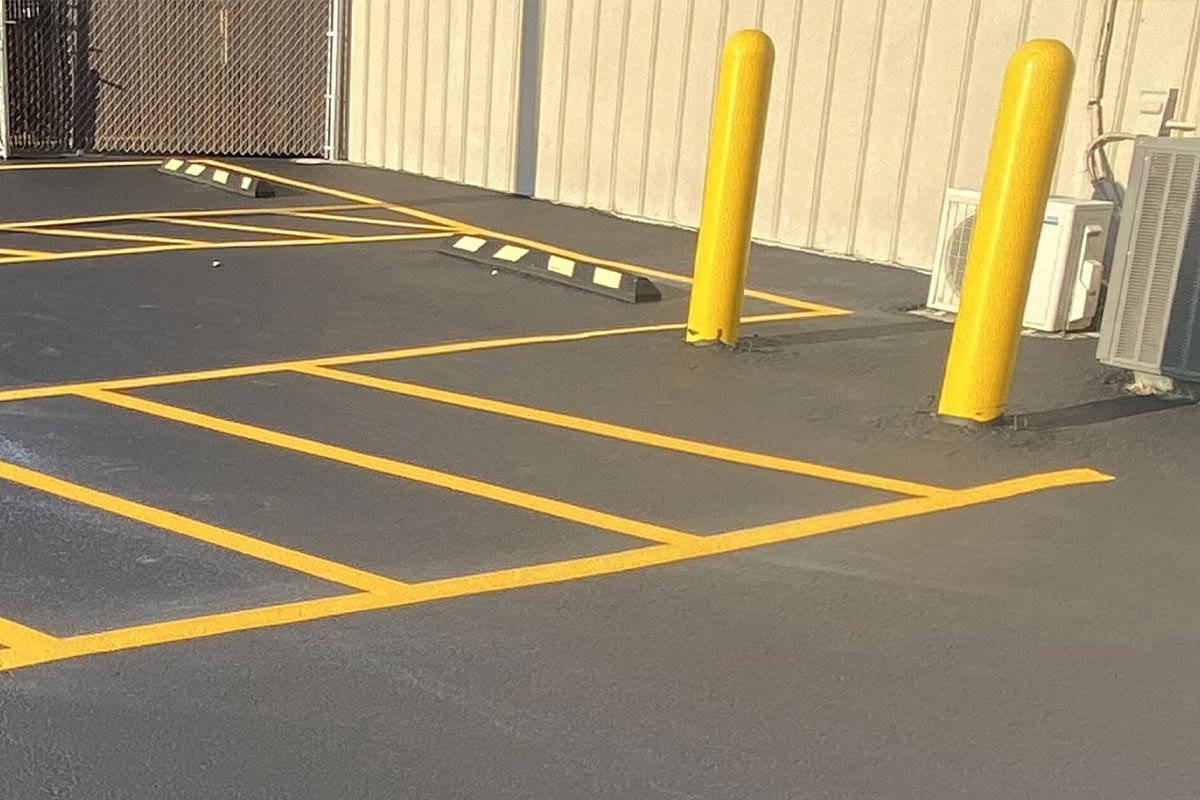
Bollard Installation in Myrtle Beach, SC
Bollard installation in Myrtle Beach means setting the protective posts that stand between vehicles and the things a vehicle should not reach: storefront glass, entry doors, walkways, utility cabinets, gas meters, drive-through lanes, propane cages and equipment enclosures. We install new bollards, replace damaged ones and handle bollard repair on existing installations across Horry and Georgetown counties.
The distinction worth holding onto is between a bollard and a wheel stop. A wheel stop halts a car that is parking; a bollard is meant to stop a car that is moving. They solve different problems and are not interchangeable.
Bollard Types and Impact Ratings
| Type | Construction | Typically used for |
|---|---|---|
| Steel pipe, concrete-filled | Steel pipe set in a footing and filled with concrete | The commercial default: storefronts, entries, utility protection |
| Steel pipe, unfilled | Steel pipe set in a footing | Lighter-duty visual and low-speed protection |
| Removable | Post seating into a permanent ground socket | Fire lane access points, service routes, event control |
| Retractable | Post retracting into a below-grade housing | Controlled vehicle access where a post must clear frequently |
| Decorative sleeve over a structural post | Structural pipe with a cover | Where appearance matters and protection still has to be real |
| Bollard repair and replacement | Reinstating damaged units and failed footings | Existing installations after impact or corrosion |
On impact ratings, precision matters. ASTM F3016, whose full designation is F3016/F3016M, is titled “Standard Test Method for Surrogate Testing of Vehicle Impact Protective Devices at Low Speeds.” Read that title carefully: it is a test method, not an installation specification. It describes how a device’s performance is evaluated in a low-speed impact, which is the relevant scenario for a commercial parking lot, where the realistic threat is a vehicle at parking-lot speed rather than a deliberate high-speed attack.
So the correct way to talk about a bollard’s rating is to say a product has been tested to a given method at a given condition, as published by its manufacturer. It is not correct to say a standard requires bollards to be installed in a particular way, because F3016 does not do that. Where a rated product is needed, we specify from manufacturer test data. Full details are available from ASTM International.
Where Bollards Go and How Deep They Set
Bollards go where a moving vehicle could reach something that matters. The usual positions on a commercial property are either side of a storefront entrance, along glazed frontages that face a parking row, around utility and gas equipment, at drive-through order points and windows, at the corners of loading areas and protecting fire hydrants and standpipes.
On embedment depth, the honest answer is that it is an engineering question rather than a fixed number. A bollard resists impact through its footing, so the depth and diameter of that footing depend on the post diameter and wall thickness, the soil conditions, the level of protection required and the manufacturer’s instructions for a rated product. Sandy coastal soils behave differently from inland clays, which is directly relevant here. Anyone quoting a single universal depth is describing one typical case rather than yours.
What is consistent is that the footing is the installation. A bollard is only as good as what it is set into, and a post that looks identical above grade can behave completely differently under impact depending on what is below it. Corrosion protection matters more on the Grand Strand than inland for the same salt-air reasons that shorten everything else here, so specification of finish and of any below-grade protection is worth getting right at installation rather than at replacement.
For a full list of our pavement marking services, visit our parking lot striping in Myrtle Beach page.
Businesses We Serve




How it Works

GET A FREE ESTIMATE
Contact us today and we’ll have a quote to you in 24 hours

SCHEDULE AN INSTALLATION
We’ll have your installation scheduled in less than 7 days, without affecting your business hours

GET A PARKING LOT THAT POPS
For a budget-friendly price, you’ll get a parking lot that looks like new
We proudly work with:


We proudly work with:


Frequently Asked Questions About Bollard Installation in Myrtle Beach, SC
What impact rating do I need for parking lot bollards?
For a commercial parking lot the realistic threat is a vehicle at parking-lot speed, which is the scenario ASTM F3016 addresses — its title is “Standard Test Method for Surrogate Testing of Vehicle Impact Protective Devices at Low Speeds.” High-speed anti-ram standards exist but are aimed at a different threat and are normally unnecessary for retail or hospitality property. Tell us what you are protecting and how fast traffic realistically moves there, and we will specify from manufacturer test data.
How deep should a bollard be buried?
There is no single correct depth, and treating it as a fixed number is how installations fail. Embedment depends on the post diameter and wall thickness, the soil conditions, how much protection is required, and the manufacturer’s instructions for a rated product. Sandy coastal soils near the Grand Strand behave differently from inland ground. The footing is effectively the installation, so this is the part worth specifying properly rather than assuming.
Do you need a permit to install a bollard?
Sometimes, and it depends on your jurisdiction and on what the bollard is doing. Protective posts around gas or utility equipment and anything affecting a fire apparatus access route are the cases most likely to attract review, since fire access is a matter for your fire code official. Because the City of Myrtle Beach, Horry County and Georgetown County administer this separately, check with your local authority before scheduling. We will tell you which office applies to your address.
What type of contractor installs bollards?
Commercial site and parking lot contractors, which is what we are. Bollard installation sits naturally with striping, wheel stops and signage because it is the same site work with the same access constraints, and doing it in one visit is cheaper and far less disruptive than scheduling separate trades. Where a bollard protects gas or electrical equipment, the utility or its contractor may have requirements of its own that we will work to.
What drives the cost of installing bollards?
Most of the labor is below grade, which is why bollard pricing surprises people. Setting a concrete-filled steel pipe in a new footing means excavation, and sandy coastal ground behaves differently from firmer inland soil. Dropping a removable post into an existing socket is trivial by comparison. Count and type follow from that, then finish and corrosion protection, decorative sleeves if you want them, removal of damaged units, and site access. Free estimate.