Thermoplastic Striping
In NW Pittsburgh, PA
Thermoplastic Pavement Markings
1-800-STRIPER provides professional thermoplastic striping in NW Pittsburgh, PA — long-service-life pavement markings for stop bars, crosswalks, directional arrows, and fire lanes applied at roughly 400°F per AASHTO M249 and PennDOT Publication 408 specifications for high-traffic commercial lots across Allegheny and Butler counties.
1-800-STRIPER® of NW Pittsburgh PROVIDes Thermoplastic Striping in NW Pittsburgh, PA | 1-800-STRIPER Services NEAR YOU
Want to reduce the maintenance requirements for your parking lot?
Thermoplastic pavement markings are a durable, weather and vehicle-resistant striping option for your parking lot or facility.
You can utilize them for stop bars, ADA stalls, no-parking zones, directional arrows, crosswalks, or your entire parking lot.
Benefits:
Why Thermoplastic Outlasts Paint in Pittsburgh Winters
Pittsburgh’s freeze-thaw cycle is the reason thermoplastic earns its premium on the right markings. Allegheny, Butler, Washington, and Beaver counties typically run through 30 to 40 freeze-thaw transitions every winter — far more than southern markets, and meaningfully more than most cities at the same latitude. Each cycle expands and contracts the asphalt enough to fatigue waterborne traffic paint within 12 to 18 months, even on lots with light traffic. Thermoplastic is a hot-applied resin-and-aggregate system that bonds chemically to asphalt rather than sitting on top of it. It survives freeze-thaw far better and shrugs off the plow-blade scrape that destroys paint at every curb transition. In our experience inspecting markings four winters into snowbelt service, thermoplastic on a Pittsburgh commercial lot lasts 3 to 5 times longer than waterborne paint on the same surface. The cost premium is roughly 2x to 2.5x the per-stripe price, which means the math favors thermoplastic on any marking with a 3-year+ service horizon: stop bars, crosswalks, directional arrows, fire-lane curbs, and accessible-stall outlines.
AASHTO M249 & PennDOT 408 Compliance
Our thermoplastic meets AASHTO M249, the federal standard for hot-applied alkyd thermoplastic pavement marking, and PennDOT Publication 408, the PA state spec governing pavement markings on state-route-adjacent commercial properties. M249 covers binder content, glass-bead drop rate (typically 7 to 9 pounds per 100 square feet), retroreflectivity targets, and softening point (minimum 199°F so the marking does not deform in summer heat). Publication 408 layers PA-specific requirements for sheeting grade, glass-bead size distribution, and bead application that are often required on commercial work in Allegheny and Butler counties, particularly properties adjacent to PennDOT routes including PA-19, PA-228, US-22, and the I-79 / I-376 access roads. We spec to both standards by default.
Application Process at 400°F
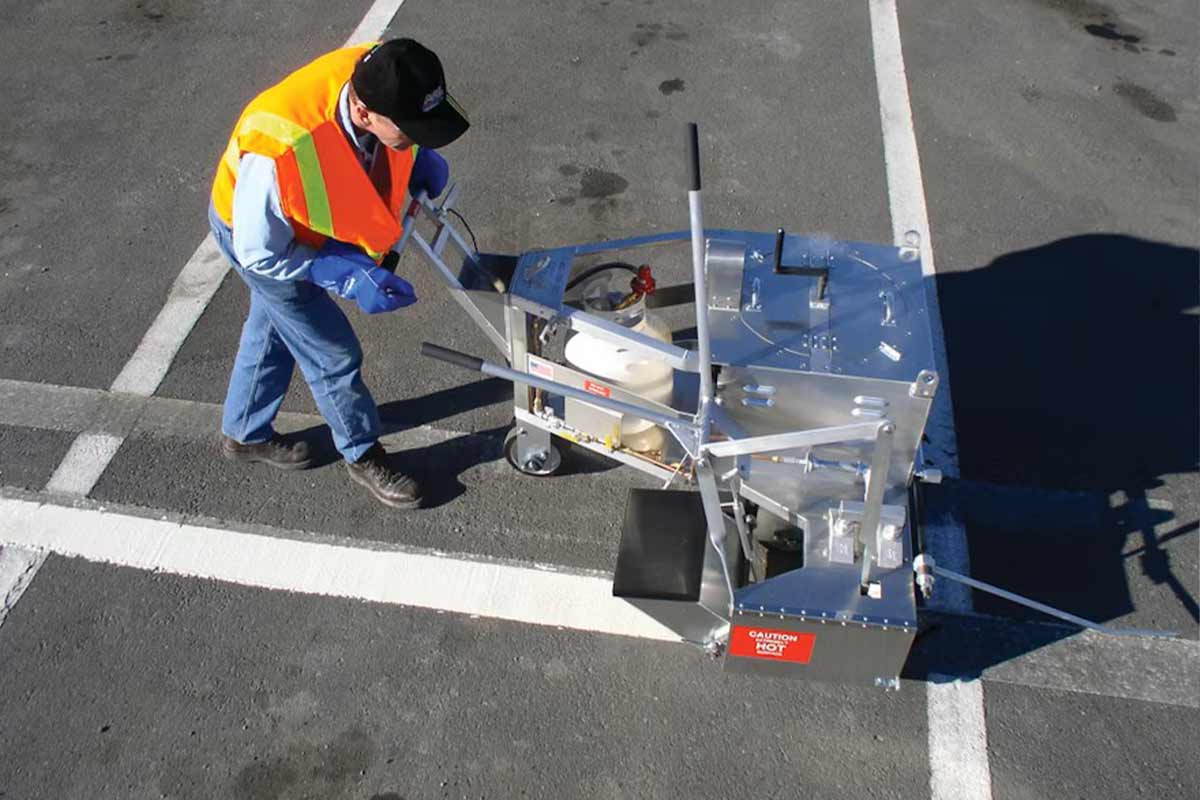
Thermoplastic application is its own workflow with its own equipment. The thermoplastic compound (typically supplied in 50-pound bags of pelletized resin, pigment, glass beads, and aggregate) loads into a melting kettle and heats to roughly 400°F. The molten material feeds through a handheld extruder for low-volume work or a truck-mounted applicator for high-volume restriping. As the material lays down, drop-on glass beads scatter across the still-molten surface to embed and provide retroreflectivity. The marking cures in 5 to 10 minutes, fast enough that we can typically reopen a lane within 15 minutes of completion, which is meaningfully faster than the 30-plus minutes paint usually requires before vehicle traffic. The fast cure is part of why thermoplastic works for high-traffic commercial properties that cannot tolerate long lane closures.
Where Thermoplastic Pays Off (and Where Paint Wins)
Thermoplastic earns its premium on high-traffic, high-friction markings: stop bars, crosswalks, directional arrows, fire lanes, accessible-stall outlines, and any marking on a state-route-adjacent property under PennDOT 408 review. Waterborne paint still makes sense for low-traffic stall lines, large-scale full-lot restripes where budget governs, and any lot scheduled for resurfacing within the next 18 months — thermoplastic on doomed pavement is wasted spend. Most Pittsburgh-area commercial properties we serve use a mix: thermoplastic on critical zones, paint on stall fields. The mixed-strategy approach lets us spend the thermoplastic premium where it returns 3-to-5x service life and keep the budget on routine markings where annual refresh is acceptable.
Service Areas Across Allegheny, Butler & Beaver Counties
We apply thermoplastic across Allegheny, Butler, Washington, and Beaver counties: Cranberry Township, Sewickley, Moon Township, Coraopolis, Robinson, Aliquippa, Beaver, Washington, and Canonsburg. Highest demand comes from properties adjacent to PennDOT routes (PA-19, Route 228, US-22, I-79, I-376), and from hospital ER lots, big-box retail, and high-volume distribution centers along the I-79 / I-376 corridor where high-friction markings see heavy daily traffic.
Application Window & Scheduling
Thermoplastic requires roughly 50°F+ ambient temperature and dry pavement to bond properly, which limits NW Pittsburgh application to roughly May through October. Cold pavement cools the molten material too quickly and leads to weak bond and premature delamination. We schedule thermoplastic work aggressively in summer and early fall, especially for property managers who need fire-lane and stop-bar refresh before the snow season. Booking 3 to 4 weeks ahead is typical for peak summer; emergency scheduling is often available for high-priority compliance work.
At a Glance
Comparison table
| Material | Service life | Plow scrape resistance | Application temp |
|---|---|---|---|
| Thermoplastic | 3-5 yr | high resistance | 50°F+ ambient |
| Waterborne paint | 12-18 mo | low resistance | 50°F+ ambient |
| Preformed cold-applied | 5-7 yr | moderate resistance | works in cooler ambient |
Process list
- (numbered): (1) Surface prep (sweep, blow, pressure-wash if needed)
- Pre-mark layout
- Heat thermoplastic to 400°F
- Extrude lines through handheld or truck applicator
- Drop glass beads
- Cure 5-10 min
- Reopen lane
For a full list of our pavement marking services, visit our full NW Pittsburgh pavement marking services page.
Businesses We Serve




How it Works

GET A FREE ESTIMATE
Contact us today and we’ll have a quote to you in 24 hours

SCHEDULE AN INSTALLATION
We’ll have your installation scheduled restriped in less than 7 days, without affecting your business hours

GET A PARKING LOT THAT POPS
For a budget-friendly price, you’ll get a parking lot that looks like new
We proudly work with:


We proudly work with:
Frequently Asked Questions About Thermoplastic Striping in NW Pittsburgh, PA
Why does thermoplastic outlast paint in Pittsburgh?
Pittsburgh winters drive 30–40 freeze-thaw cycles per year, and each cycle expands and contracts pavement enough to fatigue ordinary waterborne traffic paint. Thermoplastic, by contrast, is a hot-applied resin-and-aggregate system that bonds chemically to asphalt and survives freeze-thaw far better. In our experience, thermoplastic on a Pittsburgh commercial lot lasts 3–5× longer than waterborne paint on the same surface — which is why we recommend it for stop bars, crosswalks, and fire-lane markings.
What spec does the thermoplastic meet?
Our thermoplastic meets AASHTO M249 — the federal standard for hot-applied alkyd thermoplastic pavement marking — and PennDOT Publication 408, the PA state spec governing pavement markings on state-route-adjacent commercial properties. M249 covers binder content, glass-bead drop rate, retroreflectivity, and softening point. Publication 408 layers PA-specific requirements for sheeting grade and bead application that are often required on commercial work in Allegheny and Butler counties.
How is thermoplastic applied?
Thermoplastic is heated to roughly 400°F in a melting kettle, fed through a handheld extruder or truck-mounted applicator, and laid down on prepared pavement. Glass beads are dropped on top of the still-molten material to embed for retroreflectivity. The marking cures in 5–10 minutes — fast enough that we can typically reopen a lane within 15 minutes of completion, vs paint which usually needs 30+ minutes before vehicle traffic.
Where should we use thermoplastic vs waterborne paint?
Thermoplastic earns its premium on high-traffic, high-friction markings: stop bars, crosswalks, directional arrows, fire lanes, accessible-stall outlines, and any marking on a state-route-adjacent property under PennDOT 408 review. Waterborne paint still makes sense for low-traffic stall lines, large-scale full-lot restripes where budget governs, and any lot scheduled for resurfacing within 18 months. Most commercial properties we serve use a mix — thermoplastic on critical zones, paint on stall fields.
Can thermoplastic be applied year-round in PA?
No. Thermoplastic requires roughly 50°F+ ambient temperature and dry pavement to bond properly, which limits Pittsburgh application to roughly May through October. Cold-weather pavement cools the molten material too quickly, leading to weak bond and premature delamination. We schedule thermoplastic work aggressively in summer and early fall, especially for property managers who need fire-lane and stop-bar refresh before the snow season.
Will plow blades damage thermoplastic markings?
Plow blades scrape painted markings every winter and gradually peel them off, but thermoplastic survives plow contact much better because it is bonded to the pavement rather than sitting on top. We’ve inspected thermoplastic markings four winters into Allegheny County snowbelt lots and found them still functionally intact — vs the same lot’s paint markings which would typically need refresh every spring. The plow-resistance advantage is one of the main reasons thermoplastic pencils out in Pittsburgh.