ADA Parking Lot Striping
In NW Pittsburgh, PA
ADA Compliant Parking Spaces, Access Aisles, and Unloading Zones
1-800-STRIPER provides ADA-compliant parking lot striping in NW Pittsburgh, PA — installing accessible spaces, van-accessible stalls, access aisles, ISA symbols, and required signage per ADA Standards for Accessible Design and the PA Accessible Parking Permit Act (Act 50 of 1997).
1-800-STRIPER® of NW Pittsburgh PROVIDes ADA Parking Lot Striping in NW Pittsburgh, PA | 1-800-STRIPER Services NEAR YOU
Need to make your property more accessible?
Upgrade your facility to become fully ADA compliant by partnering with us to create clear, accessible parking for all your visitors.
Our ADA Compliant line striping services include:
ADA + PA Act 50/1997 — The Code Stack
Two layers of code govern accessible parking on every NW Pittsburgh commercial lot. The federal 2010 ADA Standards for Accessible Design set the baseline: minimum stall counts by total lot size, van-accessible ratios (at least 1 in every 6 accessible stalls), access-aisle widths (5-foot minimum for standard accessible, 8-foot minimum for some van-accessible configurations), ISA pavement symbols, and R7-8 sign requirements at minimum 60 inches mounting height. The PA Accessible Parking Permit Act of 1997 (Act 50) layers state-level enforcement on top, defining permit issuance, fine schedules for non-compliance, and the legal basis for towing unauthorized vehicles per PA Title 75 §3353. Local enforcement happens at the municipal and county level. Allegheny County Department of Human Services accepts accessibility complaints, and Pittsburgh Bureau of Police can authorize tow-away. The combined federal + state + local stack is what we design every accessible-stall project against.
Stall Ratios & Layout Math
ADA stall ratios scale with total parking. For total parking of 1 to 25, you need 1 accessible stall (and that stall must be van-accessible). 26 to 50 total: 2 stalls. 51 to 75: 3. 76 to 100: 4. 101 to 150: 5. 151 to 200: 6. 201 to 300: 7. 301 to 400: 8. 401 to 500: 9. 501 to 1,000: 2% of total. 1,001 and up: 20 stalls plus 1 per 100 over 1,000. At least 1 in every 6 accessible stalls must be van-accessible, with separate stall + aisle dimensions. Most NW Pittsburgh commercial lots fall in the 50 to 200 stall range, which puts the accessible-stall count between 2 and 6, meaning 1 to 2 of those must be van-accessible. We work the ratio against the lot’s total stall count before any layout work begins.
Van-Accessible vs Standard Accessible
A standard accessible stall is at least 8 feet wide with a 5-foot access aisle alongside. A van-accessible stall has two valid configurations: 11 feet wide with a 5-foot aisle, or 8 feet wide with an 8-foot aisle. Either configuration leaves room for a side-loading wheelchair lift to deploy. The van-accessible stall must be marked “VAN ACCESSIBLE” on its R7-8 sign and is typically located closest to the building entrance or accessible route. Two adjacent accessible stalls can share a single 5-foot access aisle between them, which often saves a few square feet of layout, though we usually recommend dedicated aisles where space allows.
2% Slope Cap — Pittsburgh’s Hilly-Terrain Reality
ADA Standards cap the running slope and cross-slope at 2% in any direction within an accessible stall, the access aisle, and the connecting accessible route. Many NW Pittsburgh commercial properties sit on grades that exceed 5% across a single lot. Designing around the grade typically means relocating accessible stalls to the flattest section of the lot (often a rear corner near a side entrance), occasionally adding ramp segments where the path of travel crosses a steeper zone, and sometimes regrading a small zone before stripe install. The work is far cheaper to plan in design than to remediate post-install. A slope-violating accessible stall often requires re-grading the full zone before a passing inspection.
ISA Symbol + R7-8 Signage
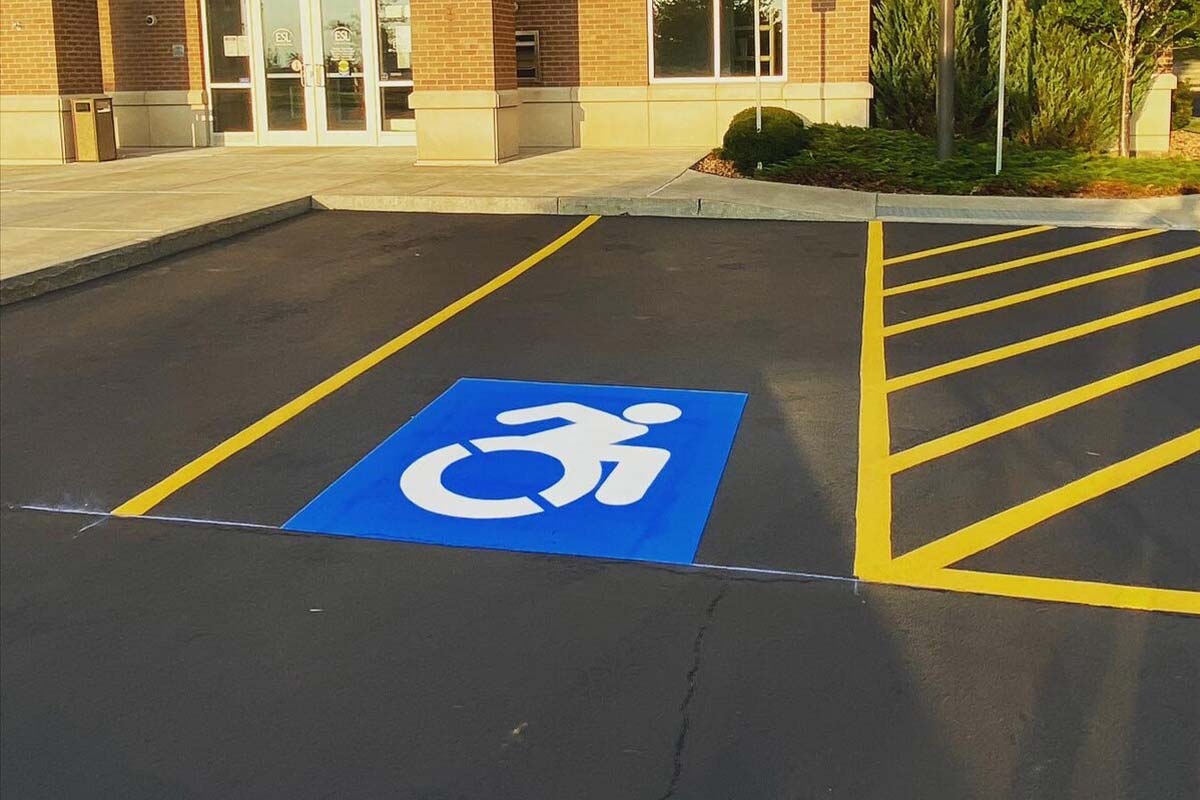
The International Symbol of Accessibility (ISA) is the standard wheelchair-and-figure pictogram, painted in white on a blue background, sized 36 inches by 36 inches minimum on pavement and centered in each accessible stall. The R7-8 sign — a vertical post-mounted sign with the same wheelchair pictogram — installs at each accessible stall with the bottom of the sign-face at minimum 60 inches above pavement. Van-accessible stalls add a “VAN ACCESSIBLE” plaque below the R7-8. Together, the pavement ISA, post-mounted R7-8, and correct stall and aisle dimensions complete the visible compliance set required for inspection.
Service Areas Across 4 Counties
We install ADA-compliant accessible parking across Allegheny, Butler, Washington, and Beaver counties. Most call volume comes from property managers running ADA upgrades after a layout change, post-resurface restripe, or a complaint-driven compliance review.
At a Glance
Stall ratio table
- 1-25 → 1 (van-accessible required)
- 26-50 → 2
- 51-75 → 3
- 76-100 → 4
- 101-150 → 5
- 151-200 → 6
- 201-300 → 7
- 301-400 → 8
- 401-500 → 9
- 501-1,000 → 2% of total
- 1,001+ → 20 + 1 per 100 over 1,000
Process list
- (numbered): (1) Survey lot
- Count total stalls
- Calculate ADA ratio
- Site slope assessment
- Layout van + standard accessible
- Stripe
- Install ISA + R7-8 signs
For a full list of our pavement marking services, visit our full NW Pittsburgh service lineup page.
Businesses We Serve




How it Works

GET A FREE ESTIMATE
Contact us today and we’ll have a quote to you in 24 hours

SCHEDULE AN INSTALLATION
We’ll have your installation scheduled in less than 7 days, without affecting your business hours

GET A PARKING LOT THAT POPS
For a budget-friendly price, you’ll get a parking lot that looks like new!
We proudly work with:


We proudly work with:


Frequently Asked Questions About ADA Parking Lot Striping in NW Pittsburgh, PA
How many ADA stalls does my Pittsburgh lot need?
Stall ratios follow the ADA Standards for Accessible Design and the PA Accessible Parking Permit Act of 1997. For total parking 1–25, 1 accessible stall (must be van-accessible). 26–50: 2 stalls. 51–75: 3. 76–100: 4. 101–150: 5. 151–200: 6. 201–300: 7. 301–400: 8. 401–500: 9. 501–1,000: 2% of total. 1,001+: 20 stalls plus 1 per 100 over 1,000. At least 1 in every 6 accessible stalls must be van-accessible.
What’s the difference between standard accessible and van-accessible?
A standard accessible stall is at least 8 ft wide with a 5-ft access aisle alongside. A van-accessible stall is either 11 ft wide with a 5-ft aisle, or 8 ft wide with an 8-ft aisle. Either configuration leaves room for a side-loading wheelchair lift to deploy. The van-accessible stall must be marked “VAN ACCESSIBLE” on its R7-8 sign and is typically located closest to the building entrance or accessible route.
How does Pittsburgh’s hilly terrain affect ADA layouts?
ADA Standards cap the running slope at 2% in any direction within the accessible stall, the access aisle, and the connecting accessible route. Many NW Pittsburgh commercial properties sit on grades that exceed 2% across the lot — sometimes exceeding 5% on hillside properties. The fix is usually to relocate accessible stalls to the flattest section of the lot (sometimes the rear corner near a side entrance), and occasionally to regrade a small zone before stripe install.
Does PA add anything beyond federal ADA requirements?
Yes. The PA Accessible Parking Permit Act of 1997 (Act 50/1997) layers state-level enforcement on top of federal ADA — defining permit-issuance, fine schedules for non-compliance, and the legal basis for towing unauthorized vehicles parked in accessible stalls. Local enforcement happens at the municipal and county level. Allegheny County Department of Human Services accepts accessibility complaints, and Pittsburgh Bureau of Police can enforce tow-away under PA Title 75 §3353.
What goes into an ISA pavement symbol?
The International Symbol of Accessibility is the standard wheelchair-and-figure pictogram, painted in white on a blue background, sized 36″ × 36″ minimum on pavement. It’s centered in each accessible stall, visible to drivers on approach. Combined with the R7-8 sign at 60″+ mounting height (per ADA) and the proper stall and aisle dimensions, the ISA symbol completes the visible compliance set required for inspection and for use in accessibility-related litigation.
Can you handle a full ADA upgrade after a layout change?
Yes — ADA upgrades are one of the most common projects we run for NW Pittsburgh property managers. We typically combine the upgrade with a full lot restripe so accessible stalls land in the right zone after the layout change. Scope includes stall + aisle stripe to the new dimensions, ISA symbols, R7-8 signs at mounting height, paired wheel stops where needed, and any access-route stripe (crosswalks, ramp edges) connecting the lot to the building entrance.