Bollard Installation
In NW Pittsburgh, PA
Bollard Installation Services
1-800-STRIPER provides professional bollard installation in NW Pittsburgh, PA — embedded steel and concrete-filled bollards meeting ASTM F3016 impact ratings to protect storefronts, fire lanes, and pedestrian zones at commercial properties throughout Allegheny and Butler counties.
1-800-STRIPER® of NW Pittsburgh PROVIDes Bollard Installation in NW Pittsburgh, PA | 1-800-STRIPER Services NEAR YOU
Want to prevent accidents and protect your property?
Bollards provide physical protection for your customers and your property.
Safety and security:
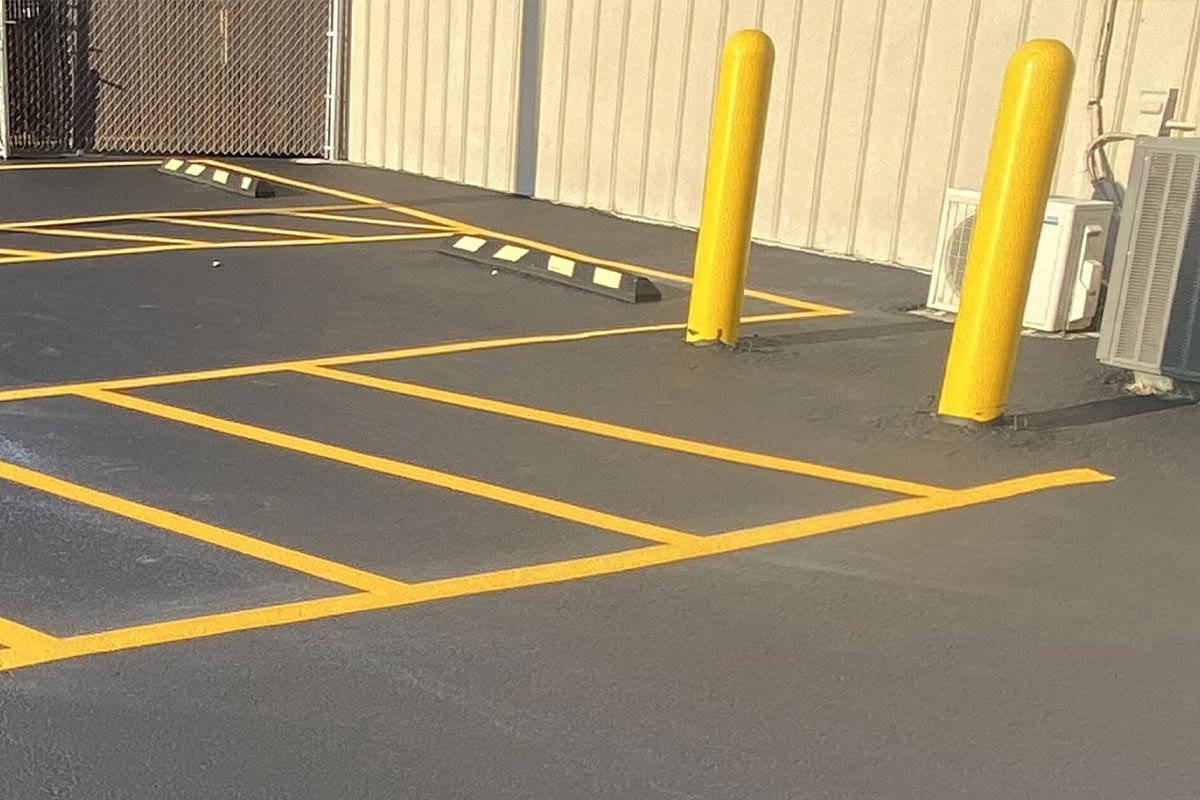
Bollards create a physical barrier between vehicles and pedestrians, protecting people in walking areas from accidental or intentional vehicle intrusions.
Bollards act as a protective barrier around storefronts, gas stations, and other vulnerable areas, minimizing the risk of costly damage from vehicle impacts.
Strategic Placement Locations:
ASTM F3016 Impact Ratings Explained
ASTM F3016 is the standard that defines how much impact force a bollard can absorb without permanent failure. The ratings cascade from S10 to S50 and describe the scenario each rating handles. S10 stops a 5,000-pound vehicle at 10 mph. S20 handles the same vehicle at 20 mph. S30 at 30 mph. S40 at 40 mph. S50 at 50 mph. For most NW Pittsburgh commercial storefront installations, S20 or S30 is the right spec; typical parking-lot collision speeds fall in that range. Higher ratings (S40 or S50) are reserved for fuel-station perimeters, high-security zones, and properties that have had a prior collision incident. The cost premium between rating tiers is usually less than the cost of replacing a storefront after a single high-speed strike.
Where to Install Bollards on a Commercial Property
Bollards do their job in three main zones. Glass storefronts are the obvious one — banks, retailers, restaurants, medical-office entries — where the cost of a vehicle striking through is far higher than the bollard install. Fire lanes and pedestrian crossings are the second zone, paired with stripe and sign markings to make the access priority unambiguous. Drive-thru lanes and fuel-station perimeters are the third, locations where a misjudged accelerator pedal can put a vehicle into a structure. We typically space bollards 4 to 6 feet on center for storefront protection, with the row offset 18 to 24 inches from the building face to leave a maintenance gap. For high-occupancy and sensitive-use facilities — schools, government buildings, public assembly venues — federal CISA Vehicle Ramming Mitigation guidance recommends additional perimeter standoff and impact-rating review.
Bollard Types & Selection
Four bollard types cover almost every commercial install. Fixed steel-pipe bollards (typically concrete-filled for additional impact mass) are the workhorse, installed in a concrete footing and rated S20 to S40 depending on diameter and footing depth. Removable bollards drop into a sleeve embedded in the pavement and pull out for valet, delivery, or event access — most commonly in fire lanes and loading zones where 24/7 obstruction would be a code problem. Retractable bollards are powered (hydraulic or pneumatic) and used at parking-garage entries, stadium ingress, and gated commercial properties. Decorative bollards include sleeve-style covers and architectural finishes that go over a rated steel pipe rather than replacing it.
Pittsburgh Venue & Storefront Examples
NW Pittsburgh has a wide range of bollard-application sites. Acrisure Stadium and PPG Paints Arena perimeters use combination fixed and retractable bollards for crowd control and vehicle access management. Suburban retail strips along PA-19, Route 228, and the Cranberry Township corridor specify storefront bollards in front of glass entries — Sheetz convenience stores, Giant Eagle and Trader Joe’s grocery anchors, PNC and First National bank branches. Drive-thru-heavy fast-food and coffee chains spec bollards at speaker islands and vehicle approach lanes. Each property type has its own preferred rating and finish, and we layout-check against the use case before quoting.
Service Areas Across Allegheny & Butler Counties
We install bollards across Allegheny, Butler, Washington, and Beaver counties. Most call volume comes from Cranberry Township and Butler County’s commercial growth corridor along PA-19 and Route 228, plus Allegheny County’s I-79 / I-376 commercial properties in Robinson, Moon Township, Coraopolis, and the Sewickley-area North Hills strip.
At a Glance
Comparison table
| Bollard type | Typical rating | Use case |
|---|---|---|
| Fixed steel-pipe (concrete-filled) | S20 to S40 | storefront, fire lane, pedestrian crossing |
| Removable | S10 to S20 | fire lane with valet/delivery access, loading zone |
| Retractable (powered) | S20 to S30 | parking-garage entry, gated property |
| Decorative cover (over rated steel) | matches base rating | architectural visibility |
Process list
- (numbered): (1) Site survey
- Mark anchor locations
- Excavate footing (36 to 48 inches deep, 18 to 24 inch diameter)
- Concrete pour
- Set bollard pipe with 4-inch embed
- Cap or decorate
For a full list of our pavement marking services, visit our back to 1-800-STRIPER of NW Pittsburgh services page.
Businesses We Serve




How it Works

GET A FREE ESTIMATE
Contact us today and we’ll have a quote to you in 24 hours

SCHEDULE AN INSTALLATION
We’ll have your installation scheduled in less than 7 days, without affecting your business hours

GET A PARKING LOT THAT POPS
For a budget-friendly price, you’ll get a parking lot that looks like new
We proudly work with:


We proudly work with:

Frequently Asked Questions About Bollard Installation in NW Pittsburgh, PA
What’s the difference between an ASTM F3016 S10 and S40 bollard?
ASTM F3016 ratings describe the impact force a bollard can absorb without permanent failure. S10 stops a 5,000-lb vehicle at 10 mph, S20 at 20 mph, S30 at 30 mph, S40 at 40 mph, and S50 at 50 mph. Most NW Pittsburgh storefront installations specify S20–S30 because typical parking-lot collision speeds fall in that range. Higher ratings (S40/S50) are reserved for fuel-station perimeters and high-security zones.
Can you install removable or retractable bollards?
Yes. Removable bollards drop into a sleeve embedded in the pavement and pull out for valet, delivery, or event access — most commonly in fire lanes and loading zones. Retractable bollards are powered (hydraulic or pneumatic) and used for traffic-control barriers at parking-garage entries, stadium ingress, and gated commercial properties. Both options carry impact ratings, just usually one rating tier below an equivalent fixed bollard.
How deep does a bollard footing need to be?
Most fixed steel-pipe bollards in NW Pittsburgh use a 36–48″ deep concrete footing, with the bollard pipe extending 4″ into the footing for an embedded anchor. The footing diameter is typically 18–24″, filled with reinforced concrete. Deeper footings are required for higher impact ratings (S30+) and for properties with frost-line concerns — Allegheny County frost line is 36″ minimum, so most bollard footings already exceed it.
Where on a property should bollards go?
Bollards protect three main zones: glass storefronts (typical retail and bank entrances), fire lanes and pedestrian crossings (paired with stripe and sign markings), and high-traffic vehicle approaches like drive-thrus and fuel-station perimeters. We layout-check every install for spacing — typically 4–6 feet on center for storefront protection, with the row offset 18–24″ from the building face to leave a maintenance gap.
Do bollards need to comply with the PA Uniform Construction Code?
For fire-lane bollards, yes — they must not obstruct the 20-ft minimum fire-lane width or 13’6″ overhead clearance specified in the PA UCC adoption of the 2018 IFC Chapter 5. Removable bollards in fire lanes also need to be unlocked by emergency responders without a special tool. For non-fire-lane installations, bollards mostly fall under property-owner discretion, with ADA Standards governing accessible-route clearances.
Can you paint or wrap bollards to match our brand?
Yes. After the structural install, we apply traffic-grade enamel or vinyl wrap in any color, including custom brand matches for retailers like Sheetz, Giant Eagle, PNC Bank, and the Pittsburgh-area medical groups. Yellow remains the most common safety color in the region (it’s the OSHA-recommended visibility standard). Decorative covers — sleeve-style stainless or aluminum — are also available on top of the rated steel pipe.