Parking Lot Layout Design
In NW Pittsburgh, PA
Customized Parking Lot Layouts
1-800-STRIPER provides professional parking lot layout design in NW Pittsburgh, PA — custom-engineered layouts that maximize parking capacity, ensure ADA compliance per ADA Standards for Accessible Design, and meet MUTCD pavement marking specifications using Graco LineLazer precision striping equipment.
1-800-STRIPER® of NW Pittsburgh PROVIDes Parking Lot Layout Design in NW Pittsburgh, PA | 1-800-STRIPER Services NEAR YOU
Are you ready to create a great first impression?
A proper parking lot layout with clear markings is critical for any business that serves the public. Let us help you make a great first impression with an attractive, well-organized, and safe parking lot.
Benefits:
Layout Goals: Capacity, Flow, Compliance
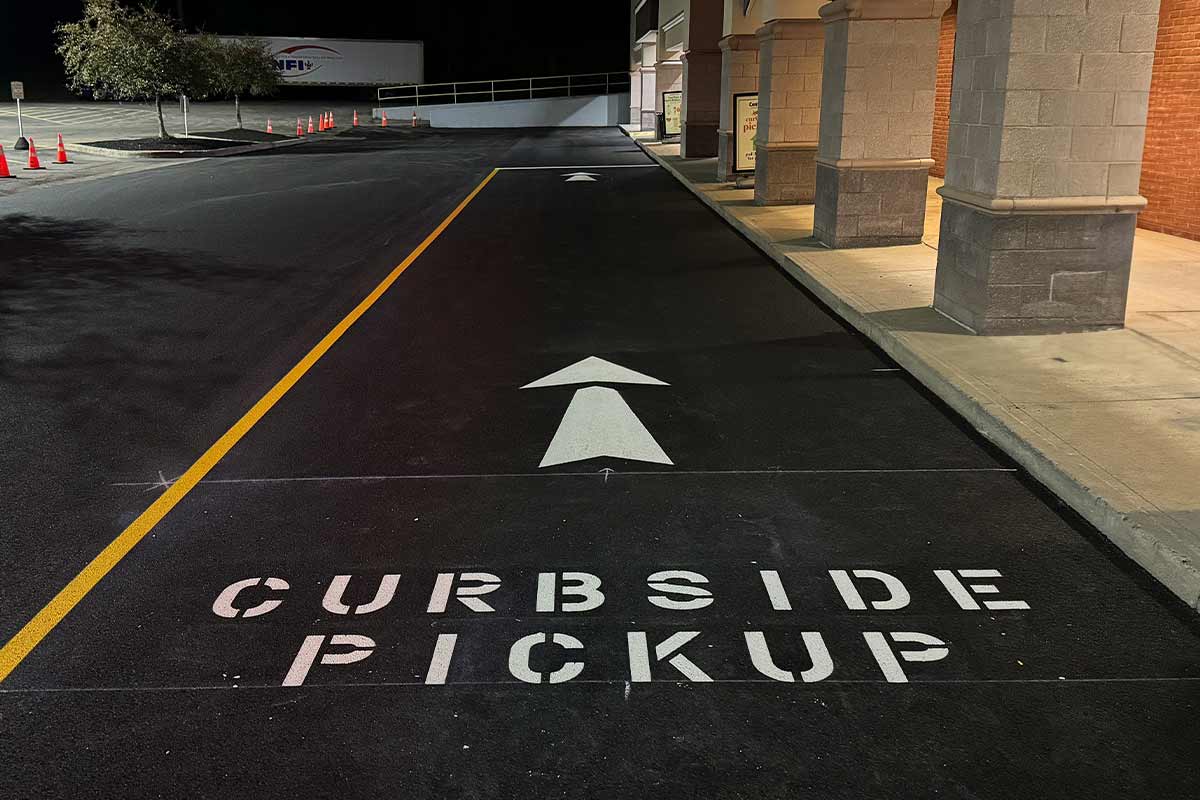
Three objectives shape almost every commercial parking-lot layout we design in NW Pittsburgh: capacity (stalls per acre), traffic flow (how vehicles enter, circulate, and exit), and compliance (ADA, fire code, MUTCD, plus the local zoning code). The three trade against each other. 90-degree (perpendicular) layouts maximize stall count per acre, typically 18 to 22 stalls per 10,000 square feet, but force slow backing-out and require wider drive aisles (typically 24 feet two-way). 60-degree angled layouts balance capacity and flow and are common at multi-tenant office parks. 45-degree layouts give the easiest vehicle entry and exit, which makes them popular at restaurants, drive-thrus, and quick-service retail, with a 15 to 20% capacity penalty vs 90-degree. We model each layout against the site’s footprint, the building’s tenant mix, and projected vehicle-flow patterns at peak hours.
ADA Compliance & PA Act 50/1997
The federal 2010 ADA Standards for Accessible Design set the baseline for accessible parking: minimum stall count by total lot size, van-accessible ratios (at least 1 in every 6 accessible stalls), access-aisle widths, and ISA symbol requirements. The PA Accessible Parking Permit Act of 1997 (Act 50) layers state-level enforcement on top, including tow-away authority and the schedule of fines for non-compliance. Local enforcement happens at the municipal and county level. Allegheny County Department of Human Services accepts accessibility complaints, and Pittsburgh Bureau of Police can enforce tow-away under PA Title 75 §3353. Pittsburgh’s hilly terrain adds a third constraint that out-of-state designers often miss: ADA caps the running slope at 2% in any direction within the accessible stall, access aisle, and connecting route. On steep lots, the accessible stalls almost always have to relocate to the flattest zone.
Hilly Terrain — Pittsburgh’s 2% Slope Challenge
Many NW Pittsburgh commercial properties sit on grades that exceed 5% across a single lot, easy to confirm by walking with a digital level or pulling the elevation contours from county GIS. ADA Standards cap the running slope and cross-slope at 2% within any accessible stall, access aisle, or pedestrian route connecting the lot to the building entrance. Designing around the grade typically means three things: relocating accessible stalls to the flattest section of the lot (often the rear corner near a side entrance), occasionally adding ramp segments where the path of travel crosses a steeper zone, and sometimes regrading a small zone before stripe install. The work is far cheaper to plan in design than to remediate post-install. ADA inspections that catch a slope violation can require re-grading the full accessible zone.
MUTCD Pavement Marking Specs
The Manual on Uniform Traffic Control Devices governs pavement marking width, color, and meaning even on private commercial property. Standard stall lines are 4 inches wide, white. Fire lanes use red curb paint with white “FIRE LANE NO PARKING” lettering. Crosswalks are typically 6-inch white parallel lines, 6 feet wide. Directional arrows follow MUTCD shape and proportion. Following MUTCD on commercial work matters because litigation after a parking-lot incident often leans on whether the markings followed the standard; non-compliant markings can shift liability to the property owner.
Cranberry Township & Suburban Growth
Cranberry Township and broader Butler County have grown commercial square footage roughly 12% from 2020 to 2025, the kind of growth that drives both new-build layout design and steady annual restripe demand for established lots. The PA-19 / Route 228 commercial corridor through Cranberry, Adams, and Jackson townships has seen meaningful expansion of medical-office parks, retail strips, and quick-service restaurants. Most new-build layout design we run starts with a green-field site survey, capacity model, ADA compliance check, and a layout draft delivered as part of the project pre-construction package.
Service Areas Across 4 Counties
We design parking-lot layouts across Allegheny, Butler, Washington, and Beaver counties. Highest demand comes from Cranberry Township, Adams Township, Jackson Township, Moon Township, Robinson, and the Sewickley North Hills strip — corridors with active commercial growth.
At a Glance
Comparison table
| Layout angle | Capacity | Flow |
|---|---|---|
| 90° (perpendicular) | maximum stalls per acre | slow backing-out, requires 24-ft aisles |
| 60° angled | moderate stalls per acre | moderate flow |
| 45° angled | fewer stalls (15-20% loss) | easiest entry/exit |
Process list
- (numbered): (1) Site survey
- Slope/grade assessment
- Capacity model
- ADA compliance check
- Stakeholder review
- Final layout draft
- Stripe install
For a full list of our pavement marking services, visit our other NW Pittsburgh parking lot services page.
Businesses We Serve




How it Works

GET A FREE ESTIMATE
Contact us today and we’ll have a quote to you in 24 hours

SCHEDULE AN INSTALLATION
We’ll have your installation scheduled in less than 7 days, without affecting your business hours

GET A PARKING LOT THAT POPS
For a budget-friendly price, you’ll get a parking lot that looks like new
We proudly work with:


We proudly work with:

Frequently Asked Questions About Parking Lot Layout Design in NW Pittsburgh, PA
What’s the difference between 90°, 60°, and 45° parking layouts?
90° (perpendicular) layouts maximize stall count per acre but make backing out slower and require wider drive aisles — typically the choice for retail and big-box. 60° angled layouts balance capacity and flow and are common at multi-tenant office parks. 45° layouts give the easiest vehicle entry and exit, which makes them popular at restaurants, drive-thrus, and quick-service retail — but lose 15–20% capacity vs 90°. We model each layout against the site’s footprint and use case.
How do you handle ADA compliance for a Pittsburgh parking lot?
The federal 2010 ADA Standards for Accessible Design set the baseline — minimum stall count by total lot size, van-accessible ratios, access-aisle widths, and ISA symbol requirements. The PA Accessible Parking Permit Act of 1997 layers state-level enforcement on top. Pittsburgh’s hilly terrain adds a third constraint: ADA caps the running slope at 2% in any direction within the accessible stall + aisle, which often forces re-grading on hillside properties before striping.
Why does Pittsburgh’s hilly terrain matter for layout design?
Many NW Pittsburgh commercial properties sit on grades that exceed 5% across a single lot — easy to confirm by walking with a digital level. ADA Standards cap the running slope and cross-slope at 2% within any accessible stall, access aisle, or pedestrian route. Designing around the grade typically means relocating accessible stalls to the flattest section of the lot, sometimes adding ramp segments, and occasionally regrading before paint — work that’s far cheaper to plan than to remediate post-install.
What MUTCD specifications apply to commercial parking lots?
The Manual on Uniform Traffic Control Devices governs pavement marking width, color, and meaning even on private commercial property. Standard stall lines are 4″ white. Fire lanes use red curb paint with white “FIRE LANE NO PARKING” lettering. Crosswalks are typically 6″ white parallel lines, 6 ft wide. Directional arrows follow MUTCD shape and proportion. Following MUTCD on commercial work matters because litigation after a parking-lot incident often leans on whether the markings followed the standard.
Do you handle truck or delivery zones for industrial properties?
Yes. NW Pittsburgh’s I-79 / I-376 / PA-65 corridor is dense with distribution centers, light-manufacturing facilities, and last-mile logistics yards. Truck-zone layout has its own constraints: turning radius minimums (typically 50–55 ft outside radius for an 18-wheeler), dock-door queue space, trailer-staging stalls (typically 12 ft × 65 ft), and bollard-protected pedestrian routes between yard and building. We design truck zones in the same project as adjacent passenger-vehicle parking.
How long does a parking lot layout design project typically take?
A small to mid-size commercial lot (under 200 stalls) typically runs 2–3 weeks from initial site survey to finished stripe. Site survey and slope assessment take 1–2 days. Layout design, capacity modeling, and ADA compliance check take 5–7 business days. Stakeholder review and revisions add 3–5 days. Actual stripe install runs 1–3 days depending on weather. Larger lots, multi-phase projects, and lots with regrading work can run 6–10 weeks.