Fire Lane Striping
In NW Pittsburgh, PA
Fire Lane and Fire Curb Striping Services
1-800-STRIPER provides professional fire lane striping in NW Pittsburgh, PA — marking compliant fire lanes, curbs, and no-parking zones per PA Uniform Construction Code (2018 IFC Chapter 5) requirements for commercial properties throughout Allegheny and Butler counties.
1-800-STRIPER® of NW Pittsburgh PROVIDes Fire Lane Striping in NW Pittsburgh, PA | 1-800-STRIPER Services NEAR YOU
Is your parking lot ready for first responders?
Our team is well-versed in local fire regulations and will parter with you to design a fire lane striping plan that creates unobstructed emergency access to protect your customers and property.
Core Services:
PA UCC 2018 IFC Ch 5 Requirements
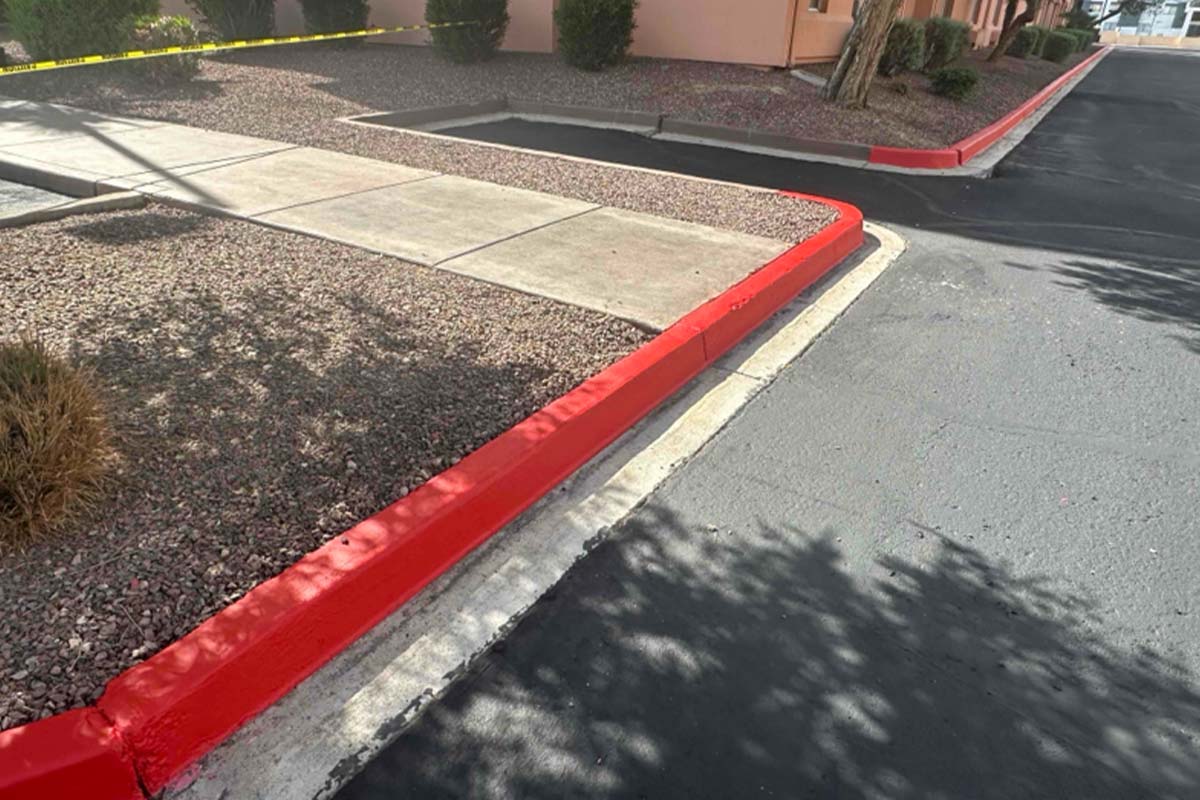
Two codes govern fire-lane striping in NW Pittsburgh, and the requirements are detailed enough that small drift triggers inspection failures. The PA Uniform Construction Code adopts the 2018 International Fire Code, including Chapter 5, which sets the on-the-ground commercial fire-lane spec. The key requirements: a 20-foot minimum unobstructed width measured curb-to-curb of clear vehicle path; a 13-foot 6-inch minimum overhead clearance the full length of the fire lane; red curb paint or red pavement striping along the entire length; “FIRE LANE NO PARKING” stenciled or signed at maximum 25-foot intervals along the lane; and accompanying R8-3 signs posted at the same intervals at minimum 80 inches mounting height. Larger drive aisles often delineate the 20-foot fire-lane zone with an inboard 4-inch white line so the lane is visible to drivers when no curbs are present. The PA UCC and IFC are enforced by the local fire marshal in each jurisdiction, meaning Cranberry Township FD, Pine-Richland FD, Sewickley Hills VFD, Moon Township FD, Coraopolis VFD, and the Pittsburgh Bureau of Fire all run independent inspections. Citations typically allow 14 to 30 days to remediate before fines escalate.
Fire Lane Width, Clearance & Striping Specs
The 20-foot width and 13-foot 6-inch clearance are unambiguous and inspection-critical. Many older NW Pittsburgh commercial properties have fire lanes that drift narrower over time. Landscaping encroachment, dumpster placement, and informal storage all close down the unobstructed width below 20 feet, which is an immediate citation. The clearance issue is most common at retail-to-warehouse transitions and at canopy-protected drive-thrus where the canopy can drop below 13 feet 6 inches. Striping spec: red curb paint along the entire length of any curb that bounds the fire lane, plus “FIRE LANE NO PARKING” stenciled in white on the curb at maximum 25-foot intervals. On non-curbed sections, an inboard 4-inch white line delineates the 20-foot fire-lane zone with “FIRE LANE NO PARKING” stenciled at intervals on the pavement. Color, font, and spacing all matter. Red is the only acceptable curb color, the legend must read “FIRE LANE NO PARKING” exactly (not “NO PARKING — FIRE LANE” or other variants), and the spacing is a hard cap at 25 feet. We pre-measure and lay out every project against the IFC spec before any paint goes down.
Pittsburgh Inspection Reality
Fire-lane inspections in NW Pittsburgh are run by the local fire department or fire marshal in each jurisdiction. Cranberry Township FD inspects the Butler County commercial corridor along PA-19 and Route 228. Pine-Richland FD covers the Wexford / Marshall Township strip. Sewickley Hills VFD and Moon Township FD cover the western Allegheny corridor. Coraopolis VFD and the Robinson Township FD cover the I-79 / I-376 commercial zone. The Pittsburgh Bureau of Fire (BoF) handles in-city properties. Most jurisdictions inspect annually as part of building-occupancy review, with more frequent inspections at hospitals, schools, and high-occupancy retail. Citations typically allow 14 to 30 days to remediate before fines escalate, and chronic non-compliance can result in occupancy-permit issues. The most-cited drift items: faded red curb paint, missing or off-spacing “FIRE LANE NO PARKING” stencils, signs mounted below the 80-inch minimum, and signs spaced beyond 25 feet. We’ve cleared dozens of inspection-driven remediation projects across the four-county area.
Curb Paint vs Pavement Stripe vs Stenciled Letters
Fire-lane marking has three working components, and getting all three right matters. Red curb paint covers the vertical face of the curb along the entire fire-lane length. Most NW Pittsburgh applications use a high-build alkyd or 100% acrylic curb paint that survives a couple of winters before refresh; thermoplastic curb paint extends the cycle to 3 to 5 years. White “FIRE LANE NO PARKING” stenciled letters appear on the curb face at maximum 25-foot intervals, with the letter height at 4 inches minimum so the legend is readable from a vehicle. On non-curbed sections of fire lane (think drive-aisle through a parking field), the marking shifts to pavement: an inboard 4-inch white line delineates the 20-foot zone, and “FIRE LANE NO PARKING” stenciled on the pavement marks intervals. The pavement stencil works best in thermoplastic because plow-blade scrape destroys painted pavement legend within a single winter. We typically recommend thermoplastic for any pavement-stenciled fire-lane work in Pittsburgh.
Re-Stripe Cadence — Paint vs Thermoplastic
Refresh frequency depends entirely on the marking material and the traffic / weather load. Waterborne paint fire-lane markings typically need annual refresh in NW Pittsburgh. Three Pittsburgh-specific factors accelerate paint wear: 30 to 40 freeze-thaw cycles per winter, snowbelt plow-blade scrape at curbs, and salt residue from winter de-icing. Most painted fire-lane stencils on a busy commercial property fade visibly by month 12 to 14 and require refresh by month 18 at the latest to stay inspection-ready. Thermoplastic fire-lane markings stretch the cycle to 3 to 5 years before refresh. Most of our hospital, retail, and high-occupancy clients have moved to thermoplastic for the curb stencils and front-door fire-lane sections — even when they keep paint elsewhere on the lot — because the inspection consequences for missed fire-lane refresh are higher than for missed stall-line refresh. We typically run an annual fire-lane visit for paint clients and a 3-year visit for thermoplastic clients, with a quick mid-cycle inspection in between to catch any plow damage.
Pairing Stripes with Signs & Bollards
Fire-lane stripes alone do not satisfy the IFC marking requirement. R8-3 “NO PARKING FIRE LANE” signs are mandatory at maximum 25-foot intervals at minimum 80 inches mounting height, paired with the stripe and stencil work. Bollards may be required at access-control points (entry curbs, key-line transitions, walking-route crossings) to protect the fire-lane zone from accidental incursion. Most fire-lane projects we run are coordinated stripe + sign + bollard installs that ship as a single inspection-ready package: stripes by our line crew, signs by our sign crew, bollards by our bollard crew, all on the same day. See our [parking lot sign installation] and [bollard installation] pages for the paired specs.
Service Areas — 4 PA Counties
We stripe and refresh fire lanes across Allegheny, Butler, Washington, and Beaver counties. Allegheny County coverage includes Cranberry Township, Sewickley, Moon Township, Coraopolis, Robinson, McCandless, Wexford, Pine, Marshall, Ross, and Bethel Park. Butler County coverage centers on the PA-19 / Route 228 commercial corridor: Cranberry, Adams, Jackson, Penn, and Forward townships, plus the Butler city center. Washington County coverage includes Washington, Canonsburg, McMurray, and Peters Township. Beaver County coverage includes Aliquippa, Beaver, Center Township, Hopewell Township, and the Beaver County airport corridor. Most call volume comes from properties along the I-79, I-376, and PA-65 commercial spines. We’ve handled fire-lane work for hospitals, hotels, retail strips, distribution centers, schools, churches, and HOAs across all four counties.
At a Glance
Code-spec checklist
- (numbered): (1) 20-ft minimum unobstructed width
- 13’6″ minimum overhead clearance
- Red curb paint full length
- “FIRE LANE NO PARKING” stencil every 25 ft maximum
- R8-3 signs every 25 ft at 80″+ mounting
- Inboard 4″ white line on non-curbed sections
Comparison table
| Material | Refresh cadence | Plow-scrape resistance |
|---|---|---|
| Waterborne paint | annual refresh | low |
| Thermoplastic curb stencil | 3-5 yr refresh | high |
| Thermoplastic pavement stencil | 3-5 yr refresh | very high |
For a full list of our pavement marking services, visit our all NW Pittsburgh parking lot services page.
Businesses We Serve




How it Works

GET A FREE ESTIMATE
Contact us today and we’ll have a quote to you in 24 hours

SCHEDULE AN INSTALLATION
We’ll have your installation scheduled in less than 7 days, without affecting your business hours

GET A PARKING LOT THAT POPS
For a budget-friendly price, you’ll get a parking lot that looks like new
We proudly work with:


We proudly work with:


Frequently Asked Questions About Fire Lane Striping in NW Pittsburgh, PA
What does the PA Uniform Construction Code require for fire lanes?
The PA UCC adopts the 2018 International Fire Code Chapter 5, which sets the baseline for commercial fire-lane requirements. Key specs: 20-ft minimum unobstructed width, 13’6″ minimum overhead clearance, red curb paint or red pavement striping, “FIRE LANE NO PARKING” stenciled or signed at maximum 25-ft intervals, and posted signs visible from the lane itself.
How wide and how marked does a fire lane need to be?
The fire lane itself must be at least 20 ft wide, measured from curb-to-curb of clear vehicle path. The standard marking sequence is red curb paint along the entire length, “FIRE LANE NO PARKING” stenciled on the curb at 25-ft intervals, and accompanying R8-3 signs posted at the same intervals at a minimum mounting height of 80″. On wider drive aisles, the 20-ft fire-lane zone is typically also delineated with an inboard 4″ white line.
How often does fire-lane striping need to be refreshed in NW Pittsburgh?
Waterborne paint fire-lane markings typically need annual refresh in Pittsburgh because freeze-thaw cycles, plow scrape, and salt residue degrade red paint visibility within 12–18 months. Thermoplastic fire-lane markings last 3–5 years before refresh, which is why most of our hospital, retail, and high-rise clients have moved to thermoplastic for the curb stencils and front-door fire-lane sections — even when they keep paint elsewhere on the lot.
Who inspects fire lanes in the Pittsburgh area?
Inspections are run by the local fire department or fire marshal in each jurisdiction — Cranberry Township FD, Pine-Richland FD, Sewickley Hills VFD, Moon Township FD, Coraopolis VFD, and the Pittsburgh Bureau of Fire (BoF) for in-city properties. Most inspect annually as part of building-occupancy review, with more frequent inspection at hospitals, schools, and high-occupancy retail. Citations typically allow 14–30 days to remediate before fines escalate.
Do fire-lane signs and bollards have to pair with the stripes?
Yes — under the IFC, fire-lane stripes alone do not satisfy the marking requirement. R8-3 “NO PARKING FIRE LANE” signs are mandatory at maximum 25-ft intervals at 80″+ mounting height, and bollards may be required at access-control points (entry curbs, key-line transitions, and walking-route crossings). We typically install stripes, signs, and bollards as a single coordinated project so the property passes inspection on the first visit.
Can a fire lane be repurposed for delivery or valet?
Only with very specific design — a clearly designated “Fire Lane / Loading Zone” combination with removable bollards and explicit posted signage that makes the access priority clear. The fire-lane width and clearance still has to be maintained 24/7, so any delivery or valet use must yield instantly to emergency vehicles. We’ve designed combination zones for several Pittsburgh-area hospital ERs, hotels, and retail front-door pickups, but they require fire-marshal sign-off before stripe install.