Warehouse Line Painting
In Union, NJ
OSHA-Compliant Safety Markings
1-800-STRIPER provides professional warehouse line painting in Union, NJ — aisle markings, pedestrian walkways, loading zones, and safety-zone floor marking that keep permanent aisles appropriately marked under OSHA’s warehousing standard for distribution facilities across North New Jersey.
1-800-STRIPER of Union PROVIDes Warehouse Line Painting Services NEAR YOU
Want your indoor space to operate more efficiently?
Warehouse and interior markings ensure clear traffic lanes, organized storage zones, and designated spaces designed to help your business operate safely and efficiently.
Benefits:
Warehouse Line Painting in Union, NJ
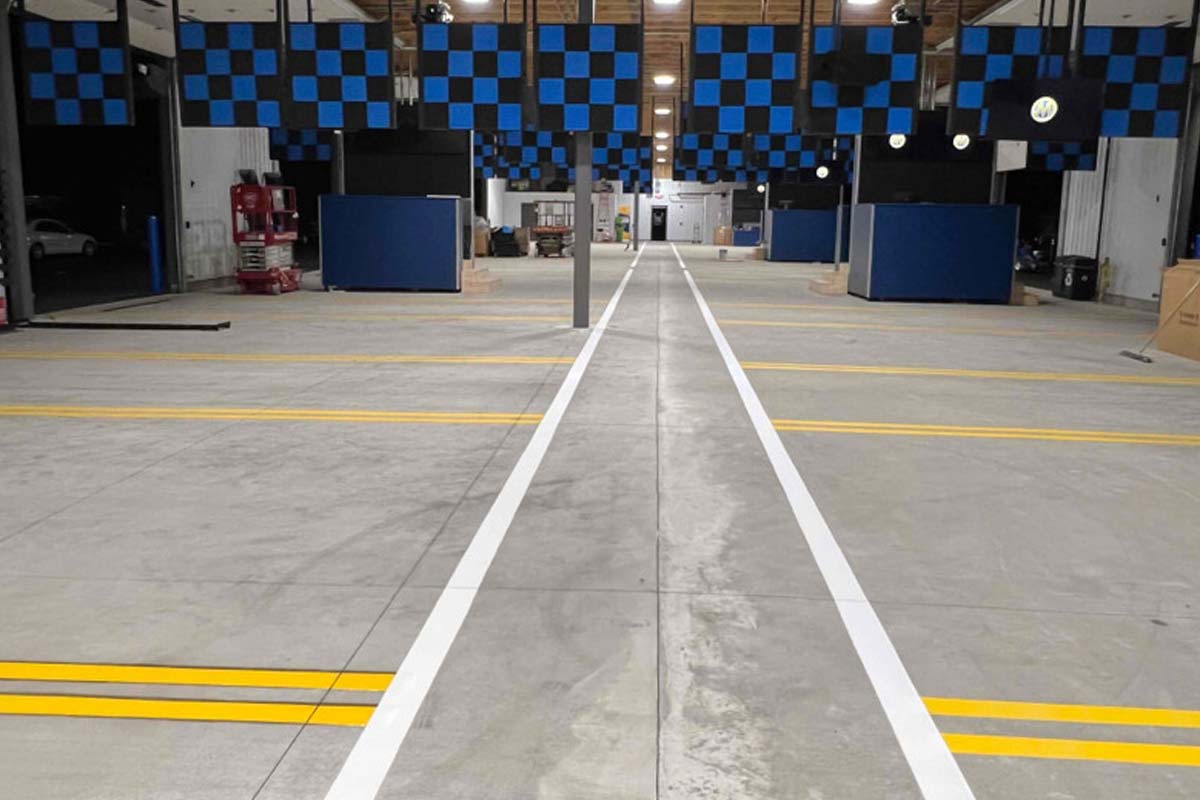
Open concrete tells a forklift driver nothing and a pedestrian less. Marking is what turns it into defined areas: aisles that stay clear, walkways pedestrians can be held to, staging zones that do not creep, and equipment areas that are visibly off-limits. 1-800-STRIPER of Union does this work for distribution and industrial facilities across North New Jersey.
Warehouse Line Marking for Aisles and Walkways
Warehouse line marking starts with the aisles, because that is where the regulation actually bites and where forklift and pedestrian paths cross.
We mark aisle boundaries continuously rather than in segments, so the edge reads as a limit and not as a suggestion. Where an aisle serves both powered equipment and people on foot, the pedestrian side is marked as its own defined channel rather than shared. On a working facility we phase the marking aisle by aisle so operations continue around us.
Warehouse Floor Marking Colors and What They Signal
Warehouse floor marking colors are the part of this work most often described as an OSHA requirement, and mostly they are not. Here is what is actually regulated and what is convention.
OSHA’s safety color code assigns red as the basic color for identifying fire protection equipment and apparatus, and for danger. It assigns yellow as the basic color for designating caution and for marking physical hazards — striking against, stumbling, falling, tripping, and caught-in-between. Those two colors are in the regulation.
Everything beyond that — white for equipment and workstations, blue for materials awaiting inspection, orange for energized equipment, green for safety materials — is industry convention supported by the voluntary consensus standard ANSI Z535.1, not a federal mandate. It is a good convention and we will follow whichever scheme your facility already uses. It is simply not the law, and a contractor telling you it is has not read the regulation.
What OSHA Actually Requires
The whole of the aisle-marking duty is one sentence. Under 29 CFR 1910.176(a), where mechanical handling equipment is used, sufficient safe clearances shall be allowed for aisles, at loading docks, through doorways and wherever turns or passage must be made; aisles and passageways shall be kept clear and in good repair, with no obstruction across or in aisles that could create a hazard; and permanent aisles and passageways shall be appropriately marked.
Read what is not there. No color is specified. No line width is specified. No aisle width is specified — the standard says “sufficient safe clearances,” which is a performance requirement judged against your equipment and your operation, not a number you can look up. Every competitor page in this market implies OSHA mandates a specific yellow stripe of a specific width. It does not, and knowing that is what lets you design a marking scheme that fits your facility instead of one that fits a myth.
Two consequences worth acting on. First, “permanent” is doing work in that sentence: the duty attaches to aisles that are part of the layout, which is why a staging area that has quietly become permanent should be marked. Second, “appropriately” means the marking has to actually communicate — which makes a faded line a compliance question and not just an appearance one.
Pedestrian Walkways and Crossing Points
The highest-consequence marking in a distribution facility is wherever a person on foot has to be in the same place as a forklift.
We mark walkways as continuous defined channels from door to destination rather than as fragments, and we mark the crossing points where a walkway meets an equipment aisle so both parties see the conflict before they arrive at it. Where sightlines are blocked by racking, the crossing is marked back from the corner rather than at it.
Warehouse Striping for Racking, Staging and Loading Zones
Warehouse striping beyond the aisles is what keeps a floor plan from drifting. Racking footprints marked to the floor make it visible when a run has been nudged out of line. Staging and outbound zones marked with defined boundaries stop pallets creeping into the aisle they were never meant to reach.
We also mark equipment and battery-charging areas, fire equipment clearances, electrical panel keep-clear zones and dock-door approach areas. All of it in the same visit, and all of it to whatever color scheme your facility already runs.
Loading Dock and Trailer Bay Markings
Dock markings do two jobs: they guide a driver reversing a trailer into position, and they keep the interior side of the door clear for the equipment that has to work there.
Union Township sets dimensions for the exterior side of this. Section 170-2601 of the township code requires a loading berth of 12 feet by 30 feet with 14 feet of vertical clearance, with the Planning Board able to require a berth up to 55 feet, and it requires on-site truck maneuvering to accommodate a WB-50 design vehicle per AASHTO. Marking berths to those dimensions is what makes them usable by the vehicle the code assumes.
Epoxy vs. Traffic Paint on Concrete
The coating choice on an interior concrete floor is a trade between service life and how long the area has to be out of use.
| Traffic paint | Epoxy | Thermoplastic | |
|---|---|---|---|
| Typical use | General aisle and zone marking | High-traffic aisles, wash-down areas | Exterior pavement, not interior floors |
| Service life on concrete | Shortest | Longest | Not applicable indoors |
| Return to service | Fastest | Longest — the main operational cost | Not applicable indoors |
| Surface prep demand | Moderate | Highest — profile and moisture matter | Not applicable indoors |
| Chemical and wash resistance | Lower | Higher | Not applicable indoors |
The honest summary is that most facilities are best served by traffic paint on the majority of the floor and epoxy only in the specific areas that justify the downtime. We will tell you which of your areas those are rather than quoting the whole floor in the more expensive product.
Distribution Facilities We Serve Across North New Jersey
Distribution centers, third-party logistics facilities, cold storage, manufacturing plants, food and beverage facilities, cross-dock operations, self-storage and equipment yards.
Our footprint is North New Jersey: Union, Morris, Essex, Somerset, Passaic, Bergen and Middlesex counties, across 79 towns. Union Township’s own section 170-1301 requires warehouse and distribution parking at one space per 3,000 square feet of gross floor area or one per employee on the largest shift, whichever is greater — a figure worth checking before a staffing change, because the employee limb can move the requirement without the building changing at all.
For a full list of our pavement marking services, visit our parking lot striping in Union page.
Businesses We Serve




How it Works

GET A FREE ESTIMATE
Contact us today and we’ll have a quote to you in 24 hours

SCHEDULE A STRIPING
We’ll have your space restriped in less than 7 days, without affecting your business hours

GET A PARKING LOT THAT POPS
For a budget-friendly price, you’ll get a parking lot that looks like new
We proudly work with:


We proudly work with:

Frequently Asked Questions About Warehouse Line Painting in Union, NJ
How to stripe a warehouse floor?
Start from the layout rather than from the paint. Identify which aisles and passageways are permanent, where pedestrians must travel, where equipment and staging areas sit, and where fire equipment and electrical panels need clearance. Then mark aisle boundaries continuously, mark walkways as defined channels, and mark crossing points where the two conflict. Surface preparation on concrete matters more than on asphalt — the coating bonds to a clean, profiled, dry floor and fails early on a dusty one.
What is the best paint for line marking?
It depends on the floor and the downtime you can afford. On interior concrete, traffic paint suits the majority of a facility: it returns to service quickly and is easy to refresh. Epoxy lasts considerably longer and resists wash-down and chemicals, at the cost of more surface preparation and a longer closure. The usual right answer is traffic paint across the floor with epoxy only in the specific high-traffic or wash-down areas that justify the downtime.
Does OSHA require a specific aisle marking color?
No, and this is the most widely repeated error about warehouse marking. The aisle-marking duty at 29 CFR 1910.176(a) says only that permanent aisles and passageways shall be appropriately marked. It specifies no color. OSHA’s separate safety color code assigns red to fire protection equipment and danger, and yellow to caution and physical hazards, but that is not an aisle-marking rule. The wider color scheme most facilities use comes from the voluntary consensus standard ANSI Z535.1, not from regulation.
How wide must a marked warehouse aisle be?
The regulation gives no number. 29 CFR 1910.176(a) requires that sufficient safe clearances be allowed for aisles, at loading docks, through doorways and wherever turns or passage must be made. That is a performance requirement judged against the equipment you actually run and the way you operate, not a dimension you can look up. In practice the aisle width is set by your largest handling equipment plus turning and pedestrian allowance, and it should be documented as your own determination.
What do the different floor marking colors mean?
Two of them are in the OSHA safety color code: red identifies fire protection equipment and danger, yellow designates caution and marks physical hazards such as tripping and caught-in-between points. The rest of the common scheme — white for equipment and workstations, blue for materials awaiting inspection, orange for energized equipment, green for safety materials — comes from the voluntary consensus standard ANSI Z535.1 and from industry practice. Consistency inside your facility matters more than which scheme you pick.
Which aisles have to be marked?
The duty at 29 CFR 1910.176(a) attaches to permanent aisles and passageways where mechanical handling equipment is used. The word doing the work is “permanent” — an aisle that is part of the operating layout is in scope, and a temporary lane opened for one project generally is not. The practical trap is the staging or through-route that was set up temporarily and has quietly become part of how the facility runs. If it is permanent in practice, mark it.
How long does warehouse floor marking last?
It depends on the coating, the traffic and the cleaning regime rather than on a calendar. Traffic paint in a high-traffic forklift aisle wears far faster than the same paint in a staging area, and a floor that is machine-scrubbed frequently loses marking faster than one that is swept. Epoxy lasts materially longer in the same conditions. The test that matters is legibility: once a line no longer clearly reads as a boundary, it has stopped doing the job the regulation asks of it.
Can you mark a floor without shutting the facility down?
That is how most of our warehouse work is done. Marking is phased aisle by aisle or zone by zone so operations continue around the crew, and scheduling is arranged so the areas you need first are released first. Many facilities prefer an off-shift or weekend window for the busiest aisles. We plan the sequence with your operations lead before the crew arrives so nothing is closed at the wrong moment.
What surface prep does an interior concrete floor need?
More than asphalt does, and it is where interior marking jobs succeed or fail. The floor needs to be clean, dry and free of dust, curing compound residue, oil and previous coating that is no longer adhering. Concrete also holds moisture, which will lift a coating applied over it. For epoxy the surface generally needs a mechanical profile as well. We assess the floor before quoting so the preparation is scoped rather than discovered on the day.
Do loading docks need marked berths?
The Township of Union sets dimensions for loading berths in section 170-2601 of its code — 12 feet by 30 feet with 14 feet of vertical clearance, with the Planning Board able to require up to 55 feet, and on-site truck maneuvering that accommodates a WB-50 design vehicle per AASHTO. Marking berths to those dimensions is what makes them usable by the vehicle the code assumes. Interior-side dock markings are separately worth doing, to keep the equipment approach clear.
Do you mark pedestrian crossings inside a warehouse?
Yes, and we treat them as the highest-consequence marking in the building. Wherever a pedestrian walkway meets an aisle used by powered handling equipment, the crossing is marked so both parties see the conflict before they reach it. Where racking blocks sightlines we set the crossing back from the corner rather than at it. This falls under the same duty to keep permanent aisles and passageways appropriately marked at 29 CFR 1910.176(a).