Parking Lot Sign Installation
In Union, NJ
ADA, Fire Lane, and Directional Signage
1-800-STRIPER provides professional parking lot sign installation in Union, NJ — setting accessible-space signs, fire lane no-parking signs, directional signage, and tow-away warnings under Union Township’s sign-permit requirements for commercial properties across Union County.
1-800-STRIPER of Union PROVIDes Parking Lot Sign Installation Services NEAR YOU
Are you communicating clearly?
We install new signs in adherence with local regulatory standards and can repair or replace damaged signs so you can clearly communicate your parking requirements.
Parking Lot Sign Installation in Union, NJ
Signage on a private lot in Union Township runs through the township’s own sign chapter, and whether a given sign needs a permit turns on what kind of sign it is. That distinction surprises most property managers, and it is the most useful thing to know before ordering signage here. Pavement markings tell a driver who is looking down; a sign tells a driver who is looking ahead, and for accessible spaces and fire lanes the sign is part of the requirement rather than optional decoration. 1-800-STRIPER of Union supplies and installs parking lot signage across Union County and the six surrounding counties, usually in the same engagement as the striping so the sign and the marking it belongs to go in together.
We install into asphalt, concrete and landscaped ground, on new posts or existing ones, and on building faces where a post is not practical. What we will not do is put a sign up in the Township of Union without first establishing whether Article 14 requires a permit for that particular sign, which is the subject of the next section.
Sign Permits in Union Township
Article 14 of the Township of Union code is unusually explicit, and it cuts both ways: it sets a permit requirement and then exempts several of the sign types most common on a commercial lot.
Before any sign, fixed awning, canopy or projecting object is altered or erected, a permit must first be obtained from the Construction Department. The application requires two sets of plans showing the proposed construction and the method of attachment. And the requirement applies to temporary as well as permanent signs — so a seasonal or event sign is in scope, not just a permanent installation.
Read the next subsection before assuming that covers your sign. Section 170-1403 carries an Exempt signs list, and its own words are that the exemptions “shall apply only to the requirement for a sign permit” — it exempts official traffic and directional signs, and signs which are required by any provision of law, and it charges no fee for a driveway directional sign. Two consequences matter on a commercial lot. An accessible-parking space sign is required by the 2010 ADA Standards, which puts it squarely in the required-by-law category. A one-way or entrance-and-exit sign is directional. The permit language in section 170-1401 is also written around signs erected upon, above or below a building or structure, which is not obviously a post set in a parking bay.
So the honest answer is that some of your signage is likely exempt from the permit and some of it may not be. The exemption does not relieve you of keeping the sign erected and maintained in good and safe condition — the ordinance says so explicitly — and the way to settle which is which for your site is to ask the Construction Department before ordering. We do that as part of the job rather than leaving it with you.
Section 170-1403 adds a requirement that is easy to overlook and easy to be cited for: each sign shall have prominently displayed a permit number as assigned by the Construction Department. A permitted sign with the number not displayed is not fully compliant.
Two placement rules from the same article are worth designing around. No sign may obstruct driving vision, traffic signals, or traffic directional and identification signs — which is a reason to resolve sign locations at layout stage rather than after the lines are down. And signs may not be attached to trees, fence posts, stumps, utility poles or other signs, so a post is a post and not a convenient existing upright.
Accessible Parking Signage
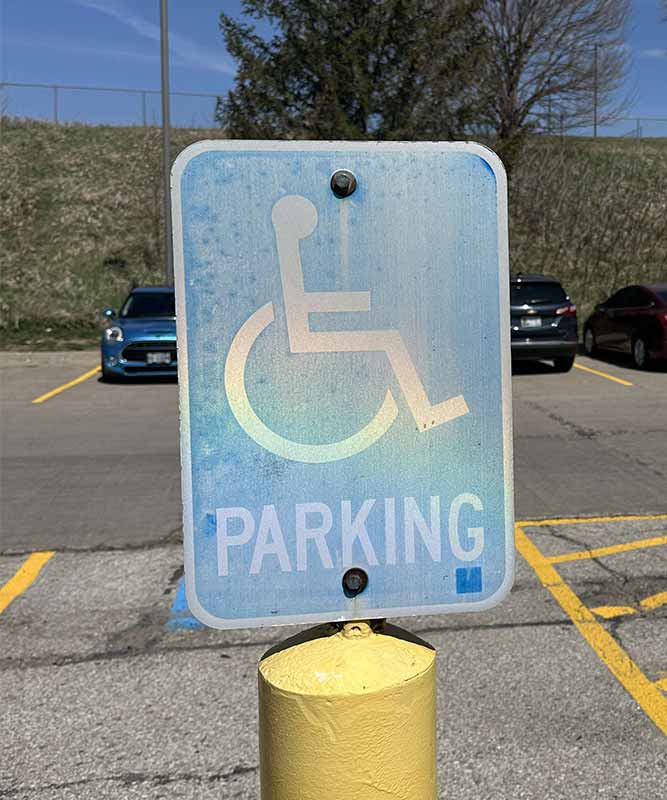
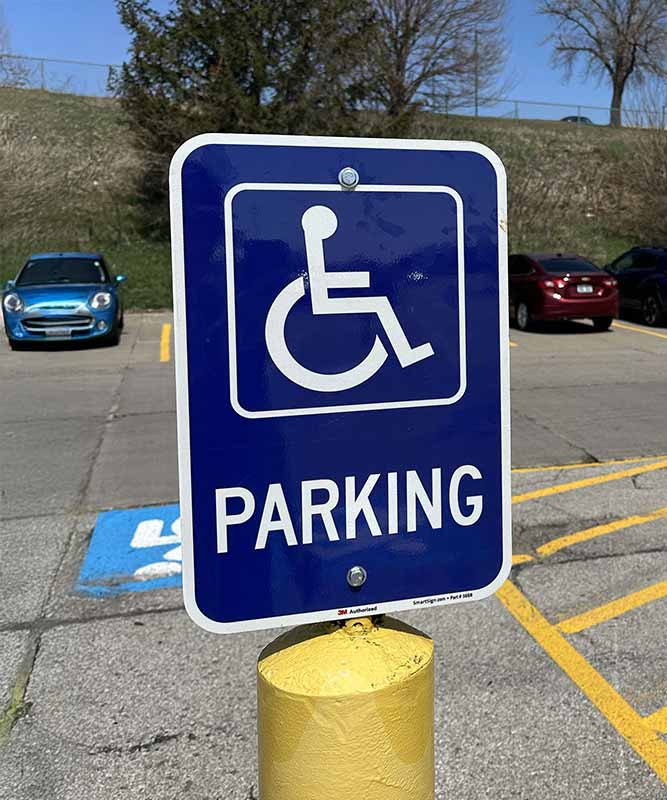
Accessible spaces are where signage is most clearly mandatory. Under the 2010 ADA Standards each accessible space requires an identification sign carrying the International Symbol of Accessibility, and spaces designated for vans must carry the words “van accessible” on that sign.
Mounting height is specified rather than conventional: the bottom of the sign sits a minimum of 60 inches above the finish floor or ground surface. The reason is practical — a sign lower than that is hidden by a parked vehicle at exactly the moment someone needs to read it. We set posts to that height as standard and we check existing installations against it, because a sign mounted low is one of the most common quiet failures on an older lot. Our ADA parking lot striping page covers the full accessible requirement, including the New Jersey Barrier Free Subcode layer that runs alongside the federal Standards.
Fire Lane and No-Parking Signs
Fire-lane signage is governed differently from accessible signage: the wording, size, mounting height and spacing come from your local fire official’s approval for your specific site rather than from a figure that applies everywhere.
That matters in this service area more than in most, because we cover 79 towns across seven counties and New Jersey delegates fire-prevention enforcement largely to local enforcing agencies and municipal fire officials. No single specification covers our footprint, and we do not carry one town’s sign schedule to another town’s lot. We confirm the requirement with the official having jurisdiction, then install to it — and in the Township of Union, we obtain the Construction Department permit for the sign as well. Our fire lane striping page covers the approval sequence.
Directional, Speed and Tow-Away Signage
| Sign type | Where it is normally used | Notes |
|---|---|---|
| Accessible space identification | At every accessible space | Required by the 2010 ADA Standards; ISA symbol; bottom at least 60 inches above the ground |
| Van accessible | At each van-accessible space | Must carry the words “van accessible” |
| Fire lane / no parking fire lane | Along designated fire lanes | Specification set by your local fire official |
| Stop and yield | At internal intersections and exits | Pair with a painted stop bar |
| Directional and one-way | At aisle entries on one-way circulation | Essential where the layout enforces direction |
| Entrance and exit | At site access points | Reduces wrong-way movement at the curb cut |
| Speed | On long internal drives | Enforceability on private property varies |
| Tow-away and private parking | At entrances and reserved areas | Wording is the operative part; check local requirements |
| Reserved, visitor, EV charging | At designated spaces | Often the most frequently changed signage on a site |
| Pedestrian crossing | At marked crossings | Pair with pavement marking |
A note on what these signs are and are not. The federal regulation that establishes the Manual on Uniform Traffic Control Devices as the national standard applies to traffic control devices on streets, highways, bikeways and private roads open to public travel — and it expressly excludes parking areas and the driving aisles within parking areas from that definition. So on the federal reading, your lot’s signs are not federally regulated devices. In the Township of Union that changes: section 266-83 requires signs and striping in a filed private parking area to conform to the current Manual on Uniform Traffic Control Devices. Both statements are true at different levels, and the municipal one is the one that governs a lot here.
For a full list of our pavement marking services, visit our parking lot striping in Union page.
Businesses We Serve




How it Works

GET A FREE ESTIMATE
Contact us today and we’ll have a quote to you in 24 hours

SCHEDULE AN INSTALLATION
We’ll have your installation scheduled in less than 7 days, without affecting your business hours

GET A PARKING LOT THAT POPS
For a budget-friendly price, you’ll get a parking lot that looks like new
We proudly work with:


We proudly work with:


Frequently Asked Questions About Parking Lot Sign Installation in Union, NJ
Can I put up my own no parking signs?
On your own private property you can post parking rules, but Union Township’s sign chapter still applies. Article 14 requires a Construction Department permit before a sign is altered or erected, with an application and two sets of plans showing the construction and method of attachment. Section 170-1403 then exempts several categories from that permit requirement, including official traffic and directional signs and signs required by any provision of law — which is where an accessible-parking sign sits. Confirm which of your signs fall inside the exemption before ordering.
Can anyone put up a road sign?
No. Regulatory signs on public streets are installed by the road authority with jurisdiction, not by adjacent property owners, and putting up an unauthorized sign in the public right-of-way is a different matter from signing your own lot. On private property you install your own parking signage — subject, in the Township of Union, to Article 14’s permit requirement and to the exemptions section 170-1403 sets against it. The township also prohibits attaching signs to trees, fence posts, stumps, utility poles or other signs.
What are the different types of parking signs?
The common set on a commercial lot: accessible space identification signs carrying the International Symbol of Accessibility, van accessible designations, fire lane and no-parking signs, stop and yield signs at internal intersections, directional and one-way signs, entrance and exit signs, speed signs on longer internal drives, tow-away and private parking notices, reserved, visitor and EV charging space signs, and pedestrian crossing signs. Accessible and fire lane signage are the two categories where the sign is part of a requirement rather than a choice.
How high should a sign be posted at a parking facility?
For accessible-space identification signs there is a specified figure: the 2010 ADA Standards require the bottom of the sign to be a minimum of 60 inches above the finish floor or ground surface, so it stays visible above a parked vehicle. For other parking-lot sign types there is no single height that applies everywhere — it depends on the sign type, the sight lines on your site, and your municipality’s own requirements. In the Township of Union, no sign may obstruct driving vision or other traffic signage.
How to install a sign post in concrete?
Two approaches, depending on the substrate. Where the post is set into the ground, the location is cored or excavated, the post is set plumb to the required height, and the void is backfilled with concrete and allowed to cure before the sign panel is loaded. Where the post has to stand on an existing slab, a base plate is mechanically anchored to sound concrete. The anchoring detail is also what the Township of Union asks to see: the permit application requires plans showing the method of attachment.
What does it mean if there are no parking signs?
On a private lot it usually means the parking rules are not being communicated, which makes them harder to enforce and easier to dispute. Some restrictions do not depend on a sign — Union Township’s section 170-2601 prohibits parking in fire lanes, landscaped areas, aisles, buffer areas, sidewalks and turning areas regardless. But accessible spaces specifically do require signage under the 2010 ADA Standards, so a lot with accessible markings and no accessible signs is incomplete rather than merely unsigned.
How far away can you park from a stop sign in NJ?
That is a public-street question rather than a parking-lot one, and it is governed by New Jersey motor vehicle law and your municipality’s own parking ordinances rather than by anything on a private lot. We would rather point you to your municipal clerk or police department for the figure that applies on your street than publish a number we have not verified. On private property, where vehicles may and may not stop is set by your site’s markings, signage and the applicable township provisions.
Do I need a permit to install a parking lot sign in Union Township?
It depends on the sign. Article 14 requires that before any sign is altered or erected a permit first be obtained from the Construction Department, with an application and two sets of plans showing the construction and method of attachment, and it covers temporary as well as permanent signs. But section 170-1403 exempts official traffic and directional signs, and signs required by any provision of law, from the permit requirement itself. Where a permit does issue, the sign must display the number assigned to it.
Do accessible parking spaces need a sign as well as pavement markings?
Pavement markings alone do not satisfy the 2010 ADA Standards. Each accessible space needs an identification sign displaying the International Symbol of Accessibility, and van spaces must be designated “van accessible” on that sign. The sign’s bottom edge must be at least 60 inches above the ground. Because that sign is required by a provision of law, section 170-1403 of the Union Township code exempts it from the township’s sign-permit requirement — though not from being kept in good and safe condition.