Parking Lot Restriping
In Union, NJ
Restripe Existing Lines and Markings
1-800-STRIPER provides professional parking lot restriping in Union, NJ — refreshing faded stall lines, ADA stalls, fire lanes, and directional arrows with durable traffic paint so every space stays clearly marked for commercial properties across Union and Morris counties.
1-800-STRIPER of Union PROVIDes Parking Lot Restriping Services NEAR YOU
Need to brighten up your faded parking lot?
Keep your parking lot safe and attractive by restriping annually to freshen up lines and symbols that have faded from the sun, weather, and traffic. Nothing beats a fresh coat of paint!
Benefits:
Parking Lot Restriping in Union, NJ
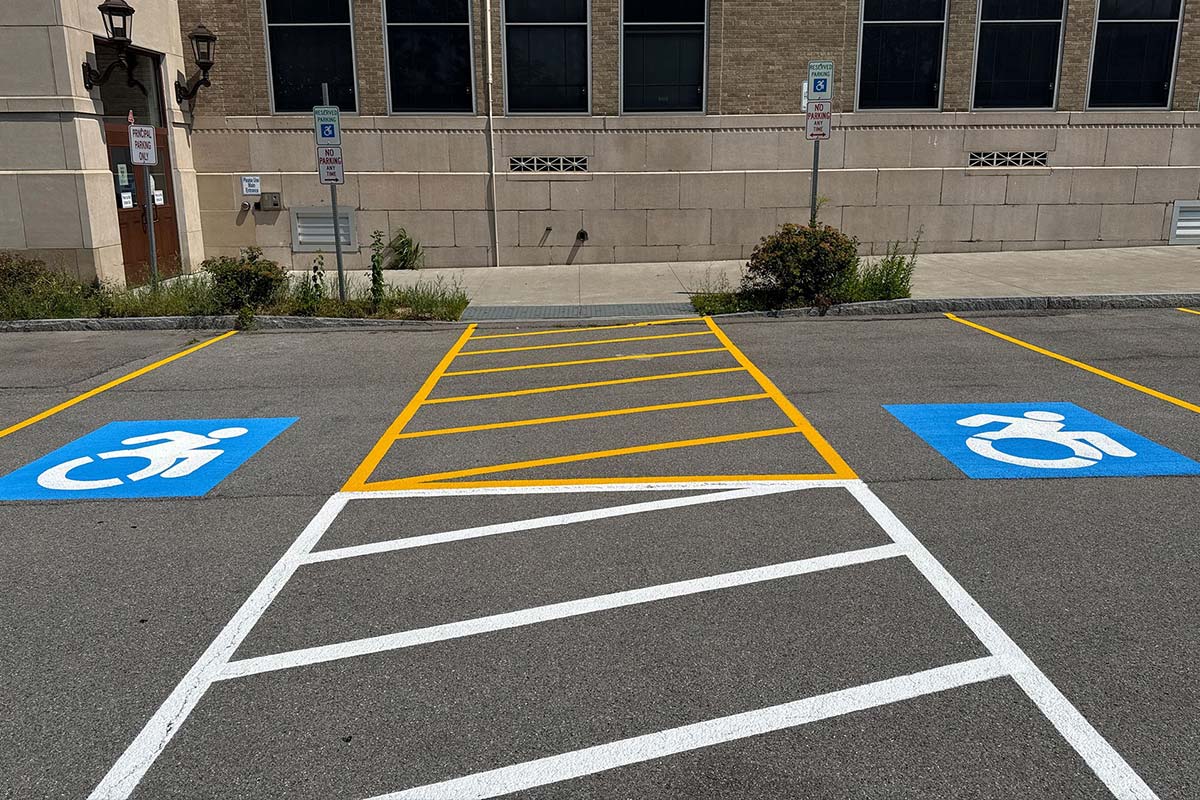
Restriping is the work of putting back what traffic, weather and plows have taken off a lot. Stall lines fade, arrows disappear, accessible symbols wear to a ghost, and the lot slowly stops telling drivers what to do. 1-800-STRIPER of Union restripes commercial properties across Union and Morris counties and out through Essex, Somerset, Passaic, Bergen and Middlesex.
The useful distinction is between refreshing a layout and changing one. Restriping puts fresh paint on the geometry you already have. If the geometry itself needs to change — more spaces, different angles, a compliant accessible bay where there was none — that is layout design, and it is a different scope with a different sequence.
When a Parking Lot Needs Restriping
No calendar answer fits every lot, because wear is driven by traffic volume, plow activity, sun exposure and the coating that was used last time. What we look for instead are conditions:
Stall lines that are readable at walking pace but not from a moving car. Arrows or stop bars that have lost their edges. Accessible symbols and access-aisle hatching that have faded to the point an enforcement officer could not identify the space. Drivers parking across lines, or clustering because they cannot see where a row starts. Snow-season scarring where the plow has caught a raised joint and stripped the paint along it.
In North Jersey the plow is usually the deciding factor. A lot that would hold its markings for years in a milder climate can lose a season’s worth of definition in one hard winter, and the damage is concentrated exactly where the traffic is.
What Union Township’s Ordinance Requires of Your Markings
This is the part most property managers have never been told, and in the Township of Union it changes restriping from a maintenance decision into a compliance one.
The township code requires that every vehicle parked in a private parking lot open to the public be parked so that the vehicle is entirely within the limits of the parking space marked upon the pavement. The obligation is written against the markings. If the markings have worn away, there is no space to be within — the condition the ordinance describes cannot be satisfied on a lot whose lines are gone.
Section 266-83 adds the standard those markings answer to, and it is the reason Union Township is unusual. It provides that signs and striping in a filed private parking area shall conform to the current Manual on Uniform Traffic Control Devices, pursuant to N.J.S.A. 39:4-198 and N.J.S.A. 39:4-183.27, and that the cost shall be borne by the operator. Federally, that manual does not reach a private parking area at all. In Union Township your own ordinance requires conformance regardless. Both statements are true, at different levels, and only the second one governs your lot.
Our Restriping Process
- Site walk and measure. We record the existing layout, count stalls, check accessible bays against current standards, and note pavement conditions that will affect adhesion.
- Layout confirmation. We confirm we are putting back the same geometry, or flag where the existing layout no longer complies and needs a decision before paint goes down.
- Surface preparation. Sweeping at minimum; power washing where oil, tire rubber or sediment would stop paint bonding. Fresh paint over a dirty surface fails early and fails unevenly.
- Scheduling and phasing. We agree which sections close in what order, so the lot keeps working while the crew moves through it.
- Layout and marking. Lines snapped and marked to the confirmed layout, then arrows, stop bars, crosswalks, hatching and accessible symbols.
- Cure and reopen. The lot stays coned until the coating is ready for traffic, then we walk it with you before we leave.
Restriping vs. a Full Relayout
Restriping is the cheaper and faster option, and it is the right one when the existing layout still works and still complies. It is the wrong one when it would preserve a problem.
Choose a relayout when the accessible spaces do not meet current standards, when the aisle widths do not match the parking angle the lot actually uses, when you need more capacity out of the same pavement, or when a change of use has changed how many spaces the township requires. In the Township of Union that last one has teeth: section 170-1301 sets parking minimums by use, and a building that becomes a warehouse or a medical office does not carry its old count with it.
Repainting a non-compliant layout resets the clock on a problem instead of fixing it, and the second visit costs what the first one did. Our parking lot layout design page covers the relayout path.
Surface Preparation Before Restriping
Paint bonds to the surface it lands on, not to the surface underneath it. Oil, grease, tire rubber, dust and organic film all break that bond, and the failure shows up as patchy edges and early wear rather than as an obvious fault on day one.
On most commercial lots a thorough sweep is sufficient. On lots with drive-through lanes, dumpster pads, delivery bays or long-standing oil staining, we recommend pressure washing the affected areas first. Our parking lot pressure washing page covers how that work is sequenced and how the wash water is handled. Where the pavement itself is failing — spalling, alligatoring, unsealed cracks — we tell you, because striping over a surface that is coming apart is money spent on a short-lived result.
Commercial Properties We Restripe
Retail centers and strip malls, office parks, industrial and distribution properties, medical and dental offices, schools and houses of worship, municipal facilities, apartment and condominium communities, self-storage sites and car dealerships.
The work looks different at each. A retail center is phased so storefronts stay reachable. A distribution property is usually scheduled around dock activity rather than around customers. A medical office needs its accessible bays done first and done right. A condominium community needs residents notified before rather than after. We plan around whichever of those you are.
For a full list of our pavement marking services, visit our parking lot striping in Union page.
Businesses We Serve




How it Works

GET A FREE ESTIMATE
Contact us today and we’ll have a quote to you in 24 hours

SCHEDULE AN INSTALLATION
We’ll have your installation scheduled in less than 7 days, without affecting your business hours

GET A PARKING LOT THAT POPS
For a budget-friendly price, you’ll get a parking lot that looks like new
We proudly work with:


We proudly work with:

Frequently Asked Questions About Parking Lot Restriping in Union, NJ
What is parking restriping?
Parking restriping is repainting the markings on an existing paved lot: stall lines, directional arrows, stop bars, crosswalks, accessible spaces and their access aisles, fire lanes, loading zones and no-parking hatching. It restores a layout that has faded rather than creating a new one. The distinction matters because if your existing layout no longer complies with current accessibility standards or your township’s dimensional minimums, repainting it preserves the problem instead of fixing it.
What does restriping a parking lot mean?
It means putting the existing layout back at full visibility. A crew confirms the current geometry, prepares the surface so paint will bond, then re-marks every element that has worn: stalls, arrows, stop bars, hatching, accessible symbols and fire-lane markings. It does not mean redesigning the lot. If the goal is more capacity, different parking angles or bringing accessible bays up to standard, that is layout design work and it is scoped separately.
How often should you restripe a parking lot?
There is no fixed interval that fits every property, because wear depends on traffic volume, plow activity, sun exposure and which coating was used last. In North Jersey the plow is usually the deciding factor, and a hard winter can take a season’s definition off a lot in one go. The practical test is condition rather than calendar: if lines are not readable from a moving vehicle, or accessible symbols and hatching have faded, the lot is due.
Do you need a permit to restripe a parking lot?
Repainting an existing approved layout is normally maintenance rather than permitted work. Two Union Township requirements sit nearby, though. Article 14 of the township code requires a Construction Department permit before a sign is erected or altered, so any new or replacement signage has its own permit path. And the township requires an individual plan on file for each private parking area open to the public. If your layout is changing rather than being refreshed, confirm the position with the township before the work is scheduled.
What do I need to stripe a parking lot?
For a compliant commercial result you need the existing or intended layout confirmed and measured, a clean and sound surface for the coating to bond to, a traffic-grade paint or thermoplastic suited to the substrate and traffic level, layout equipment that holds a straight line over distance, and the current accessibility and local dimensional requirements to mark against. The last item is the one that is usually missing, and it is the one that decides whether the finished lot passes inspection.
How do you calculate parking lot striping?
By measurement, not by rule of thumb. We measure the paved area, count existing and intended stalls, record the parking angle each row uses, measure aisle widths against the minimum for that angle, and identify how many accessible spaces the total space count requires. That produces a linear footage of line, a count of symbols and arrows, and a list of anything that does not currently comply. Contact us for a free estimate and we will walk the lot and do the measuring.
Does Union Township require my stripes to match a specific standard?
It does, and the requirement is unusual. Section 266-83 of the Township of Union code requires that signs and striping in a filed private parking area conform to the current Manual on Uniform Traffic Control Devices, pursuant to N.J.S.A. 39:4-198 and N.J.S.A. 39:4-183.27. Federally that manual does not govern a private parking area, because the relevant regulation excludes parking areas and their driving aisles. Union Township adopted it by reference for private lots anyway, so in this township it applies.
What happens if my stall markings have worn away?
You lose the condition the township code is written against. Union Township requires every vehicle in a private lot open to the public to be parked entirely within the limits of the parking space marked upon the pavement. Where the markings are gone, there is no marked limit for a vehicle to be within, so faded striping stops being an appearance issue and becomes a code condition. It is also the point at which drivers start parking across rows and you lose usable capacity.
How long before we can park on fresh stripes?
It depends on the coating and on the weather that day — temperature, humidity and direct sun all change it. We cone or barricade the marked sections until the product is ready for traffic and we give you the specific time for the material actually used on your lot, taken from the manufacturer’s written instructions rather than from a general figure. On most commercial jobs the phasing is arranged so the sections you need first are the sections marked first.
Can you restripe over the existing layout?
Usually yes, and that is the normal case. The exception is where the existing layout does not meet current requirements. In the Township of Union, section 170-2601 sets a minimum stall length of 20 feet, reduced to 18 feet where curb overhang is provided, and a minimum width of 9 feet, and it prohibits 90-degree one-way aisles outright. If your rows do not meet those figures, repainting them puts a non-compliant layout back down, and we will tell you before we do it.
Do you restripe fire lanes at the same time?
We do, and it is the sensible way to handle it: the lot closes once and the whole marking surface is consistent afterwards. Fire-lane markings and their signage answer to your municipal fire official rather than to the parking sections of the code, so we confirm the approved fire-lane locations before re-marking rather than assuming the faded lines were correct. Our fire lane striping page covers how that approval works across the towns we serve.
Do you restripe ADA stalls to current standards?
We restripe them to the current figures rather than tracing what is already down. An accessible bay laid out under an older standard can be short on stall width, short on access-aisle width, missing its van space, or sitting on a cross-slope steeper than the 1:48 the 2010 ADA Standards allow. Restriping is the moment to correct that, because the layout is already being re-marked. Our ADA parking lot striping page covers the full requirement, including the New Jersey Barrier Free Subcode layer.