
Wheel Stop Installation
In Central Miami, FL
Concrete and Rubber Parking Stops
1-800-STRIPER provides professional wheel stop installation in Central Miami, FL — anchoring concrete, recycled-rubber, and plastic-composite wheel stops at stall heads to protect sidewalks, storefronts, and ADA accessible routes for commercial properties throughout Miami-Dade County.
1-800-STRIPER® of Central Miami PROVIDes Wheel Stops Services NEAR YOU
Need to protect vehicles or walls from accidental damage?
Wheel stops (also called parking blocks) protect your property, enhance safety, and improve parking lot organization.
Benefits:
Wheel stops prevent vehicles from parking too far into a space or overextending into other spots, pedestrian walkways, and other areas, while also helping with vehicle alignment. They can prevent damage to buildings, curbs, or landscaping. Wheel stops also serve as clear visual cues for proper parking and are sometimes used on slopes to prevent cars from rolling.
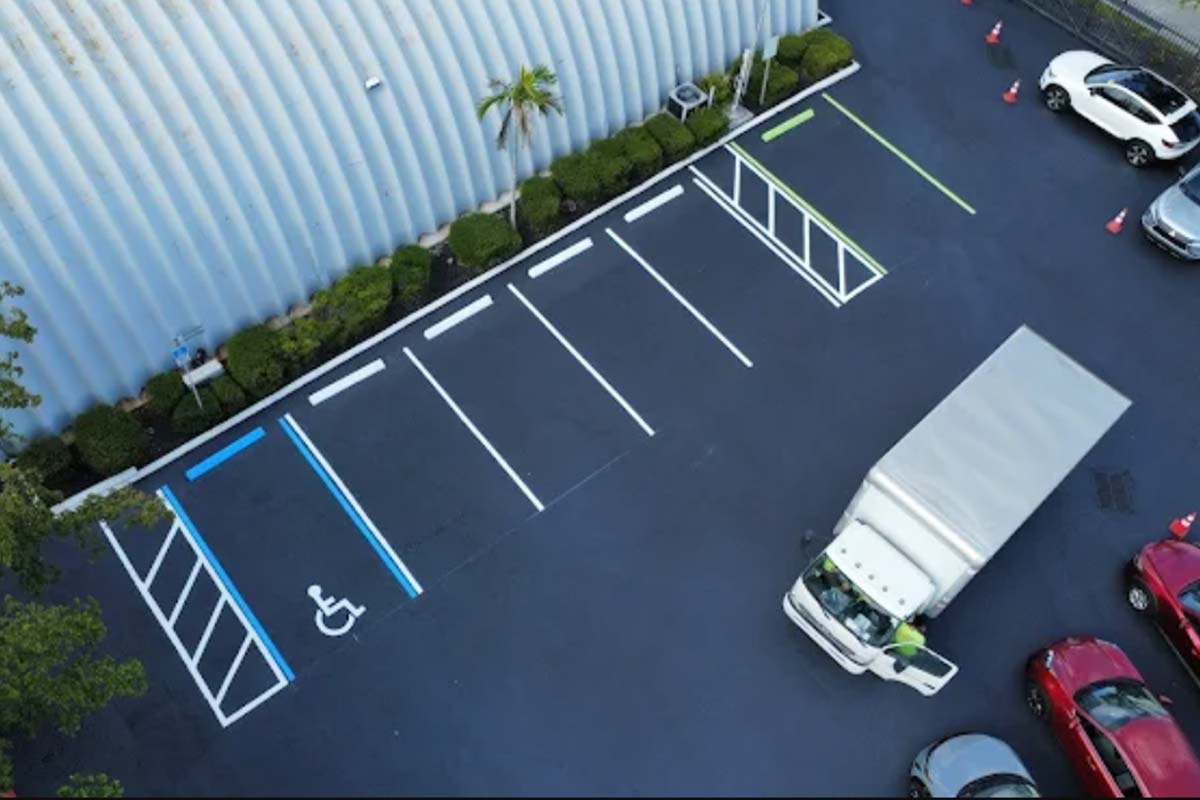
Wheel Stop Installation in Central Miami, FL
A wheel stop is a low barrier fixed at the head of a parking stall that a vehicle’s front tires meet before the rest of the vehicle can travel any further. It is one of the cheapest pieces of infrastructure on a commercial property and one of the few that prevents damage rather than repairing it.
What it protects is everything sitting just past the stall: sidewalks and the pedestrians on them, storefront glass and building facades, bollards, light poles, landscaping and irrigation, electrical and utility equipment, fencing, and — most consequentially — the accessible routes people rely on to reach the entrance.
We install and replace wheel stops across Miami-Dade County: retail centers, office parks, medical and dental plazas, restaurants, hotels, condominium and HOA parking, self-storage, schools, and houses of worship. Most jobs pair with striping, because a wheel stop is set from the stall geometry and the two decisions belong together.
Concrete, Rubber, and Composite Wheel Stops
| Concrete | Recycled rubber | Plastic composite | |
|---|---|---|---|
| Weight | Heaviest; resists displacement by mass alone | Substantially lighter | Lightest of the three |
| Behavior under impact | Rigid — transfers the impact; can chip, crack, or spall | Absorbs and rebounds | Absorbs and flexes |
| Corrosion and salt air | Surface degrades over time; embedded steel reinforcement can corrode where exposed | Does not corrode | Does not corrode |
| Appearance over time | Chipping and staining show readily | Retains appearance; color is through the material | Retains appearance; color is through the material |
| Handling and installation | Requires equipment or a crew to place | Handled by one or two people | Handled by one person |
| Replacement | Heavier, slower job | Straightforward | Straightforward |
| Typical fit | Long-established lots, properties matching existing concrete stops | Coastal and high-rainfall sites, high-turnover lots, properties that replace stops often | Coastal sites, lighter-duty lots, properties prioritizing appearance |
The coastal argument, stated as a material property rather than a lifespan. Concrete is a porous material with steel reinforcement inside it. In a salt-air, high-rainfall environment, water and chloride reach that reinforcement wherever the surface is chipped or cracked; the steel corrodes and expands, and the surrounding concrete spalls. That is a description of how the material behaves, and it is why recycled rubber and composite stops — which have no reinforcement to corrode and absorb impact instead of fracturing — are worth weighing on a Miami-Dade property. We are not going to attach a service life in years to any of the three, because that depends on your traffic, your drivers, and how often a delivery truck finds the stop.
Wheel Stops and ADA Accessible Routes
This is where wheel stops stop being a maintenance item and start being a compliance one.
The 2010 ADA Standards for Accessible Design require an accessible route connecting an accessible parking space to the entrance it serves, and require that route to remain usable. A vehicle overhanging its stall into an access aisle, across a sidewalk, or into the route itself obstructs it — and an obstructed accessible route is a real problem for the person trying to use it, not a technicality.
Two situations account for most of what we see:
- Overhang into an access aisle. The access aisle beside an accessible space exists so someone can deploy a ramp or lift and transfer out of the vehicle. A pickup or van nosing into it from the adjacent stall takes away the clearance that makes the space usable.
- Overhang onto a walkway. Where stalls face a sidewalk without a curb high enough to stop a vehicle, the front of the car ends up on the pedestrian route — most often exactly where the sidewalk is narrowest.
Wheel stops are not themselves required by the standards. They are frequently the practical fix, and they are usually the least disruptive one: setting a stop is faster and less invasive than re-laying a curb or reconfiguring the stall.
How Wheel Stops Are Anchored
The substrate decides the method, and placement decides whether it works.
- Set the position from the stall geometry. Measured back from the head of the stall so the vehicle stops before its overhang reaches whatever is being protected, while leaving the stall usable. Too far forward and the stop does nothing; too far back and drivers cannot get far enough into the space.
- Mark and drill. Anchor points laid out to the stop’s cast or molded holes.
- Asphalt substrate. Typically pinned with driven steel spikes or rebar sections through the stop into the pavement.
- Concrete substrate. Typically anchored with bolts into drilled and, where appropriate, sleeved holes.
- Check seating. The stop must sit flat. A stop rocking on an uneven surface works its anchors loose under repeated impact.
- Mark for visibility where required. A low, fixed object at the head of a stall is a trip and strike hazard if a driver or pedestrian does not see it — particularly at night and in rain.
Damaged stops can be replaced individually without touching the rest of the lot. Where several are failing at once, it is worth looking at whether the material or the placement is the underlying cause, so the replacements outlast the originals.
Get a Wheel Stop Installation Quote in Central Miami
A phone call usually settles this fastest — (786) 434-8020 — and the estimate form on this page reaches the same desk. We will ask how many stalls need stops, what the substrate is, and what you are protecting — a sidewalk, a storefront, an accessible route, or a set of stops that keep breaking. Estimates are free.
For a full list of our pavement marking services, visit our parking lot striping in Central Miami page.
Businesses We Serve




How it Works

GET A FREE ESTIMATE
Contact us today and we’ll have a quote to you in 24 hours

SCHEDULE AN INSTALLATION
We’ll have your installation scheduled restriped in less than 7 days, without affecting your business hours

GET A PARKING LOT THAT POPS
For a budget-friendly price, you’ll get a parking lot that looks like new
We proudly work with:


We proudly work with:


Frequently Asked Questions About Wheel Stop Installation in Central Miami, FL
What are wheel stops for?
They stop a vehicle at a defined point at the head of the stall. That protects what sits beyond it — sidewalks, storefronts, building facades, landscaping, utility equipment, and the accessible routes pedestrians use — and it keeps vehicles from encroaching into an adjacent walkway. On accessible stalls in particular, an overhanging vehicle can obstruct the very route the stall exists to serve.
Concrete, rubber, or composite — which should I choose?
Concrete is heavy, rigid, and the traditional choice, but it can chip and spall over time. Recycled rubber and plastic composite are lighter, do not corrode, and tend to absorb impact rather than fracture — which is worth weighing in a salt-air, high-rainfall environment like coastal Miami-Dade. Handling weight also affects installation. We will walk through the trade-offs for your property.
Do wheel stops help with ADA compliance?
They can, in a specific way. The 2010 ADA Standards for Accessible Design require accessible routes to remain unobstructed, and a vehicle overhanging into an access aisle or a sidewalk is a real obstruction. A correctly placed wheel stop prevents that. Wheel stops are not themselves an ADA requirement, but they are frequently the practical fix for an encroachment problem.
How are wheel stops anchored?
The substrate decides the method. On asphalt, wheel stops are typically pinned with driven spikes or rebar; on concrete, they are usually anchored with bolts into drilled holes. Placement matters as much as anchoring — set too far forward or back and the stop either fails to protect the walkway or makes the stall awkward to use. We set placement from the stall geometry.
Can you replace damaged wheel stops without redoing the whole lot?
Yes. Replacing individual damaged, cracked, or dislodged stops is routine work and does not require touching the rest of the lot. If a number of them are failing at once it is usually worth discussing whether the material or the placement is the underlying cause, so the replacements last longer than the originals did.
Do wheel stops need to be painted or marked?
Often, yes. Painting improves visibility — particularly at night, in rain, and for drivers unfamiliar with the lot — and wheel stops on accessible stalls are commonly marked to match the stall’s color scheme. Because a wheel stop is a low, fixed object at the head of a stall, visibility is a genuine safety consideration rather than a purely cosmetic one.