
Sports Court Striping
In Central Miami, FL
Multi-Sport Court Line Marking
1-800-STRIPER provides professional sports court striping in Central Miami, FL — marking pickleball courts to USA Pickleball specifications, basketball courts, tennis courts, and playground game markings using durable acrylic traffic paint.
1-800-STRIPER® of Central Miami PROVIDes Sport Court and Playground Markings Services NEAR YOU
Want to get people to come out to play?
Brighten up your faded sport courts or turn your playground into a safe, colorful, and engaging space that entices people to come out and play.
Sport Court Specialties:
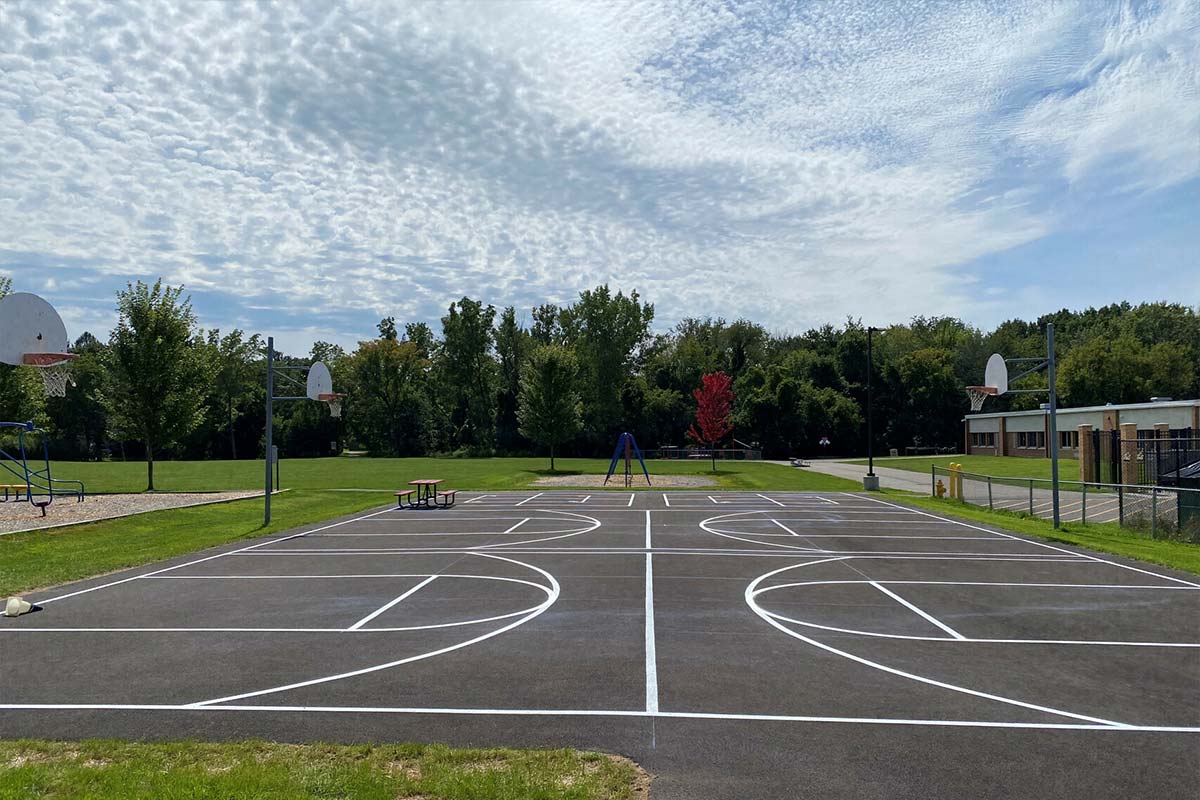
Sports Court Striping in Central Miami, FL
Court striping is line work on a playing surface, and the surface is what makes it a different trade from parking lot striping. A court coating is a built system — an acrylic surface applied over asphalt or concrete, textured to a specific playing speed. Lines are applied into that system, not onto raw pavement, and a product or a technique borrowed from a parking lot will not behave the way it should.
We stripe and re-stripe courts across Miami-Dade County for schools and school districts, municipal parks and recreation departments, HOAs and condominium communities, apartment complexes, hotels and resorts, community and recreation centers, and private clubs. The work runs from refreshing faded lines on a single court to laying out a full multi-sport conversion.
The demand driver right now is pickleball, and most of it is conversion rather than new construction — existing tennis and basketball courts being re-lined to add pickleball, usually while keeping the original sport playable.
Pickleball Court Layout and Dimensions
A pickleball court is laid out around one geometry that governs everything else: the non-volley zone, universally known as the kitchen. USA Pickleball defines it as a 7-foot by 20-foot area at each end of the net, its lines running parallel to the net 7 feet from it between the two sidelines — and that band is what makes the sport play the way it does. Get it wrong and the court is not a pickleball court; it is a rectangle with lines on it.
These are the governing figures, transcribed from the 2026 USA Pickleball Official Rulebook:
| Element | Specification | Rule |
|---|---|---|
| Court, playing surface | A rectangle 20 feet (6.10 m) wide and 44 feet (13.41 m) long, for both singles and doubles | 3.A.1 |
| Minimum total playing area | 30 feet (9.14 m) wide by 60 feet (18.29 m) long | 3.A.3 |
| Recommended, new construction and tournament play | 34 feet (10.36 m) by 64 feet (19.5 m) | 3.A.3 |
| Recommended, stadium court | 50 feet (15.24 m) by 80 feet (24.38 m) | 3.A.3 |
| Non-volley zone (the kitchen) | A 7-foot by 20-foot area at each end of the net; the non-volley zone lines run parallel to the net, 7 feet (2.13 m) from it, between the two sidelines | 3.A.4.c |
| Net height at the sidelines | 36 inches, plus or minus 0.25 inch, above the playing surface where the net crosses the outer edge of the sidelines | 3.B.6 |
| Net height at the center | 34 inches, plus or minus 0.25 inch, above the playing surface at the center point of the court | 3.B.7 |
| Net post spacing | 22 feet, plus or minus 1.0 inch, measured inside post to inside post | 3.B.2 |
| Line width and color | All lines 2 inches (5.08 cm) wide, the same color, clearly contrasting with the playing surface | 3.A.4.e |
| Service courts | The areas at each end between the non-volley zone and the baseline, either side of the centerline; each is bounded by and includes its adjacent baseline, sideline, and the centerline | 3.A.4.f |
Read the two area figures together — that pair is what decides a conversion. The court is 20 by 44. The minimum playing surface is 30 by 60, and the recommendation for new construction is 34 by 64. The difference between those numbers is the run-off space a player needs to chase a ball without meeting a fence, a net post, or the adjacent court. A tennis court will hold multiple pickleball courts on paper and still fail on run-off, which is why we measure the whole available area rather than the old court’s lines.
What else changes a conversion:
- The available slab, not the old court. A tennis court’s footprint accommodates more than one pickleball court, but only if the run-off space works out. The fence line and the net posts are usually the binding constraints.
- Whether the existing sport stays. A tennis court re-lined for pickleball while remaining a tennis court is a different design problem from a tennis court converted outright.
- The surface underneath. A failing or ponding coating has to be dealt with before line work is worth paying for.
Basketball, Tennis, and Multi-Sport Overlays
Overlay courts are the majority of what we do, and the difficulty in them is not the marking — it is the reading.
A court carrying pickleball, basketball, and tennis lines at once presents three overlapping geometries to a player who needs to see one of them instantly, at speed, in bright sun or under floodlights. Done carelessly, everyone using the court is slightly confused all the time. The techniques that prevent that:
- Decide the primary sport first. One sport’s lines are laid in the highest-contrast color and, where the surface allows, its playing area is defined by a color block. Everything else is a guest on the court.
- Separate by hue, not just by shade. Two colors that read as distinct in daylight can converge under sodium or LED floodlighting, and a court used mostly in the evening should be checked against that.
- Sequence the application. Lines go down in an order that keeps the primary sport’s edges clean, because an intersection painted second reads as broken.
- Limit the stack. There is a point past which another sport’s lines cost more in readability than they add in utility. We will say so rather than paint whatever is asked for.
- Use the surface color. A contrasting playing-area block does more for readability than any amount of line-color juggling.
Court builders rarely cover this, because a purpose-built court carries one sport. Overlay sequencing is the striping trade’s problem, and it is where the difference between a good court and a frustrating one actually lives.
Basketball work runs from full-court and half-court layouts to key and three-point line refreshes and post-resurfacing re-lays. Tennis covers singles and doubles lines, service boxes, and centerline marks. We also mark volleyball, shuffleboard, and four-square.
Playground and Game Markings
Playground markings are the same craft aimed at a younger user. Hopscotch, four square, activity and number circles, alphabet and map grids, running tracks and start lines, sensory paths, line-up and queue markings for school entrances, and bus and drop-off lane markings on the adjacent hardstand.
Two things govern the work. Surfaces vary more than on a sports court — playground hardstand can be asphalt, concrete, or a coated surface, and each takes the product differently. And the layout is a use question rather than a rules question: markings that work with how children move through the space, and that sit clear of doors, gates, and vehicle routes. We walk the area with the school or facility before proposing a layout.
Get a Sports Court Striping Quote in Central Miami
Talk it through with us on (786) 434-8020, or use the estimate form on this page. We will want to know what sports the court needs to carry, what is on it now, and roughly how old the surface is. For conversions we would rather measure the whole available area than the existing court. Estimates are free.
For a full list of our pavement marking services, visit our parking lot striping in Central Miami page.
Businesses We Serve




How it Works

GET A FREE ESTIMATE
Contact us today and we’ll have a quote to you in 24 hours

SCHEDULE AN INSTALLATION
We’ll have your play space restriped in less than 7 days, without affecting your playtime

GET A PARKING LOT THAT POPS
For a budget-friendly price, you’ll get a parking lot that looks like new
We proudly work with:


We proudly work with:


Frequently Asked Questions About Sports Court Striping in Central Miami, FL
What sports courts do you stripe?
Pickleball, basketball, tennis, volleyball, shuffleboard, and multi-sport overlay courts, plus playground game markings such as hopscotch, four square, and activity circles. We work on outdoor hard courts at schools, parks, HOAs, condominium and apartment communities, resorts, and community centers across Miami-Dade County, on asphalt and concrete alike. Existing court coatings and post-tensioned slabs both change what we recommend, so we look at the surface before quoting a layout.
Can one court hold lines for more than one sport?
Yes — overlay courts are common, and pickleball lines added to an existing tennis or basketball court are the most frequent request. The design challenge is readability: color separation, line sequencing, and deciding which sport reads as primary. Done well, players see their own lines without confusion. Done carelessly, a multi-sport court frustrates everyone using it.
Do you mark pickleball courts to official dimensions?
Yes — we mark to USA Pickleball specifications, which is the governing body’s published standard for court layout and dimensions. If your court is being converted from another sport, the available area determines whether a full-size layout fits or the space suits a different configuration. We measure the area before committing to a layout.
What paint is used on a sports court?
Durable acrylic products designed for court surfaces. Court paint has to handle direct sun, heavy rain, and constant foot traffic and pivoting, and it needs to bond to a court surface rather than to pavement — court coatings behave differently from parking lot asphalt. Surface condition and existing coatings both affect what we recommend.
Can you stripe over an existing faded court?
Usually, yes — refreshing worn lines on a sound court is routine. What matters is the condition of the surface underneath. If the court coating itself is failing, peeling, or holding water, new lines applied on top will fail with it. We assess the surface first and tell you honestly if the court needs attention before line work is worth doing.
How long before we can play on a newly striped court?
It depends on the product and the conditions on the day, particularly humidity — which in South Florida is a genuine scheduling factor rather than a footnote. Most courts are back in play quickly, and we will give you the cure window for your specific job before we start. If you have a league schedule or an event date, tell us up front.