
ADA Parking Lot Striping
In Central Miami, FL
ADA-Compliant Accessible Parking
1-800-STRIPER provides ADA-compliant parking lot striping in Central Miami, FL — installing accessible spaces, van-accessible stalls, access aisles, ISA symbols, and required signage per the 2010 ADA Standards for Accessible Design and Florida Statute 553.5041.
1-800-STRIPER® of Central Miami PROVIDes ADA Compliance Services NEAR YOU
Need to make your property more accessible?
Upgrade your facility to become fully ADA compliant by partnering with us to create clear, accessible parking for all your visitors.
Our ADA Compliant line striping services include:
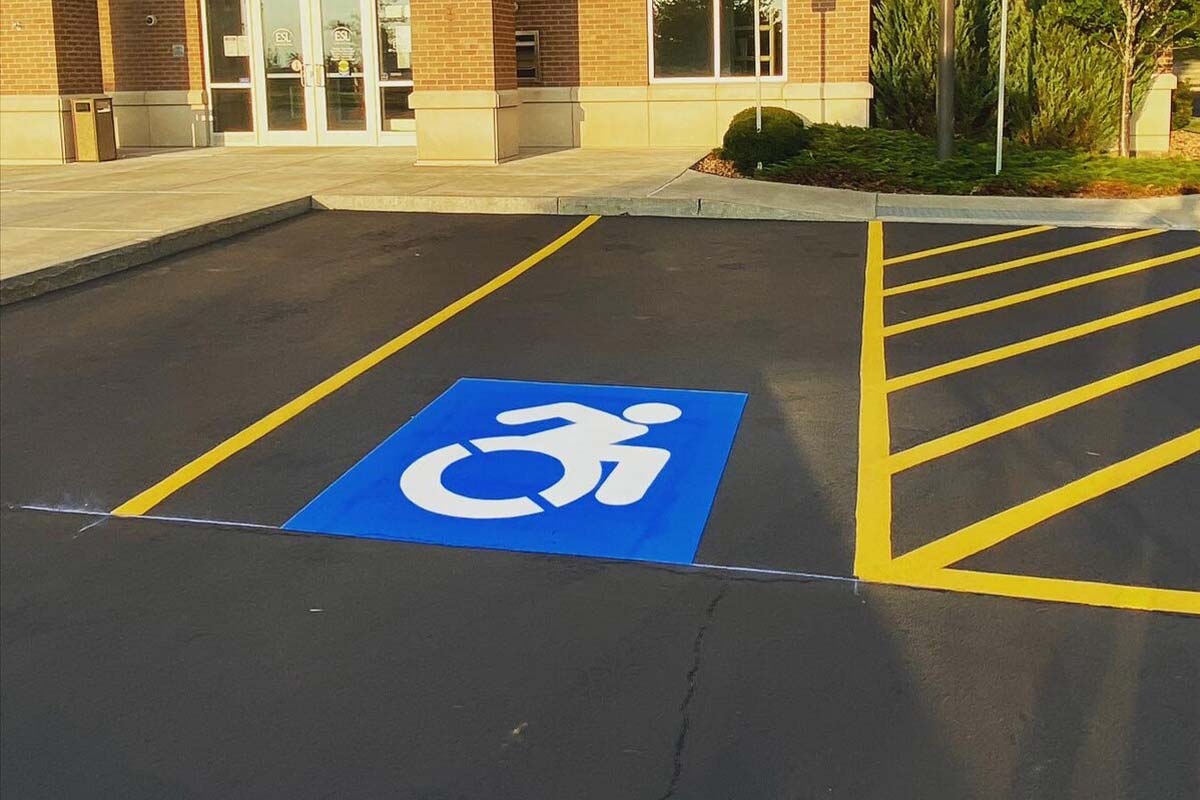
ADA Parking Lot Striping in Central Miami, FL
Accessible parking is the part of a commercial lot with the least tolerance for approximation. Every other marking on the property is a matter of organization and traffic flow. Accessible parking is a matter of whether a person can get out of their vehicle and reach the door, and it is governed by a federal standard, a Florida statute, and a state accessibility code at the same time.
It is also the area where a lot falls behind quietly — usually not through neglect, but through inheritance. A lot laid out under an earlier standard gets faithfully repainted to its original geometry every few years. The paint stays fresh; the layout stays out of date. Nothing in the maintenance cycle prompts anyone to check.
What actually triggers the obligation is worth being clear about, because it is not the same for every lot. New construction and alterations are built to the 2010 ADA Standards for Accessible Design directly. For an existing facility that is not being altered, the ADA asks a different question: public accommodations must remove architectural barriers “when it is readily achievable to do so” — the wording used in the Department of Justice’s own ADA Title III primer. Restriping is often among the least disruptive changes a property can make, but whether any particular fix is required of your lot depends on that test and on what work is already planned. We will tell you what we measure and what the standards say; we are not the ones who determine your compliance obligation.
We handle accessible parking work across Miami-Dade County: retail and mixed-use centers, medical and dental offices, office parks, restaurants and hotels, condominium and HOA communities, schools, houses of worship, and industrial properties. That work ranges from re-marking a single stall to laying out compliant accessible parking for a whole lot during a resurfacing.
Where Florida Goes Beyond the Federal ADA
Two instruments apply to your lot at once, and they do not say the same thing.
The 2010 ADA Standards for Accessible Design are the federal baseline: how many accessible spaces a facility needs, how many of those must be van-accessible, and where they have to sit relative to the entrance.
Florida Statute 553.5041 then adds state requirements on top, and Florida’s accessibility provisions live in the Florida Building Code, Accessibility volume — a separate volume from the Building volume, which is where people usually look for them and where they are not.
Four places where meeting the federal standard alone still leaves you short in Florida:
| Florida requirement (FS 553.5041) | |
|---|---|
| Space width | Each accessible parking space must be at least 12 feet wide |
| Access aisle | Parking access aisles must be at least 5 feet wide, and the aisle must be striped diagonally to designate it as a no-parking zone |
| Blue outlining | Accessible spaces must be prominently outlined with blue paint, and repainted when necessary |
| Signage | A sign placed on or at least 60 inches above the finished floor or ground surface, measured to the bottom of the sign, bearing the International Symbol of Accessibility and the caption “PARKING BY DISABLED PERMIT ONLY”; a sign erected after October 1, 1996 must indicate the penalty for illegal use of the space |
The width provision is the one that most often surprises people. The federal 2010 ADA Standards allow two van configurations — an 11-foot space with a 5-foot access aisle, or an 8-foot space with an 8-foot aisle (§502.2 and §502.3.1). Florida sets a single 12-foot minimum width for accessible spaces with a 5-foot access aisle, wider than either federal option. A contractor applying the federal numbers to a Florida lot produces work that looks properly sourced and is measured against the wrong instrument.
The blue-paint requirement is Florida-specific too, and it comes with an ongoing obligation: the statute says the outlining is repainted when necessary. Faded blue outlining is not a cosmetic issue in this state.
Accessible Stalls, Access Aisles, and ISA Symbols
Compliance is a set of elements that only works as a set. Partial compliance is common precisely because each element is individually plausible on its own.
The space. Correct width, on a surface with a slope within what the standard permits — a stall on a noticeable grade is not a compliant stall regardless of how it is painted.
The access aisle. The marked, diagonally striped area immediately adjacent to the space. It exists so a person can deploy a ramp or a lift, get a wheelchair alongside the vehicle, and transfer. It is not overflow, it is not a half-space, and it is not somewhere to leave a shopping cart corral. It is the functional half of the accessible stall, and a vehicle parked in it or overhanging into it defeats the whole space.
The ISA symbol. The International Symbol of Accessibility marked on the pavement within the space, kept legible.
The accessible route. From the access aisle to the entrance the parking serves, without a step, without a curb the standard does not allow, and without a parked vehicle across it. The 2010 Standards require accessible spaces to sit on the shortest accessible route to the entrance they serve, which is why the location of accessible parking is not a matter of convenience for the layout.
The signage. Mounted at the height Florida requires, with the required symbol, caption, and penalty notice. A pavement symbol without conforming signage is one of the fastest things to put right. Sign requirements are covered in more depth on our parking lot sign installation page.
Where wheel stops come in. On stalls facing a walkway, a vehicle’s overhang can obstruct the access aisle or the route itself. A correctly placed wheel stop is often the least disruptive fix.
How Many Accessible Spaces Your Lot Needs
The federal count scales with the size of the parking facility. This is Table 208.2 of the 2010 ADA Standards for Accessible Design, transcribed from ada.gov:
| Total parking spaces provided in parking facility | Minimum number of required accessible parking spaces |
|---|---|
| 1 to 25 | 1 |
| 26 to 50 | 2 |
| 51 to 75 | 3 |
| 76 to 100 | 4 |
| 101 to 150 | 5 |
| 151 to 200 | 6 |
| 201 to 300 | 7 |
| 301 to 400 | 8 |
| 401 to 500 | 9 |
| 501 to 1000 | 2 percent of total |
| 1001 and over | 20, plus 1 for each 100, or fraction thereof, over 1000 |
Four things the table alone does not tell you, all of which change the answer for a real property:
Van spaces come out of that count, not in addition to it. Section 208.2.4 provides that for every six, or fraction of six, parking spaces required to be accessible, at least one must be a van parking space. A lot requiring four accessible spaces needs at least one of them to be van-accessible; a lot requiring seven needs at least two.
The count is per parking facility, not per site. Where a property has more than one parking facility, the standards require the number to be calculated for each facility separately. A site with three separate lots does not pool its spaces — each lot carries its own requirement. The standards’ own advisory note makes the point that “parking facility” covers parking structures as well as surface lots.
Some facility types carry a much higher proportion. Ten percent of patient and visitor parking serving hospital outpatient facilities must be accessible, and twenty percent for rehabilitation facilities and outpatient physical therapy facilities specializing in conditions that affect mobility. In a county with the medical density of Miami-Dade this is not an edge case.
Florida’s requirements sit on top of all of it. The count is federal; the space width, aisle width, blue outlining, and signage are where the state statute applies.
We count your spaces on the walkthrough and tell you what your lot requires rather than working from a number over the phone — because the facility-by-facility rule and the outpatient proportions both turn on facts about the property that are not visible from the space count alone.
Get an ADA Compliance Assessment in Central Miami
Book a review on (786) 434-8020, or through the estimate form on this page. An accessible-parking review is a walkthrough: we count the spaces, measure the stalls and aisles, check the route to the entrance, look at the signage, and give you a written picture of where the lot stands. Estimates are free, and if your lot is already compliant we will tell you that.
For a full list of our pavement marking services, visit our parking lot striping in Central Miami page.
Businesses We Serve




How it Works

GET A FREE ESTIMATE
Contact us today and we’ll have a quote to you in 24 hours

SCHEDULE AN INSTALLATION
We’ll have your installation scheduled in less than 7 days, without affecting your business hours

GET A PARKING LOT THAT POPS
For a budget-friendly price, you’ll get a parking lot that looks like new!
We proudly work with:


We proudly work with:


Frequently Asked Questions About ADA Parking Lot Striping in Central Miami, FL
How many accessible parking spaces does my lot need?
The required number scales with the total number of spaces in the lot, and a share of those accessible spaces must be van-accessible. The counts are set out in the 2010 ADA Standards for Accessible Design. Rather than quote a figure that may not match your lot’s total, we will count your spaces on the walkthrough and tell you exactly what your lot requires.
What makes an accessible parking space compliant?
Several things together, which is why partial compliance is so common. The space needs correct dimensions, an adjoining access aisle of the required width, an accessible route from the aisle to the building entrance that stays unobstructed, the International Symbol of Accessibility marked on the pavement, and correctly mounted signage. Missing any one of them is a finding — signage and access aisles are the usual gaps.
Where does Florida go beyond the federal ADA requirements?
In several concrete ways. Florida Statute 553.5041 requires accessible spaces to be “prominently outlined with blue paint” and repainted when necessary. It sets a single width of at least 12 feet for each accessible space with an access aisle of at least 5 feet, striped diagonally as a no-parking zone. And it requires a permanent sign mounted at least 60 inches to the bottom, carrying the caption “PARKING BY DISABLED PERMIT ONLY”. A lot built to the federal standard alone can fall short here.
Can I just repaint the existing accessible stalls?
Only if they are compliant to begin with. Repainting reproduces whatever layout is already there — so if the access aisle is undersized, the stall count is short for the lot, or van-accessible provision is missing, repainting locks the problem in and makes it look freshly done. We check the geometry before repainting and tell you if something needs to change.
What is an access aisle and why does it matter?
It is the marked, striped area immediately adjacent to an accessible space that gives someone room to deploy a wheelchair ramp or lift and transfer out of the vehicle. It is not spare space and it is not a parking space — it is the functional part of the accessible stall. Vehicles parked in or overhanging an access aisle defeat the purpose of the stall entirely.
Do accessible stalls need signage as well as pavement markings?
Yes. The pavement symbol alone is not sufficient — accessible spaces require properly mounted signage, and Florida sets its own requirements for how that signage is mounted and worded. A faded, missing, or knocked-down sign is a compliance gap even when the pavement markings look perfect. We assess signage and striping together for exactly this reason.