
Warehouse Line Painting
In Central Miami, FL
OSHA-Compliant Safety Markings
1-800-STRIPER provides professional warehouse line painting in Central Miami, FL — marking permanent aisles, pedestrian walkways, staging zones, and dock areas per OSHA 29 CFR 1910.176(a) with durable epoxy and traffic paint for industrial facilities across Miami-Dade County.
1-800-STRIPER® of Central Miami PROVIDes Warehouse Floor Markings Services NEAR YOU
Want your indoor space to operate more efficiently?
Warehouse and interior markings ensure clear traffic lanes, organized storage zones, and designated spaces designed to help your business operate safely and efficiently.
Benefits:
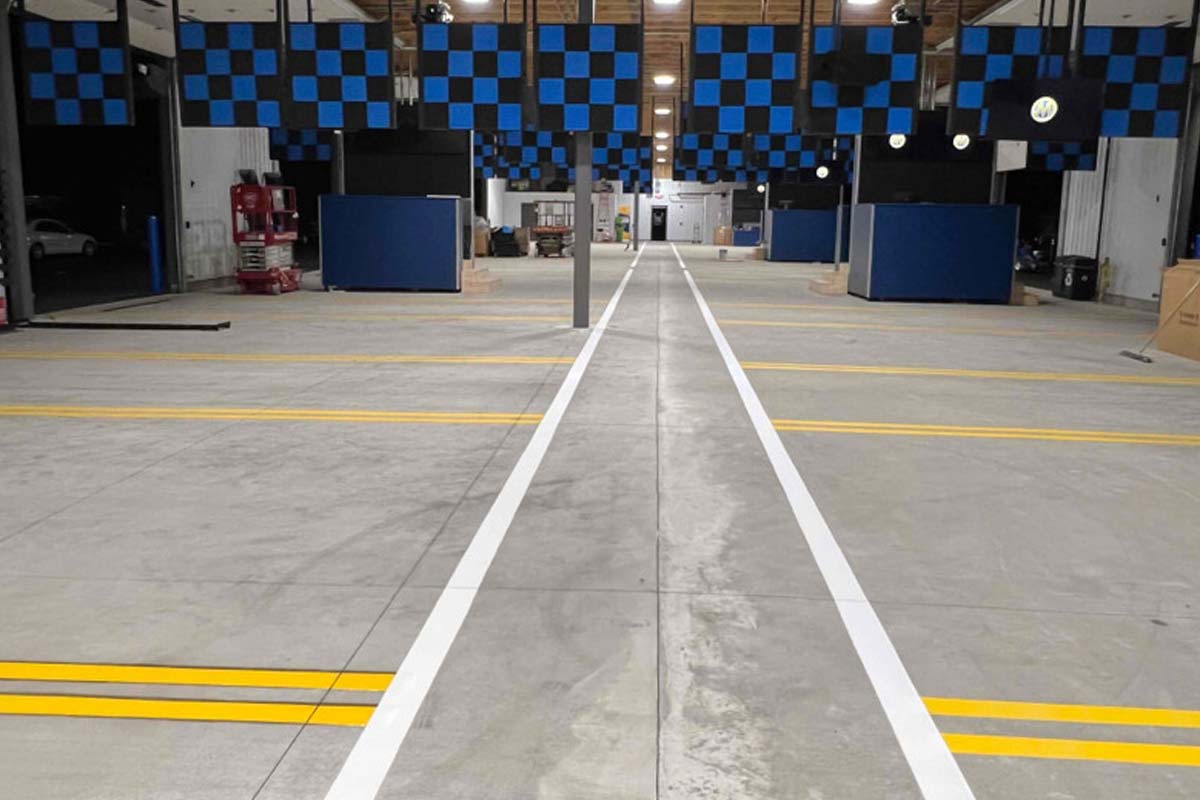
Warehouse Line Painting in Central Miami, FL
Floor marking is how a warehouse tells people and equipment where they are allowed to be. Done well, it separates forklifts from pedestrians, keeps racking aisles clear, keeps electrical panels and fire equipment reachable, and gives a new hire on their first shift the same information a ten-year employee carries in their head.
Miami-Dade’s warehousing is concentrated in a few corridors, and we work in all of them: Medley, where our own address sits, Doral, Hialeah and Hialeah Gardens, the Airport West industrial district, and the facilities clustered around the seaport and the rail terminals. Distribution centers, cold storage, cross-dock facilities, light manufacturing, self-storage, and third-party logistics operations are the bulk of it.
The work is almost always phased. A functioning facility does not stop, so we section the floor, work around shift patterns, and sequence the job so the areas not being marked keep operating.
What OSHA Actually Requires — and What It Doesn’t
This is the part most warehouse-striping pages get wrong, so it is worth being precise.
The marking duty lives in 29 CFR 1910.176(a), not in 1910.22. The text reads: “Permanent aisles and passageways shall be appropriately marked.” That provision sits within the standard covering the handling and storage of materials, and it applies where mechanical handling equipment is used. Section 1910.22 is the provision usually cited for aisle marking. It contains zero occurrences of the word “aisle.”
No OSHA regulation specifies a line color or a line width for aisle marking. 1910.176(a) asks that permanent aisles be “appropriately marked” and stops there. The same section asks for “sufficient safe clearances” without giving a dimension. Yellow lines four inches wide is a widely used industry convention, and a good one. But it is a convention, not a legal requirement. A facility that marks its aisles differently for a defensible operational reason is not in violation of anything. 29 CFR 1910.144, the safety color code, assigns red and yellow to specific hazard categories; it does not govern aisle lines.
Why does this matter to you rather than just being a pedantic point? Because a compliance argument built on a provision that does not say what it is claimed to say is not a compliance argument. If an inspector, an insurer, or your own EHS lead asks why the floor is marked the way it is, the useful answer names the actual duty and then explains the operational reasoning behind the choices the regulation leaves open. We would rather give you that than a laminated color chart presented as law.
Aisles, Walkways, Staging, and Dock Zones
| Zone | What gets marked | Common industry convention | Governing reference |
|---|---|---|---|
| Permanent aisles and passageways | Aisle boundary lines along the full run | Yellow boundary lines | 29 CFR 1910.176(a) — marking required; color and width not specified |
| Pedestrian walkways | Bordered walking lanes, crossings at forklift routes | Contrasting color, often with a hatched or bordered treatment | No specific federal marking rule — operational safety practice |
| Forklift travel lanes | Directional lanes, one-way arrows, blind-corner and intersection markings | Directional arrows in the aisle color | Operational practice; separation of pedestrians and equipment |
| Staging and hold areas | Bordered footprints for inbound, outbound, quarantine, and returns | Distinct colors by function | Operational practice |
| Dock approaches | Trailer spot markings, restraint zones, dock-door approach paths | High-contrast borders | Operational practice |
| Equipment clearances | Keep-clear zones at electrical panels, eyewash, extinguishers, and exits | Hatched keep-clear borders | Access requirements under the relevant OSHA and fire provisions |
| Rack and bay identification | Bay numbers, rack end markings, location codes | Facility-specific | Operational practice |
The color column is a record of what facilities commonly do, not a list of requirements. The right set of markings for your building comes from how material actually moves through it, which is why we walk the floor with your operations lead before proposing a layout rather than applying a template.
Product choice follows the floor and the traffic. Durable epoxy generally stands up better to sustained forklift traffic; traffic paint applies faster and returns an area to service sooner. Sealed and unsealed concrete behave differently, and an old floor with a failing surface will not hold a marking regardless of what goes on it.
Schedule Warehouse Line Painting in Central Miami
Send your facility address and approximate square footage through the estimate form on this page, or call (786) 434-8020. We will walk the floor, look at how material and people move through it, and propose a marking layout built around that rather than a standard drawing. Estimates are free.
For a full list of our pavement marking services, visit our parking lot striping in Central Miami page.
Businesses We Serve




How it Works

GET A FREE ESTIMATE
Contact us today and we’ll have a quote to you in 24 hours

SCHEDULE A STRIPING
We’ll have your space restriped in less than 7 days, without affecting your business hours

GET A PARKING LOT THAT POPS
For a budget-friendly price, you’ll get a parking lot that looks like new
We proudly work with:


We proudly work with:


Frequently Asked Questions About Warehouse Line Painting in Central Miami, FL
Does OSHA require aisle marking in a warehouse?
Yes. Under 29 CFR 1910.176(a), “Permanent aisles and passageways shall be appropriately marked.” That is the actual marking requirement, and it applies to permanent aisles and passageways in facilities where mechanical handling equipment is used. It is worth knowing that many sources cite 29 CFR 1910.22 for this — that provision does not address aisle marking at all.
What line color and width does OSHA require for aisles?
Neither — and this surprises most facility managers. No OSHA regulation specifies a color or a width for aisle marking. 1910.176(a) requires only that permanent aisles be “appropriately marked”, and the same section asks for “sufficient safe clearances” without giving a number. Yellow aisle lines are a widely used industry convention, not a legal requirement. OSHA’s safety color code, 29 CFR 1910.144, addresses specific hazard colors, not aisle lines.
What gets marked in a typical warehouse line painting job?
Permanent aisles and passageways first, since those are the ones the regulation names. Beyond that, most facilities mark pedestrian walkways, forklift travel lanes, staging and stationary-equipment zones, dock approaches, electrical panel and emergency equipment clearances, and rack or bay identification. The right set depends on how the facility actually moves material — we walk the floor before proposing a layout.
Which product is used on a warehouse floor?
Durable epoxy and traffic paint are both used, and the choice depends on the floor, the traffic, and how long the facility can give up the area. Epoxy generally offers greater durability under forklift traffic; traffic paint applies and returns to service faster. Sealed and unsealed concrete behave differently, so the floor’s condition drives the recommendation more than preference does.
How much downtime does warehouse line painting require?
Less than most facilities expect, because the work is almost always phased. We section the floor so operations continue in the areas not being marked, and we frequently work around shift patterns rather than shutting a facility down. Cure time depends on the product and the conditions in the building. We plan the sequence with your operations lead before starting.
Do you work in Medley, Doral, and Hialeah industrial facilities?
Yes — those corridors are where most of Miami-Dade’s warehousing sits, and they are core territory for us. We work in distribution centers, cold storage, light manufacturing, logistics facilities, and self-storage across Miami-Dade County. Call (786) 434-8020 with your facility address and square footage and we will arrange a walkthrough.