Thermoplastic Striping
In Central Miami, FL
Long-Lasting Pavement Markings
1-800-STRIPER provides professional thermoplastic striping in Central Miami, FL — heat-applied, retroreflective pavement markings for stop bars, crosswalks, directional arrows, and fire lanes that bond into the pavement instead of drying on top of it, for high-traffic commercial lots across Miami-Dade County.
1-800-STRIPER® of Central Miami PROVIDes Thermoplastics Services NEAR YOU
Want to reduce the maintenance requirements for your parking lot?
Thermoplastic pavement markings are a durable, weather and vehicle-resistant striping option for your parking lot or facility.
You can utilize them for stop bars, ADA stalls, no-parking zones, directional arrows, crosswalks, or your entire parking lot.
Benefits:
Thermoplastic Striping in Central Miami, FL
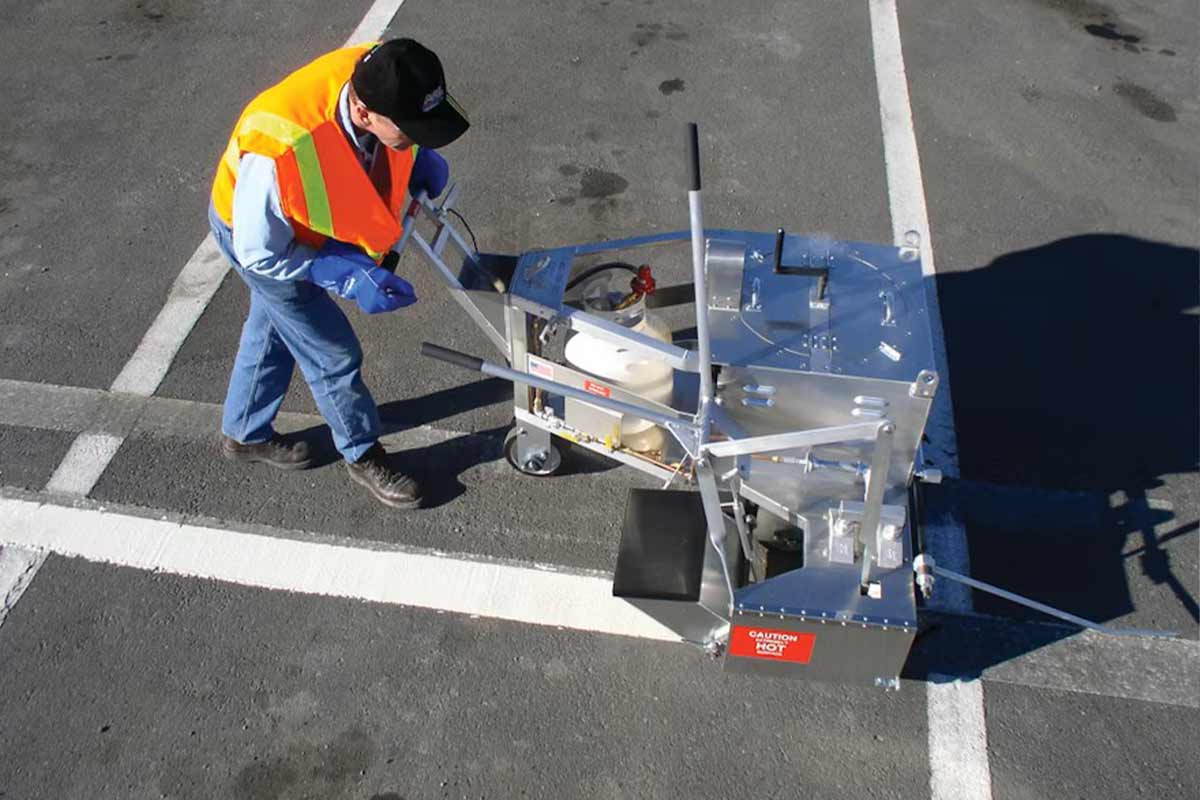
Thermoplastic is a marking material that arrives as a solid, is heated until it flows, and is applied hot. As it cools it fuses with the pavement rather than sitting on it as a dried film. The result is a marking several times thicker than paint, with glass beads worked into the surface so headlights are returned toward the driver instead of scattered.
That thickness is the whole proposition. It is also why thermoplastic is not the answer for a whole parking lot. It costs more per foot to install, it takes specialized heated application equipment, and on markings that see no concentrated wheel traffic the extra durability buys you very little. The properties that benefit are the ones where the same few markings are driven over thousands of times a week.
We install thermoplastic across Miami-Dade County — distribution and logistics facilities in Medley, Doral, and Hialeah, retail centers with heavy drive-through and pickup traffic, hospital and medical campuses, hotel and venue forecourts, and any lot where a repaint has become an annual event.
Thermoplastic vs. Traffic Paint
| Thermoplastic | Traffic paint | |
|---|---|---|
| Applied as | Solid material heated until molten, applied hot | Liquid coating applied cold |
| Bond | Fuses into the pavement surface | Dries as a film on top of the surface |
| Thickness | Substantially thicker — a raised, tangible marking | Thin surface film |
| Night visibility | Glass beads worked through the material; retroreflective by design | Beads broadcast onto the wet film; effective, but a thinner reservoir |
| Service life under heavy traffic | Considerably longer | Shorter, and shortest exactly where traffic concentrates |
| Return to service | Cools and is trafficable quickly | Cure time varies with product and conditions |
| Surface requirements | Sound, clean, dry pavement; new asphalt must cure first | More tolerant, but bond still depends on cleanliness |
| Best use on a commercial lot | Stop bars, crosswalks, arrows, drive-through paths, fire lanes | Standard stall lines and the majority of lot markings |
| Repair | Sections replaced rather than overpainted | Refreshed by repainting |
The practical read: paint is the right default for most of a lot, and thermoplastic earns its place on the handful of markings that keep failing first.
Where Thermoplastic Makes Sense on a Commercial Lot
Look at where the tires go. Markings fail where wheels track over them repeatedly, and on almost every commercial property that is a short list: stop bars at the exit, the crosswalk between the lot and the entrance, directional arrows in the main drive aisle, the drive-through lane at a quick-service restaurant or pharmacy, loading-dock approach markings, and fire lane boundaries along a route apparatus and delivery traffic both use.
Stall lines are usually the wrong place for it. A vehicle crosses a stall line twice per visit at low speed; it crosses the drive-aisle arrow every time it moves through the lot. If your last two repaints have been driven by the same few markings wearing out, that is the list worth converting.
Surface condition decides whether the conversation happens at all. A marking is only as sound as what it is bonded to, so failing, contaminated, or freshly laid asphalt each need addressing first. We assess the pavement before recommending thermoplastic, and there are lots where the honest recommendation is to repave or repair before spending on a premium marking.
How Thermoplastic Is Applied
- Surface assessment. Pavement condition, age, and cleanliness. New asphalt needs time before markings go down — the Florida Department of Transportation’s own guidance for state work is to wait at least 14 days after the final asphalt surface course is constructed.
- Cleaning and preparation. The surface must be clean and dry. Dust, oil, and moisture all defeat the bond.
- Layout. Marked out from the existing geometry or the approved plan.
- Heating and application. The material is brought to application consistency in heated equipment and laid to the specified thickness, with glass beads incorporated for retroreflectivity.
- Cooling. Thermoplastic sets as it cools rather than curing chemically, so the markings are trafficable relatively quickly.
- Inspection. Line dimensions, thickness, bead distribution, and edge quality checked before the area reopens.
What the FDOT specification says, and what it does not. Section 711 of the FDOT Standard Specifications for Road and Bridge Construction covers thermoplastic pavement markings. It is a highway specification governing state road work, and it does not legally bind a private commercial parking lot. It is still the best available benchmark, and we build to it because there is no better one. What it publishes: hot-applied longitudinal markings between 0.10 and 0.15 inches thick; non-longitudinal markings 0.09 to 0.12 inches; a refurbishment minimum of 0.06 inches; preformed thermoplastic at 0.125 inches; minimum retroreflectivity of 450 for white and 350 for yellow longitudinal markings in standard thermoplastic; and glass-sphere embedment between 50 and 60 percent.
On temperature, the specification is more precise than the internet is. FDOT requires application only on dry surfaces, and only when the ambient air and surface temperature is at least 50°F and rising for asphalt or 60°F and rising for concrete. Separately, and in a different clause, it specifies the heating capability the equipment must have. That is a requirement about the equipment, not a specified application temperature for the material — and the two are routinely collapsed into a single confident “thermoplastic is applied at” figure that appears across the trade press and on competitor pages. We do not publish one, because no primary document we could find states it. What we can tell you is what your job will be held to: dry surface, ambient and surface temperature at or above the thresholds above and rising.
Get a Thermoplastic Striping Quote in Central Miami
(786) 434-8020 reaches us directly, and the estimate form on this page reaches the same desk. Describe which markings on your lot keep failing and how traffic moves through the property, and we will tell you which of them justify thermoplastic and which are better left in paint. Estimates are free.
For a full list of our pavement marking services, visit our parking lot striping in Central Miami page.
Businesses We Serve




How it Works

GET A FREE ESTIMATE
Contact us today and we’ll have a quote to you in 24 hours

SCHEDULE AN INSTALLATION
We’ll have your installation scheduled restriped in less than 7 days, without affecting your business hours

GET A PARKING LOT THAT POPS
For a budget-friendly price, you’ll get a parking lot that looks like new
We proudly work with:


We proudly work with:

Frequently Asked Questions About Thermoplastic Striping in Central Miami, FL
What is thermoplastic striping?
Thermoplastic is a heat-applied pavement marking material. Rather than drying as a film on top of the surface the way paint does, it is applied hot and bonds into the pavement, producing a thicker, more durable marking. Glass beads are typically incorporated to make the marking retroreflective, so it returns headlight illumination back toward the driver at night.
How is thermoplastic different from traffic paint?
Thickness and service life are the main differences. Paint is a thin surface film — quicker and simpler to apply, and easy to refresh. Thermoplastic is substantially thicker and bonds into the pavement, so it holds up longer under heavy traffic and typically offers better night visibility. Paint suits most standard stall lines; thermoplastic earns its place on the markings that take the most wear.
Where does thermoplastic make sense on a commercial lot?
On the markings that take concentrated, repeated traffic: stop bars, crosswalks, directional arrows in main drive aisles, drive-through paths, and fire lanes. It is usually not the right choice for every stall line on a lot — the durability advantage matters most where wheels actually track. We will tell you which markings on your property justify it and which are better served by paint.
Is thermoplastic required on a private parking lot?
No. The Florida Department of Transportation publishes thermoplastic specifications in Section 711 of its Standard Specifications for Road and Bridge Construction, but that is a highway specification governing state road work — it does not legally bind a private commercial parking lot. It is still a useful benchmark: FDOT calls for hot-applied longitudinal markings between 0.10 and 0.15 inches thick, and application only on dry surfaces at or above 50°F for asphalt and 60°F for concrete. Treat it as a reference standard, not a mandate.
How long does thermoplastic last compared to paint?
Longer, and by a meaningful margin under heavy traffic — but the honest answer is that service life depends on traffic volume, vehicle type, surface condition, and how the marking was applied, and any single number quoted without seeing your lot would be a guess. What we can say is that thermoplastic is chosen specifically where repeated repainting has become the more expensive option.
Can thermoplastic be applied to any pavement?
It needs a sound, clean, dry surface, and the pavement’s condition and age both matter — a marking bonds to the surface it is applied to, so a failing or contaminated surface produces a failing marking regardless of the product. New asphalt also needs to cure before markings go down. We assess the surface before recommending thermoplastic.