Parking Lot Restriping
In Central Miami, FL
Restripe Existing Lines and Markings
1-800-STRIPER provides professional parking lot restriping in Central Miami, FL — refreshing faded stall lines, ADA stalls and access aisles, fire lanes, and directional arrows with durable traffic paint for commercial properties across Miami-Dade County.
1-800-STRIPER of Central Miami PROVIDes Restriping Services NEAR YOU
Need to brighten up your faded parking lot?
Keep your parking lot safe and attractive by restriping annually to freshen up lines and symbols that have faded from the sun, weather, and traffic. Nothing beats a fresh coat of paint!
Benefits:
Parking Lot Restriping in Central Miami, FL
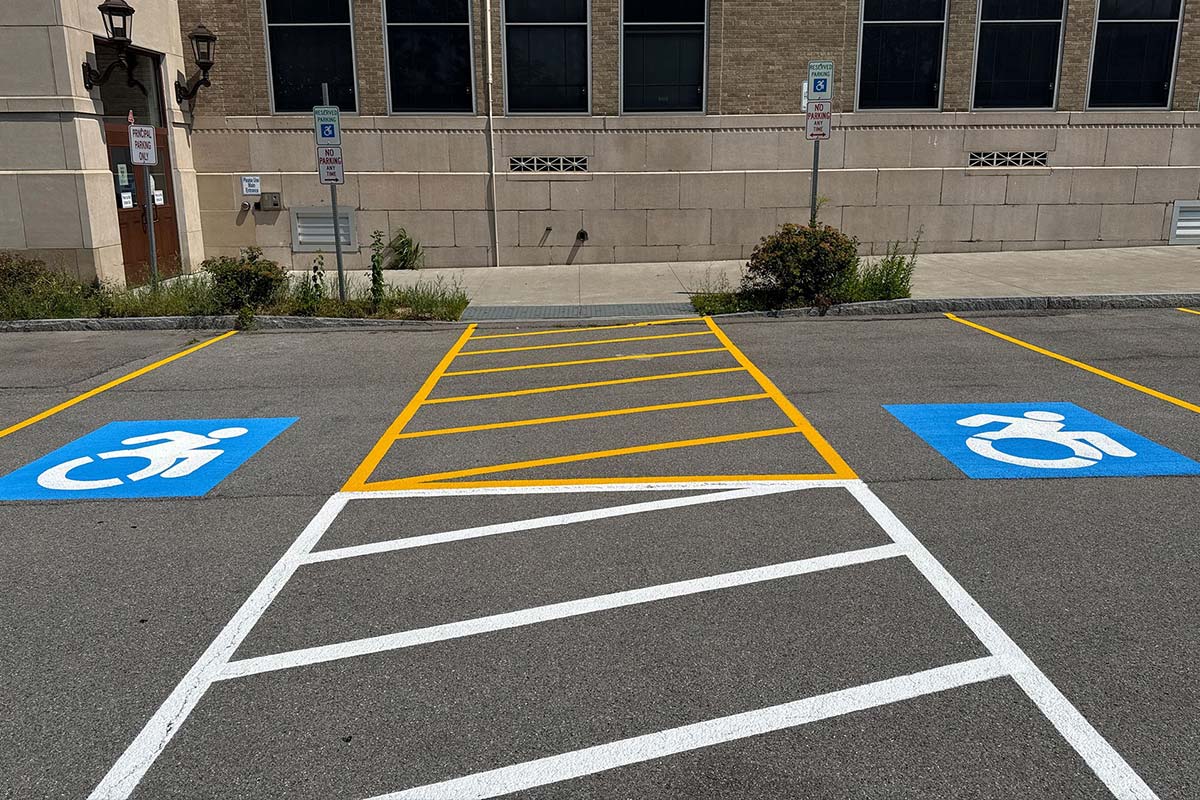
Restriping is the repainting of markings that already exist on your lot — stall lines, accessible spaces, fire lanes, arrows, stop bars, crosswalks, and curbs. The layout stays as it is. What changes is that a driver can read it again.
That distinction matters more than it sounds. A lot that needs a new layout needs measurement, a stall-count study, and a design decision. A lot that needs restriping needs a clean surface, the right paint, and a crew that follows the existing geometry accurately instead of freehanding over the ghost of the old lines. Most commercial properties in Miami-Dade need the second thing, and they need it more often than they schedule it.
We restripe retail centers, office parks, medical plazas, industrial and warehouse lots, condominium and HOA parking, houses of worship, schools, and self-storage facilities across the county — from Brickell and Coconut Grove through Coral Gables, Westchester, and Tamiami, out to the industrial corridors in Medley, Doral, and Hialeah, and across to Miami Beach and Key Biscayne. Estimates are free, and for anything larger than a handful of stalls we come and look at the lot rather than quoting from an aerial photo.
When a Miami-Dade Parking Lot Needs Restriping
There is no calendar answer to this, and any contractor who gives you one without seeing your property is quoting a sales script rather than a condition assessment. What there is instead is a set of signals, and a local climate that works harder on paint than most of the country’s does.
The signals, in the order they matter:
Accessible stalls first. If the International Symbol of Accessibility on the pavement has gone patchy, or the diagonal striping in the access aisle has faded to the point where drivers park across it, that is the marking to fix before anything else on the lot.
Fire lanes second. Red curb and lane markings that have lost their edges, or lettering that has worn to the point of being unreadable, come next — a fire lane only does its job if a driver can read it.
Then stall lines. The practical test is a night test in the rain. Stand at the entrance after dark during a shower and see whether the lines resolve. Headlights on wet asphalt are an unforgiving reading condition, and a lot that passes it is a lot that works.
Then everything else: directional arrows that no longer route traffic, stop bars nobody stops at, faded numbering, crosswalks that pedestrians have stopped using because the pattern has gone.
What the climate contributes. We can put real numbers on the weather here, because NOAA’s National Centers for Environmental Information publish 1991–2020 climate normals for Miami International Airport: 67.41 inches of precipitation a year, spread across 89.6 days with at least a tenth of an inch of rain, against an annual mean daily maximum of 84.2°F. That is a great deal of standing water and thermal cycling working on a painted surface, and it is why a lot in Miami-Dade will generally not hold markings as long as the same lot in a dry, temperate climate.
What that does not give us is a repainting interval. We are not going to tell you “every eighteen months,” because the figure would be invented. Traffic volume does more damage to a marking than weather does — a busy grocery anchor turns over its stall lines far faster than an office lot with the same rainfall — and drive-aisle markings wear at several times the rate of the stalls beside them. The honest answer is that we would rather walk your lot than sell you a schedule.
What a Restriping Job Includes
A restripe is scoped from what is on the ground, so no two are identical. This is the set most commercial properties in Miami-Dade end up with:
| Marking | What restriping covers |
|---|---|
| Standard stalls | Full re-lay of stall lines to the existing geometry, including double-line stall heads where the lot uses them |
| Accessible spaces | Space outline, access aisle with its diagonal striping, and the International Symbol of Accessibility |
| Fire lanes | Lane boundary lines, curb painting, and no-parking lettering at the spacing the fire code official requires |
| Directional control | Arrows, one-way markings, stop bars, and yield markings in drive aisles |
| Pedestrian markings | Crosswalks, walkway edges, and pedestrian-refuge hatching |
| Property-specific | Stall numbering, reserved and visitor designations, loading and no-parking hatching, EV or compact-stall markings where they exist |
| Curbs | Red fire-lane curb, yellow no-parking curb, and painted islands |
We confirm the existing layout before the first line goes down. If we find something that should not be reproduced — an undersized access aisle, an accessible stall count that no longer matches the lot’s size, an arrow that routes traffic into a blind corner — we raise it before painting, not after. Repainting a defect makes it look new and current, which is the worst of both outcomes.
Miami-Dade County’s own off-street parking standards sit in Miami-Dade County Code Chapter 33, Article VII — Off-Street Parking, and they are what a local zoning review will look at for a commercial lot. Where a property falls under a municipal code instead — the City of Miami, Miami Beach, Hialeah, and Coral Gables each maintain their own — the applicable standard is the city’s. We will point you at the right one for your address; what we will not do is recite dimensions out of a code book at you and call it a compliance opinion.
How Restriping Works, Step by Step
- 1. Site walk and measure. We record the existing layout, count the stalls, note the accessible spaces and their aisles, locate fire lanes, and photograph anything that looks like it needs a decision rather than a repaint.
- 2. Surface assessment and cleaning. Paint bonds to the surface it lands on. Loose grit gets blown or swept; oil staining, algae, and heavy soiling need pressure washing before the surface will hold a marking. If your lot needs more than routine cleaning we say so in the estimate rather than discovering it on the day.
- 3. Layout confirmation. We agree the plan with you in writing — same layout, or the specific corrections we have flagged. Nothing changes on your lot because a crew leader made a judgment call at eight in the morning.
- 4. Stall lines. The bulk of the work, laid to the confirmed geometry with durable traffic paint.
- 5. Accessible spaces and fire lanes. Set out separately and checked against requirements rather than against the old paint, because these are the markings where reproducing an error carries a real consequence.
- 6. Arrows, legends, and curbs. Directional markings, stop bars, crosswalks, numbering, and curb painting.
- 7. Cure and reopen. We phase most lots in sections so the property keeps functioning, and we tell you the cure window for the product we used before we start rather than after.
Traffic control runs through all of it. Cones, barricades, and a sequence that keeps the entrances working are part of the job on an occupied property, not an extra.
Restriping and ADA Re-Marking
This is the part of a restripe worth reading twice, because it is where most of the money and most of the risk sit.
A repaint is the moment your accessible parking gets looked at properly. Nothing else in the normal life of a parking lot brings someone out with a tape measure and a reason to check. And accessible parking is the area we look at hardest — not because owners are careless, but because the lot was laid out to whatever was current when it was built, and it has been faithfully repainted to that same layout ever since.
The federal baseline is the 2010 ADA Standards for Accessible Design, which set how many accessible spaces a lot needs for its total space count, how many of those must be van-accessible, the access aisle each space requires, and the accessible route from the aisle to the building entrance. Florida then adds its own layer through Florida Statute 553.5041, which is stricter than the federal standard in several concrete ways — the space width, the access aisle, the blue outlining, and the signage all have Florida-specific requirements. A lot built to the federal standard alone can still fall short here.
Four things we check before repainting an accessible stall:
– Does the lot have enough accessible spaces for its size, and enough of them van-accessible? – Is the access aisle the required width, and striped diagonally as a no-parking zone? – Does the accessible route from the aisle reach the entrance without a step, a curb, or a parked vehicle overhanging it? – Is the signage present, correctly mounted, and correctly worded?
If the answer to any of those is no, we tell you before the paint comes out. Sometimes the fix is trivial — restriping an aisle a foot wider, moving a wheel stop, replacing a sign. Sometimes it means giving up a standard stall to create a compliant one. Either way it is a decision you make with the information in front of you, which is not the same as finding out from a demand letter two years later.
Get a Free Restriping Estimate in Central Miami
The quickest route to an answer is a phone call — (786) 434-8020 — or the estimate form further down this page. Give us the property address and roughly how many stalls the lot holds, and say what prompted the call — faded lines, an inspection notice, a tenant complaint, an ADA question, a property changing hands. We will walk the lot, tell you what it needs and what it does not, and put it in writing. Estimates are free, and there is no charge for being told that your lot can wait another season.
For a full list of our pavement marking services, visit our parking lot striping in Central Miami page.
Businesses We Serve




How it Works

GET A FREE ESTIMATE
Contact us today and we’ll have a quote to you in 24 hours

SCHEDULE AN INSTALLATION
We’ll have your installation scheduled in less than 7 days, without affecting your business hours

GET A PARKING LOT THAT POPS
For a budget-friendly price, you’ll get a parking lot that looks like new
We proudly work with:


We proudly work with:

Frequently Asked Questions About Parking Lot Restriping in Central Miami, FL
How do I know when my parking lot needs restriping?
The practical test is visibility: if a driver arriving at night or in rain cannot immediately read the stall lines, the markings have stopped doing their job. Look for faded stall lines, a barely visible accessible-stall symbol, worn directional arrows, and fire lane markings that have lost their edge. Accessible stalls and fire lanes are the ones to check first, because those are the markings an inspector looks at.
What is included in a parking lot restriping job?
A typical restripe covers stall lines, accessible spaces and their access aisles, the International Symbol of Accessibility, fire lanes and no-parking zones, directional arrows, stop bars, crosswalks, and any curb painting or stall numbering the property uses. We confirm the existing layout before we start, so the restripe follows what is actually there — or the corrected layout, if something needs to change.
Is restriping just repainting the same lines?
Not always, and this is where it pays to ask. A restripe is the natural moment to check whether the accessible stalls still meet current requirements — access aisle width, the number of accessible spaces for the lot’s size, van-accessible provision, and signage. If a lot was laid out before those requirements changed, repainting the old lines simply reproduces the problem. We flag it before we paint.
How long does restriping take and when can the lot reopen?
It depends on stall count, how much surface prep is needed, and whether we can take the lot in sections. Most commercial lots are done in a single visit, and we routinely phase the work so part of the lot stays open. Reopening depends on the product used and conditions on the day — we will tell you the cure window for your job before we start, not after.
Does the Miami climate make markings fade faster?
Weather is a genuine wear factor here, and we can put numbers on it: NOAA’s 1991–2020 climate normals for Miami International Airport record 67.41 inches of rain a year across roughly 90 days with measurable rainfall, with an annual mean daily high of 84.2°F. That is a lot of water and heat working on a painted surface. Traffic volume still does most of the damage, though — which is why we would rather look at your lot than quote an interval.
Do you clean the lot before restriping?
Markings only bond properly to a clean, sound surface, so preparation is part of the job rather than an upsell. Loose debris, dirt, oil staining, and algae all interfere with adhesion. Depending on the condition we may sweep, blow, or pressure wash the surface first. If a lot needs more than routine cleaning, we will say so in the estimate rather than paint over it.