Wheel Stop Installation
In West Broward, FL
Concrete and Rubber Parking Stops
1-800-STRIPER provides professional wheel stop installation in West Broward, FL — anchoring concrete parking bumpers, rubber wheel stops, and plastic-composite parking blocks at stall heads so parked vehicles cannot encroach on sidewalks, storefronts, or the accessible routes the ADA standards require to stay clear.
1-800-STRIPER of West Broward PROVIDes Wheel Stop Installation Services NEAR YOU
Need to protect vehicles or walls from accidental damage?
Wheel stops (also called parking blocks) protect your property, enhance safety, and improve parking lot organization.
Benefits:
Wheel stops prevent vehicles from parking too far into a space or overextending into other spots, pedestrian walkways, and other areas, while also helping with vehicle alignment. They can prevent damage to buildings, curbs, or landscaping. Wheel stops also serve as clear visual cues for proper parking and are sometimes used on slopes to prevent cars from rolling.
Concrete Parking Bumpers in West Broward, FL
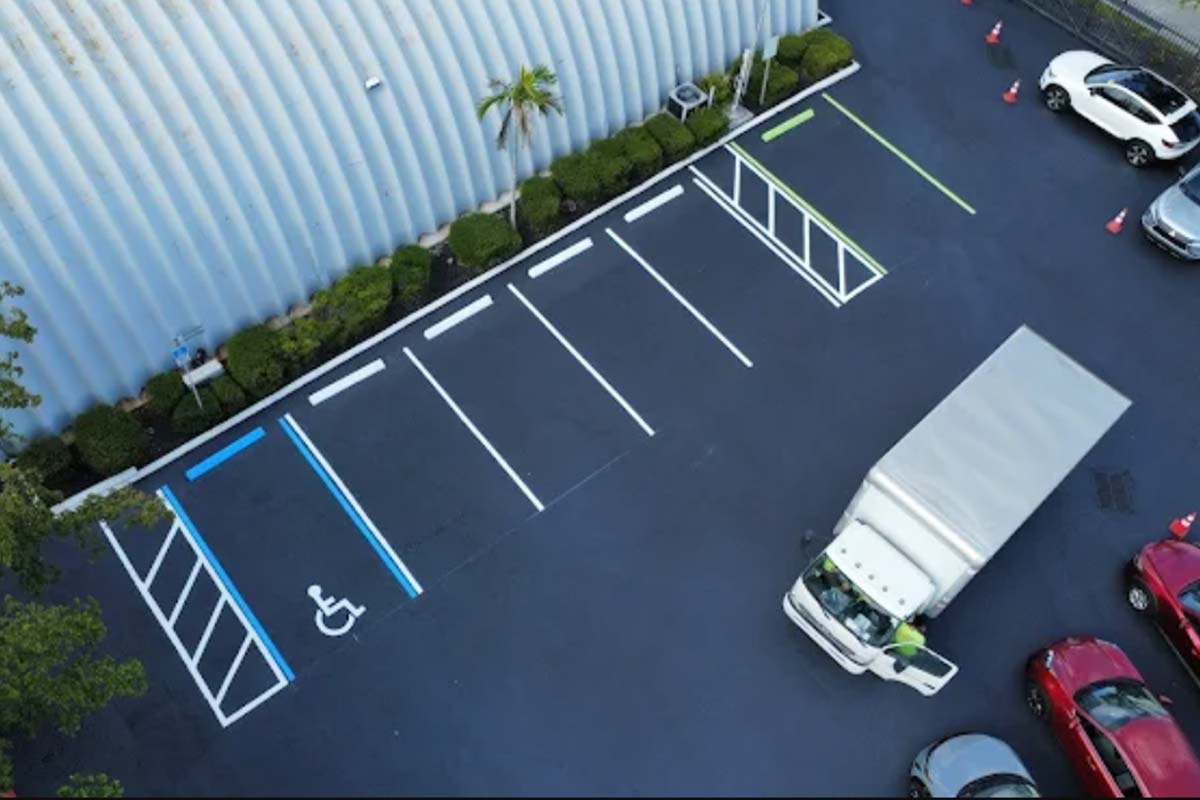
Concrete parking bumpers are the most widely used version of this product, and they go by more names than almost anything else in a parking lot. Depending on who is specifying the job, the same item is called a concrete parking bumper, a parking bumper, a wheel stop, a concrete wheel stop, a parking block, a parking stop, or a curb stop. They all describe a low barrier anchored at the head of a stall that keeps a parked vehicle from rolling or being driven past the line. The reason they matter is what sits beyond that line. On most commercial properties it is a sidewalk, a storefront, a landscaped area, or an accessible route that has to stay clear. Concrete is the default material because it is heavy, durable, and inexpensive to replace after an impact, and because it holds up to sun and rain without degrading.
Concrete, Rubber, and Plastic Parking Blocks Compared
Concrete parking bumpers are the heaviest option and the most resistant to being displaced by a vehicle. They are also brittle: a hard strike chips or cracks them, and a cracked bumper becomes a trip hazard rather than a barrier. Recycled rubber parking blocks are lighter, absorb impact by deforming instead of fracturing, and will not chip, which makes them a strong fit where pedestrians walk over and around them constantly. Being lighter, they depend more heavily on their anchors. Plastic composite parking blocks sit between the two, resisting moisture and ultraviolet exposure well, which matters in this climate where sun and rain work on everything year round. Rubber and composite units are usually easier to handle and reposition, so they suit lots that reconfigure. Concrete remains the choice where maximum mass is wanted and the unit will not be moved.
| Material | Mass and displacement | Behavior under impact | Best fit |
|---|---|---|---|
| Concrete | Heaviest, most resistant to displacement | Brittle; chips or cracks, and a cracked unit becomes a trip hazard | Maximum mass, unit will not be moved |
| Recycled rubber | Lighter, depends more on its anchors | Deforms instead of fracturing; will not chip | Constant pedestrian traffic over and around it |
| Plastic composite | Between the two, easy to reposition | Resists moisture and ultraviolet exposure well | Lots that reconfigure, strong-sun exposure |
Wheel Stops and ADA Accessible Routes
The strongest reason to install wheel stops is an accessibility one, and it is written into the federal standard. Section 502.7 of the 2010 ADA Standards for Accessible Design requires that parking spaces and access aisles be designed so that cars and vans, when parked, cannot obstruct the required clear width of adjacent accessible routes. The advisory to that section names wheel stops as an effective way of achieving it. Note the precise relationship, because it is routinely overstated by people selling the product: wheel stops are not themselves mandated. The mandated outcome is the unobstructed accessible route, and a wheel stop is one recognized means of getting there. Where a vehicle’s overhang would otherwise intrude on a sidewalk that forms part of an accessible route, a wheel stop is usually the simplest fix. Placement is what makes it work, since a stop set too far forward does not prevent the overhang it was installed to stop.
For a full list of our pavement marking services, visit our parking lot striping in West Broward page.
Businesses We Serve




How it Works

GET A FREE ESTIMATE
Contact us today and we’ll have a quote to you in 24 hours

SCHEDULE AN INSTALLATION
We’ll have your installation scheduled restriped in less than 7 days, without affecting your business hours

GET A PARKING LOT THAT POPS
For a budget-friendly price, you’ll get a parking lot that looks like new
We proudly work with:


We proudly work with:


Frequently Asked Questions About Wheel Stop Installation in West Broward, FL
What is a wheel stopper called?
It has an unusually large family of names, and they all refer to the same product: a concrete parking bumper, a parking bumper, a wheel stop, a concrete wheel stop, a parking block, a parking stop, or a curb stop. Which term you hear depends mostly on who is speaking. Property managers and site plans in this area tend to say concrete parking bumpers, manufacturers’ catalogs tend to say wheel stops or parking blocks, and contractors use all of them interchangeably. If you are comparing quotes and the wording differs between them, that is almost certainly a vocabulary difference, not a difference in what is being installed.
Are parking stoppers required by code?
Not as a standalone requirement, and it is worth being precise about this because it is often overstated. What the 2010 ADA Standards require, at section 502.7, is that parking spaces and access aisles be designed so that cars and vans, when parked, cannot obstruct the required clear width of adjacent accessible routes. The advisory to that section names wheel stops as an effective way to achieve that outcome. So the mandate attaches to the result, an unobstructed accessible route, and wheel stops are one recognized means of reaching it. Other designs, such as deeper stalls or relocated routes, can satisfy the same requirement.
Where should wheel stops be installed?
At the head of stalls where a parked vehicle would otherwise overhang something that needs to stay clear. The highest-value locations are stalls facing a sidewalk that forms part of an accessible route, stalls facing storefront glass or building walls, spaces adjacent to landscaping or irrigation, and stalls in front of utility equipment. Placement within the stall is what determines whether they work, because a stop set too far forward still allows the overhang it was meant to prevent. They are generally not used in every stall of a lot, since they add trip hazards and complicate sweeping and maintenance.
How much does it cost to install a wheel stop?
We quote by site, not by unit, because the variables move the total more than the product does. The drivers are how many are being installed in one visit, the material selected, whether the surface is asphalt or concrete, the anchoring method that surface requires, whether existing damaged units have to be removed and disposed of, and whether the work has to be phased around business hours to keep the property open. Removing and replacing broken concrete bumpers is a different job from setting new ones on clean pavement. Call us for a free estimate on your lot.
How are wheel stops anchored?
Anchoring depends on the surface and on the material of the unit. On asphalt, spikes or rebar pins are driven through the pre-cast holes into the pavement. On concrete, the usual method is drilling and setting anchor bolts, sometimes with adhesive, because driven pins do not hold reliably in a rigid surface. Rubber and composite blocks are lighter and therefore depend more on the anchors than on their own mass. The failure mode worth knowing is that a stop which works loose becomes a trip hazard in a pedestrian area, so anchoring is a safety detail rather than an installation convenience.