
ADA Parking Lot Striping
In West Broward, FL
ADA-Compliant Accessible Parking
1-800-STRIPER provides ADA-compliant parking lot striping in West Broward, FL — laying out accessible spaces, access aisles, ISA symbols, and required signage to the 2010 ADA Standards for Accessible Design and Florida’s accessible-parking statute, which sets a wider stall than the federal minimum.
1-800-STRIPER of West Broward PROVIDes ADA Parking Lot Striping Services NEAR YOU
Need to make your property more accessible?
Upgrade your facility to become fully ADA compliant by partnering with us to create clear, accessible parking for all your visitors.
Our ADA Compliant line striping services include:
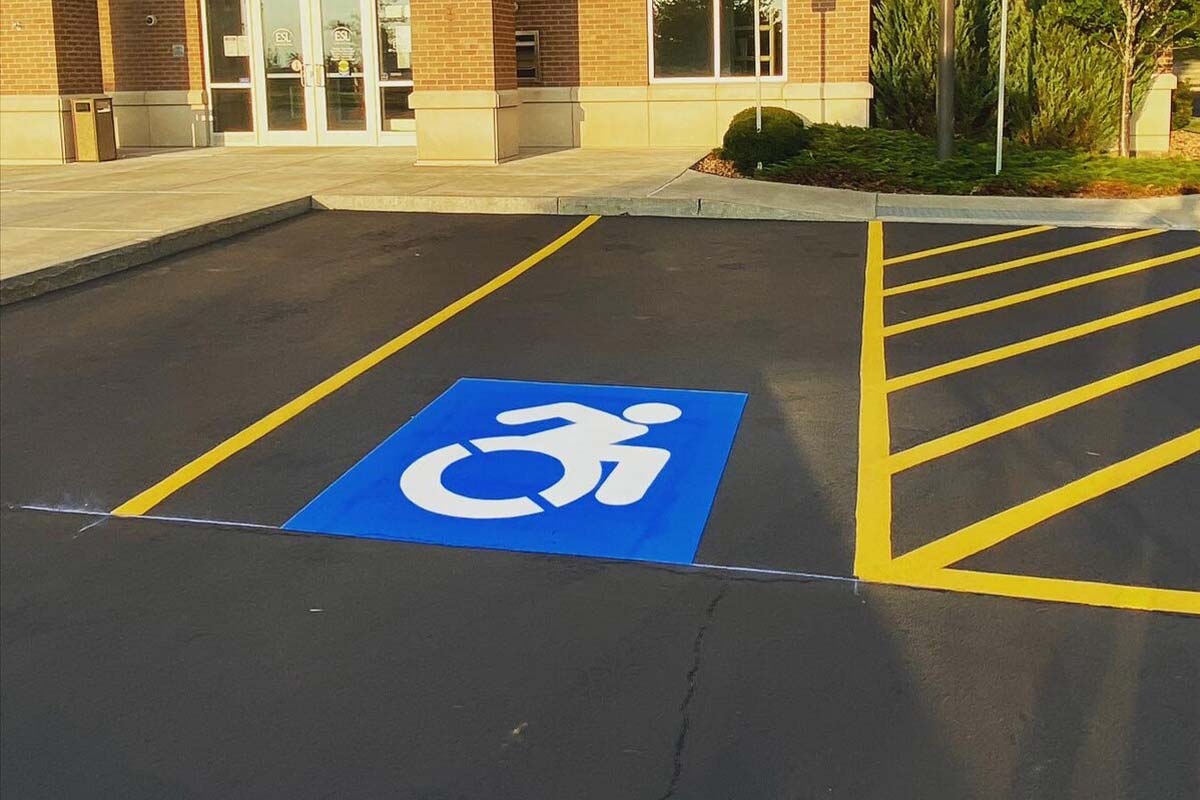
ADA Parking Lot Striping in West Broward, FL
Accessible parking in Florida is governed by two instruments at once, and they do not always agree. The federal 2010 ADA Standards set a national floor. Florida’s own accessible parking statute exceeds that floor on several elements, and where it does, the Florida number is the one that binds. Getting this wrong is expensive in a specific way: a lot striped to the federal minimum stall width is legal in most states and short of Florida’s requirement here. What the statute asks of an existing lot depends on what is being done to it. Florida Statute 553.5041(1) expressly preserves the readily achievable standard and the standards applicable to alterations, so new construction is held to the full requirement while barrier removal on an existing facility is held to what is readily achievable, and an alteration to the maximum extent feasible. That distinction is the first thing we establish on a site.
How Many Accessible Spaces Florida Requires
Florida does not set its own count. Florida Statute 553.5041 adopts the federal scoping table, so Table 208.2 of the 2010 ADA Standards for Accessible Design is the Florida requirement. One accessible space is required for lots of 1 to 25 spaces, two for 26 to 50, three for 51 to 75, four for 76 to 100, and so on up the table. Lots of 501 to 1,000 spaces require 2 percent of the total. The statute treats that as a floor rather than a ceiling: subsection (4)(c) requires the count to be increased on the basis of demonstrated and documented need.
Accessible Space Width: Florida Is Stricter Than Federal
This is the element that catches out-of-state operators. The federal standard requires a car accessible space 96 inches wide, and a van accessible space 132 inches wide or 96 inches with a 96-inch access aisle. Florida requires 12 feet, which is 144 inches, for every accessible space regardless of whether it is designated for cars or vans. There is no narrower Florida option. A lot striped to 96 inches meets the federal standard and still fails Florida law.
Federal Minimum vs. the Florida Requirement
Element by element, this is where the two instruments part company on a West Broward lot:
| Element | Federal 2010 ADA Standards | Florida Statute 553.5041 |
|---|---|---|
| Accessible space width | 96 inches (car), 132 inches (van) | At least 12 feet, every accessible space |
| Access aisle width | At least 60 inches | At least 5 feet |
| Access aisle marking | Method and color not specified | Striped diagonally as a no-parking zone |
| Space outline color | Not specified | Prominently outlined with blue paint |
| Accessible route clear width | 36 inches | At least 44 inches |
| Sign caption | International Symbol of Accessibility | Adds “PARKING BY DISABLED PERMIT ONLY” |
| Sign height to bottom | At least 60 inches (502.6) | At least 60 inches |
| Number of spaces | Table 208.2 | Table 208.2, increased on documented need |
Access Aisles
The access aisle is the striped area beside the space that makes a transfer possible, and it is not optional or decorative. Florida requires 5 feet, matching the federal 60-inch minimum, and the aisle runs the full length of the space it serves. Two adjacent accessible spaces may share one aisle between them. The aisle must connect to an accessible route, because an aisle that strands a user behind a curb has not achieved anything.
Why Florida Access Aisles Are Striped Diagonally
Florida requires the access aisle to be striped diagonally to identify it as a no-parking zone. The requirement is Florida’s, not the federal standard’s, and it exists because an unmarked aisle reads as empty pavement to a driver looking for a space. The diagonal hatching is what communicates that the area is functionally part of the accessible space. Obstructing it carries consequences of its own under Florida law.
The Blue Outline Florida Requires
The federal standard deliberately declines to specify marking color. The advisory to section 502.3.3 states that the method and color of marking are not specified by those requirements but may be addressed by State or local laws. Florida addresses it directly: accessible spaces must be prominently outlined with blue paint. So the blue you see on Florida accessible stalls is a state requirement, not an ADA one, and a lot marked in white is short of Florida law even though it satisfies the federal standard.
Accessible Parking Signs in Florida
Every accessible space needs an above-grade sign, and Florida specifies more than the federal standard does. The sign carries the International Symbol of Accessibility, and Florida adds a required caption reading PARKING BY DISABLED PERMIT ONLY. Van accessible spaces additionally carry the van accessible designation, which comes from the federal standard at section 502.6 rather than from Florida law. Signs erected after October 1996 must indicate the penalty for unlawful use. We install to the requirement and never publish the penalty figure itself, which changes independently of the striping.
What Happens When the Sign Is Missing
Of everything on this page, this detail carries the most weight, and almost nobody publishes it. Florida Statute 316.1955 provides that only a warning may be issued for unlawfully parking in a space designated for persons with disabilities if there is no above-grade sign as provided in Florida Statute 553.5041. A missing or knocked-down sign drops enforcement to a warning rather than the citation the space would otherwise carry. Read the rest of the same subsection, though: a violation may not be dismissed for a marking that falls short of Florida Statute 553.5041 where the space is in general compliance and is clearly distinguishable as an accessible space. So imperfect paint does not void enforcement; a missing above-grade sign is the specific thing that reduces it. The same statute treats obstructing the access aisle as carrying the same penalty as parking in the space itself.
Accessible Routes and the 44-Inch Rule
The accessible route connects the space to the building entrance, and Florida is stricter here too. The federal minimum clear width for an accessible route is 36 inches. Florida requires 44 inches. On a restripe this matters because the route is often defined by where the stalls and wheel stops sit, so a layout change on the pavement can narrow a route without anyone touching the sidewalk.
Van-Accessible Spaces
Federal scoping requires at least one in every six accessible spaces, rounded up, to be van accessible. In Florida the width question resolves itself, because the 12-foot requirement applies to every accessible space. What remains distinct for van spaces is vertical clearance along the vehicular route to and from the space, and the van accessible designation on the sign. In our experience vertical clearance is the constraint that rules out a parking structure level.
Space Dispersal Across Multiple Entrances
Accessible spaces are not all placed together at whichever entrance is most convenient to stripe. They are located on the shortest accessible route to an accessible entrance, and where a building has several accessible entrances serving different functions, the spaces are dispersed among them. A medical building with separate lobby and treatment entrances is the common West Broward case, and the count alone can be met while dispersal is not.
Restriping an Existing Accessible Space
Repainting an accessible space is not always a like-for-like refresh. Older Florida lots were frequently striped to the federal 96-inch width, and a lot laid out before the current statute may not have a stall that meets 12 feet at all. Where the existing geometry falls short, the honest answer is that bringing the stall to 12 feet means relocating or widening it, not just a fresh coat of paint, which usually costs adjacent spaces. Whether the statute compels that on your lot depends on the work: Florida Statute 553.5041(5)(e) requires barrier removal from a parking facility to comply unless doing so would not be readily achievable, and an alteration to comply to the maximum extent feasible. Where full compliance is not achievable, the statute allows alternative accessible parking locations with signage directing users to them, and does not permit reducing the required number or dimensions of those spaces. We measure the existing stalls and the route before quoting a restripe so that decision is made deliberately.
For a full list of our pavement marking services, visit our parking lot striping in West Broward page.
Businesses We Serve




How it Works

GET A FREE ESTIMATE
Contact us today and we’ll have a quote to you in 24 hours

SCHEDULE AN INSTALLATION
We’ll have your installation scheduled in less than 7 days, without affecting your business hours

GET A PARKING LOT THAT POPS
For a budget-friendly price, you’ll get a parking lot that looks like new!
We proudly work with:


We proudly work with:


Frequently Asked Questions About ADA Parking Lot Striping in West Broward, FL
What are the parking requirements for ADA in Florida?
Florida applies the federal 2010 ADA Standards and then exceeds them on specific elements. The number of accessible spaces comes straight from federal Table 208.2, which Florida Statute 553.5041 adopts, so the table is the federal one — with the statute adding that the number must be increased on the basis of demonstrated and documented need. Florida is stricter on stall width, requiring 12 feet for every accessible space against the federal 96 inches, and on accessible route width, requiring 44 inches against the federal 36. Florida also fills gaps the federal standard leaves open, including the blue outline and the diagonally striped access aisle.
How wide must an accessible parking space be in Florida?
Twelve feet, and that applies to every accessible space, not only to van spaces. The federal 2010 ADA Standards allow a 96-inch car space and a 132-inch van space, so Florida’s requirement is meaningfully wider than the national floor. Each space also needs an access aisle at least 5 feet wide running the full length of the space, striped diagonally to mark it as a no-parking zone. This is the single most common compliance gap we find on older West Broward lots, because a stall striped to the federal minimum looks correct and is not.
Does Florida require blue paint on accessible spaces?
Yes. Florida requires accessible spaces to be prominently outlined with blue paint, and to be repainted when necessary so they stay clearly distinguishable. What surprises people is that the blue comes from Florida law, not from the ADA. The federal standard explicitly declines to specify marking color, stating in the advisory to section 502.3.3 that the method and color of marking are not specified by those requirements but may be addressed by State or local laws. Florida is one of the states that addressed it, so blue is the law here and not merely a convention.
What must the accessible parking sign say in Florida?
The sign carries the International Symbol of Accessibility, and Florida adds a caption reading PARKING BY DISABLED PERMIT ONLY. Spaces serving vans additionally carry the van accessible designation, which is federal rather than Florida law. The bottom of the sign sits at least 60 inches above the ground surface so it stays visible when a vehicle is parked in the space. Signs erected after October 1996 must also indicate the penalty for unlawful use. We install signs that meet the requirement and direct owners to the current statute for the penalty amount itself, which changes independently of any striping work.
What happens if there is no sign at the accessible space?
The space becomes very difficult to enforce. Florida Statute 316.1955 provides that only a warning may be issued for unlawfully parking in a space designated for persons with disabilities if there is no above-grade sign as provided in Florida Statute 553.5041. Blue paint on the pavement does not substitute for the sign. But the same subsection also provides that a violation may not be dismissed for a marking that falls short of Florida Statute 553.5041 where the space is in general compliance and is clearly distinguishable, so imperfect paint does not void enforcement. It is the missing sign specifically that drops the outcome to a warning. The same statute also treats obstructing the access aisle as carrying the same penalty as parking in the space itself, which is why the aisle hatching matters.
How do you stripe a handicap parking space?
In Florida the assembly runs in a set order. Lay out a stall 12 feet wide on an accessible route to an accessible entrance. Add an access aisle at least 5 feet wide running the full length of the space, striped diagonally to identify it as a no-parking zone. Outline the space prominently in blue paint. Apply the International Symbol of Accessibility within the stall. Install the above-grade sign with the required caption, its bottom edge at least 60 inches above the surface. Verify the accessible route from the aisle to the entrance holds 44 inches of clear width throughout.