
Sports Court Striping
In West Broward, FL
Multi-Sport Court Line Marking
1-800-STRIPER provides professional sports court striping in West Broward, FL — laying out pickleball courts to the USA Pickleball Official Rulebook, plus basketball and tennis courts, on asphalt and concrete surfaces at HOA communities, apartment complexes, schools, and commercial recreation properties.
1-800-STRIPER of West Broward PROVIDes Sports Court Striping Services NEAR YOU
Want to get people to come out to play?
Brighten up your faded sport courts or turn your playground into a safe, colorful, and engaging space that entices people to come out and play.
Sport Court Specialties:
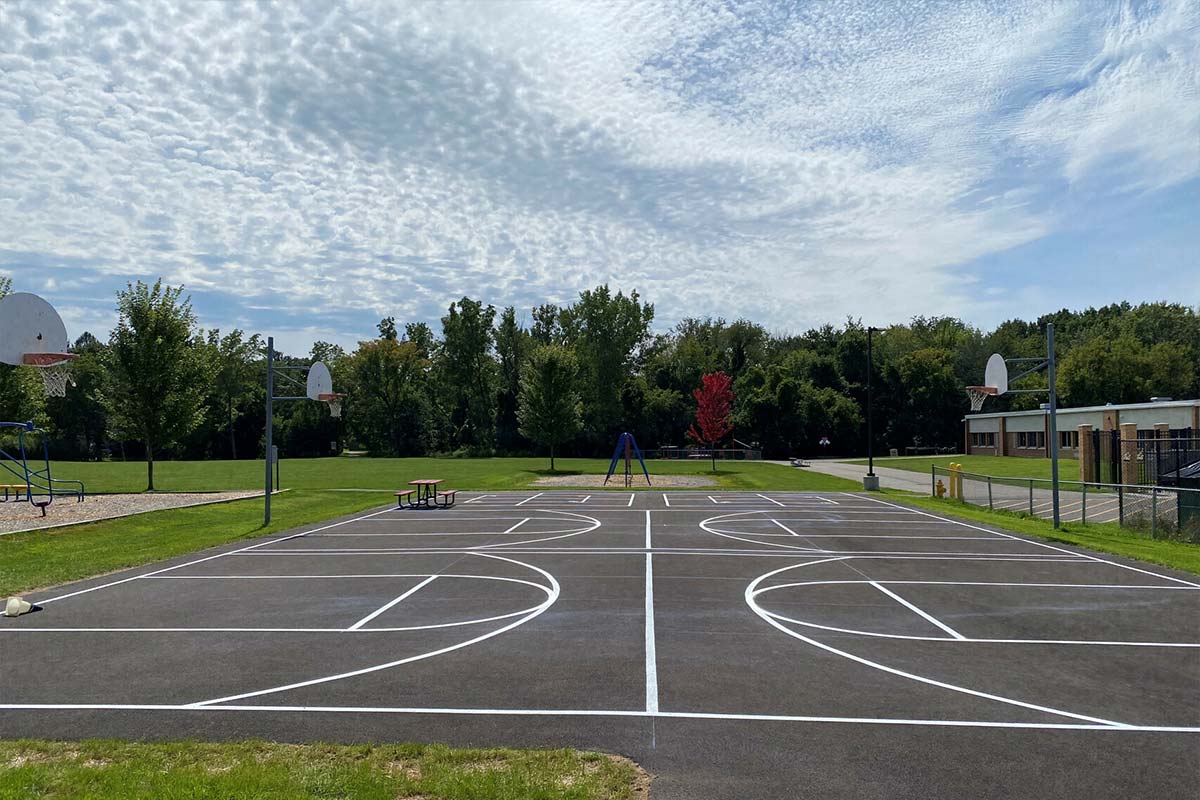
Sports Court Striping in West Broward, FL
Sports court striping is layout work before it is painting work. The lines have to be dimensionally correct for the sport, square to each other, and durable enough to survive sun and rain on an outdoor surface in South Florida. Most of our work here is at HOA and condominium communities, apartment complexes, schools, and commercial recreation properties, and a growing share of it is pickleball, either as a new court or as lines added to a surface that already exists.
Pickleball Court Dimensions
A pickleball court measures 20 feet wide by 44 feet long, and that is the same for singles and doubles play. Each side carries a non-volley zone extending 7 feet back from the net, the area commonly called the kitchen. The net is 36 inches high at the sidelines and 34 inches at the center. Those figures come from USA Pickleball, the sport’s national governing body.
Court Size vs. Total Playing Surface
The court and the surface it sits on are two different numbers, and confusing them is the most common planning mistake we see. USA Pickleball’s guidance for USA Pickleball Courts and Construction puts the recommended total playing surface at about 30 feet by 60 feet for a 20-by-44 court. The difference is run-off space behind the baselines and outside the sidelines, and it is what decides whether a conversion actually fits and how many courts a given area will hold.
| Dimension | USA Pickleball figure |
|---|---|
| Court, singles and doubles | 20 feet by 44 feet |
| Non-volley zone each side of the net | 7 feet back from the net |
| Net height at the sidelines | 36 inches |
| Net height at the center | 34 inches |
| Recommended total playing surface | About 30 feet by 60 feet |
| Recommended outdoor orientation | North to south |
Why Court Orientation Matters in South Florida
USA Pickleball recommends orienting outdoor courts north to south so players are not looking directly into the sun during morning or late-afternoon play, and describes that sun exposure as a common safety hazard. This lands harder here than in most of the country. Our latitude and our clear afternoons mean a poorly oriented court is unusable at exactly the hours people want to play. Orientation is fixed at layout and is expensive to change afterward, so it is worth settling before any line goes down.
Basketball Court Striping
Basketball dimensions are set by the governing body for the level of play, and they differ between recreational, school, collegiate, and professional standards. Rather than publish a number that may not match your facility, we work from the specification your property was built to and confirm it before layout. For a community or HOA court the practical questions are the usable surface available, the key and three-point geometry appropriate to the level of play, and whether the court is shared with another sport.
Tennis Court Striping
Tennis is the same situation. The dimensions are defined by the sport’s governing body for the level of play, and we confirm them against your facility’s specification instead of assuming. Tennis courts in this territory are the surfaces we are most often asked to convert or share, because a single tennis court has enough surface to carry pickleball lines, and that is where the requests we receive are concentrated.
Adding Pickleball Lines to an Existing Court
Adding pickleball to a tennis or basketball surface is the highest-demand job in this category right now, and it is mostly a question of geometry and contrast. The existing surface has to have room for the court plus adequate run-off, the new lines have to be placed without creating ambiguity where they cross existing lines, and the net situation has to be resolved, whether by a portable net or a permanent post installation. Where the surface will not accommodate the run-off, we say so rather than laying a court that plays badly.
Line Colors and Contrast on a Shared Surface
When two sports share one surface, contrast is what keeps play readable. The pickleball lines need to be clearly distinguishable from the lines already there, which usually means a different color and enough separation that a player is not deciding between two lines at speed. Color choice also interacts with the surface coating and with glare, and lighter, higher-contrast combinations hold up better under strong sun. We plan the color scheme against what is already on the surface instead of applying a default.
Court Surfaces: Asphalt and Concrete
USA Pickleball’s construction guidance is direct about this: any hard surface such as concrete or asphalt will serve, and grass will not, because the ball will not bounce. Both asphalt and concrete work well here provided the surface is sound and drains properly. Standing water is the enemy of both play and line durability, and in a climate with heavy seasonal rain, drainage is worth resolving before striping rather than after.
Accessible Routes to the Court
A recreation amenity is part of the property, and the route to it is subject to the same accessibility requirements as the route to any other facility. That means an accessible route from the accessible parking spaces to the court area, and accessible parking provided at the required count and dimensions. This is the element property managers most often miss on a court project, because the court itself gets all the attention and the path leading to it does not.
For a full list of our pavement marking services, visit our parking lot striping in West Broward page.
Businesses We Serve




How it Works

GET A FREE ESTIMATE
Contact us today and we’ll have a quote to you in 24 hours

SCHEDULE AN INSTALLATION
We’ll have your play space restriped in less than 7 days, without affecting your playtime

GET A PARKING LOT THAT POPS
For a budget-friendly price, you’ll get a parking lot that looks like new
We proudly work with:


We proudly work with:


Frequently Asked Questions About Sports Court Striping in West Broward, FL
What are the dimensions of a pickleball court?
A pickleball court is 20 feet wide by 44 feet long, and that measurement is the same for singles and for doubles. Each side has a non-volley zone that extends 7 feet back from the net, usually called the kitchen. The net is 36 inches high at the sidelines and 34 inches high at the center, which is why it sags slightly by design, not by accident. These figures come from USA Pickleball, the national governing body for the sport, and they are the dimensions a court needs to be built to if it is going to be used for regulation play.
How much space do I actually need for a pickleball court?
More than the court itself, and this is the number that actually decides feasibility. USA Pickleball’s construction guidance recommends a total playing surface of about 30 feet by 60 feet for a 20-by-44 court. The extra space is run-off behind the baselines and outside the sidelines, and players need it to chase a ball safely. Most published information gives the court size and stops there, which is how a property ends up with a court that technically fits and plays badly. Bring us the available area and we will tell you honestly how many courts it holds.
Can you add pickleball lines to an existing tennis or basketball court?
Often yes, and it is the most requested job in this category right now. Three things decide it. The surface has to be large enough for a 20-by-44 court plus adequate run-off, and the recommended total playing surface of about 30 by 60 feet is the figure to test against. The new lines need enough color contrast and separation from the existing lines that play stays readable where they cross. And the net has to be resolved, either portable or permanently installed. Both asphalt and concrete take the lines well, since USA Pickleball notes any hard surface will serve while grass will not let the ball bounce.
Does a sports court need an accessible route?
Yes, and it is the part most often overlooked on a court project. The court is a facility on the property, so the 2010 ADA Standards reach the route that gets people to it. In practice that means accessible parking at the required count and dimensions, and an accessible route running from those spaces to the court area without steps, excessive slope, or obstructions. Property managers tend to focus the budget on the court surface and the lines, then discover the approach path is the compliance gap. We look at both when we scope the work.