
Warehouse Line Painting
In West Broward, FL
OSHA-Compliant Safety Markings
1-800-STRIPER provides professional warehouse line painting in West Broward, FL — marking permanent aisles and passageways, pedestrian walkways, equipment and staging zones, and dock approaches to satisfy the OSHA aisle-marking rule for distribution, storage, and light-manufacturing facilities.
1-800-STRIPER of West Broward PROVIDes Warehouse Line Painting Services NEAR YOU
Want your indoor space to operate more efficiently?
Warehouse and interior markings ensure clear traffic lanes, organized storage zones, and designated spaces designed to help your business operate safely and efficiently.
Benefits:
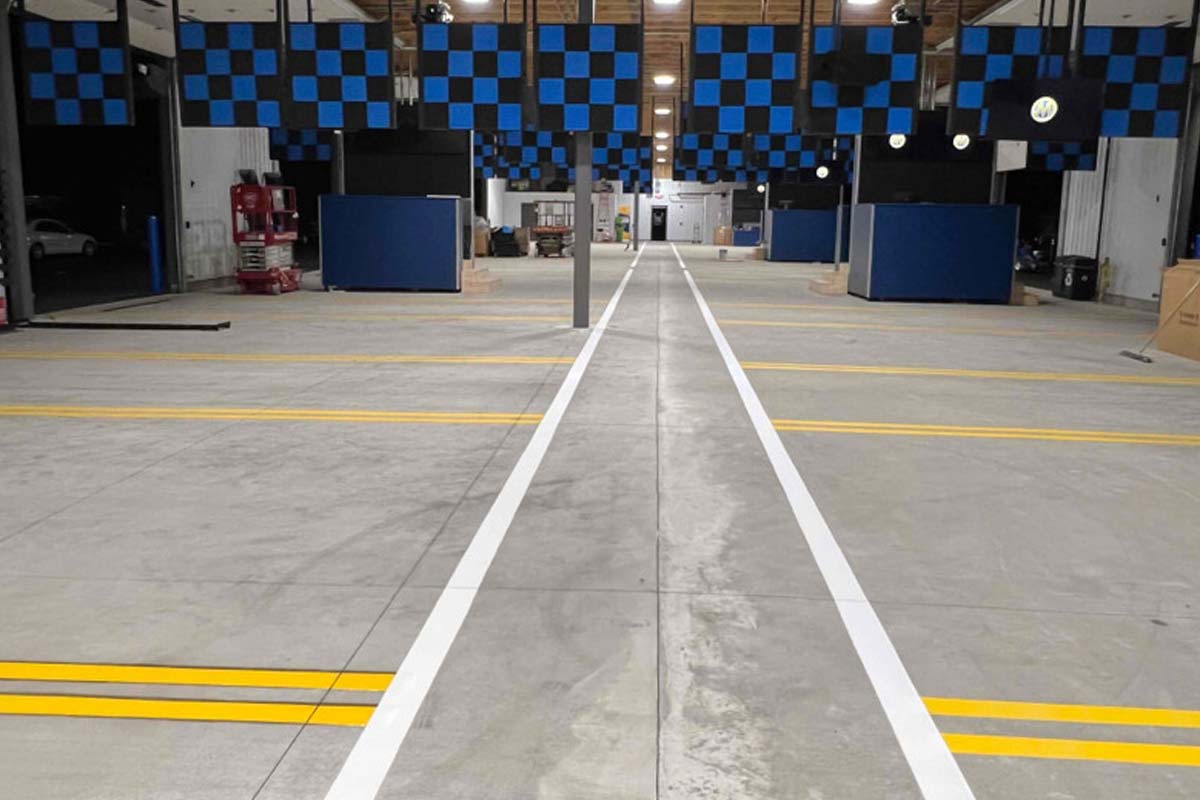
Warehouse Line Painting in West Broward, FL
Warehouse floor marking organizes traffic inside a building the way striping organizes it outside one. The work covers aisles and passageways, pedestrian walkways and crossings, equipment and staging zones, and dock approaches, in distribution, storage, and light manufacturing facilities across West Broward.
What OSHA Actually Requires
The marking duty sits in OSHA 29 CFR 1910.176(a), which states that permanent aisles and passageways shall be appropriately marked. The word permanent is doing real work in that sentence: the duty attaches to aisles that are a fixed part of the layout, not to every temporary lane created by how pallets happen to be stacked this week.
What OSHA Does Not Specify
Neither a color nor a width is mandated for aisle marking. The regulation requires that aisles be appropriately marked and that sufficient safe clearances be maintained, and it stops there. That silence is deliberate, and it means a facility cannot be cited for choosing yellow over white on the basis of the aisle-marking rule itself.
| Aspect of aisle marking | Mandated by 1910.176(a)? |
|---|---|
| Marking permanent aisles and passageways | Yes — “appropriately marked” |
| Maintaining sufficient safe clearances | Yes, where mechanical handling equipment is used |
| A specific line color | No |
| A specific line width | No |
| Marking temporary lanes formed by stacking | No — the duty attaches to permanent aisles |
Aisles and Passageways
The same subsection requires sufficient safe clearances where mechanical handling equipment is used, specifically for aisles, at loading docks, through doorways, and wherever turns or passage must be made. Aisle marking is therefore about maintaining a usable clearance, not about decorating the floor, and the layout should reflect how equipment actually turns.
Pedestrian Walkways and Crossings
Separating people from powered equipment is the highest-value marking in most facilities. Walkways along production and storage areas, crossings where foot traffic meets equipment routes, and safe standing areas at docks are the usual set. These are not separately mandated by the aisle-marking rule, but they are how facilities meet their broader duty to keep people out of equipment paths.
Equipment, Staging, and Dock Zones
Marking gives fixed positions to things that otherwise drift: pallet staging, inbound and outbound holding areas, battery charging and equipment parking, and keep-clear zones at electrical panels, eyewash stations, and fire equipment. Dock approaches get particular attention because reversing vehicles and pedestrians share that space.
Coatings for Warehouse Floors
Sealed concrete is the usual substrate, and coating selection follows traffic type. Areas crossed constantly by hard-wheeled equipment need a more abrasion-resistant coating than a walkway does. Surface preparation matters more indoors than most people expect, because a sealed or previously coated floor will reject a marking that was applied over a contaminated surface.
For a full list of our pavement marking services, visit our parking lot striping in West Broward page.
Businesses We Serve




How it Works

GET A FREE ESTIMATE
Contact us today and we’ll have a quote to you in 24 hours

SCHEDULE A STRIPING
We’ll have your space restriped in less than 7 days, without affecting your business hours

GET A PARKING LOT THAT POPS
For a budget-friendly price, you’ll get a parking lot that looks like new
We proudly work with:


We proudly work with:


Frequently Asked Questions About Warehouse Line Painting in West Broward, FL
Does OSHA require warehouse aisles to be marked?
Yes, for permanent aisles. The requirement is at 29 CFR 1910.176(a), which states that permanent aisles and passageways shall be appropriately marked. The word permanent matters, because the duty attaches to aisles that are a fixed feature of the layout rather than to temporary lanes formed by however product is stacked at the moment. The same subsection also requires sufficient safe clearances for aisles, at loading docks, through doorways, and wherever turns or passage must be made, wherever mechanical handling equipment is used.
What color must warehouse aisle lines be?
No color is mandated. This surprises most facility managers, because yellow is so nearly universal that it reads like a rule. The aisle-marking requirement at 1910.176(a) specifies no color at all. A separate standard, 29 CFR 1910.144, assigns red and yellow to particular hazard classes such as fire equipment and physical hazards, but it does not set a color for aisle marking. So yellow is a strong and sensible convention, not a legal requirement, and the absence of a mandate is the accurate answer.
How wide do warehouse aisle markings have to be?
No width is mandated either. The regulation requires only that permanent aisles and passageways be appropriately marked, and that sufficient safe clearances be maintained for aisles, at loading docks, through doorways, and wherever turns or passage must be made. A commonly used line width has grown up in practice, and it is a reasonable default, but it is convention rather than code. What governs is the clearance the aisle provides for the equipment using it, which is a layout question rather than a paint question.
What surfaces can warehouse markings be applied to?
Sealed concrete is the substrate we most often mark in these facilities, and it takes markings well. Asphalt surfaces inside a building or at dock approaches can also be marked. The determining factor is less the material than its condition and preparation, since a coated or sealed floor will reject markings applied over dust, oil, or a failing previous coating. Coating class is then selected against traffic type, because a lane crossed constantly by hard-wheeled equipment needs more abrasion resistance than a pedestrian walkway does.