Thermoplastic Striping
In East Louisville, KY
Long-Lasting Pavement Markings
1-800-STRIPER provides professional thermoplastic striping in East Louisville, KY — heat-applied, retroreflective pavement markings that bond into the asphalt instead of drying on top of it, for high-traffic commercial lots, drive lanes, and crosswalks.
1-800-STRIPER of East Louisville PROVIDes Thermoplastic Striping Services NEAR YOU
Want to reduce the maintenance requirements for your parking lot?
Thermoplastic pavement markings are a durable, weather and vehicle-resistant striping option for your parking lot or facility.
You can utilize them for stop bars, ADA stalls, no-parking zones, directional arrows, crosswalks, or your entire parking lot.
Benefits:
Thermoplastic Striping in East Louisville, KY
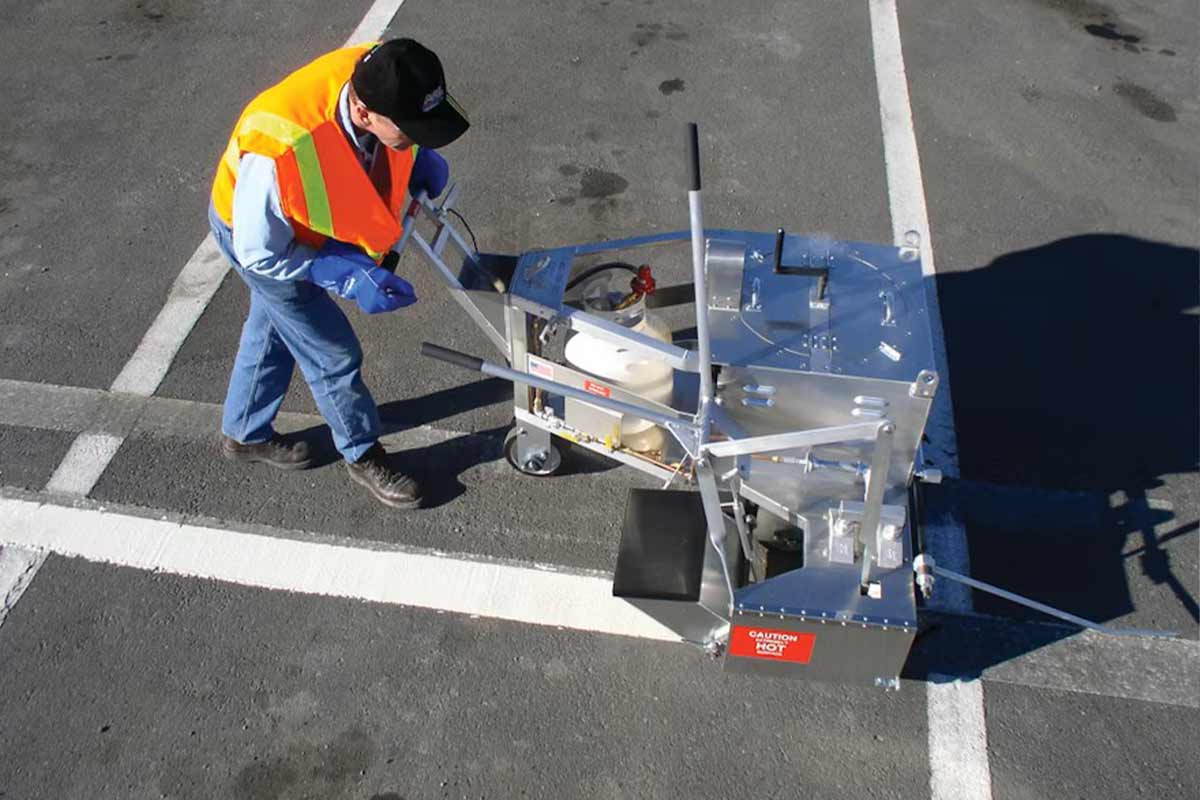
Thermoplastic is a different material doing a different job. Traffic paint is a liquid that dries on the surface. Thermoplastic arrives as a solid, gets melted, and is laid down hot so that it fuses into the pavement instead of sitting on it. Glass beads are mixed through the material and dropped onto its surface while it is still molten, which is what makes it read at night under headlights.
We install it on commercial properties where the marking is going to take punishment: entrance and exit lanes, drive aisles that see constant turning traffic, crosswalks, stop bars, directional arrows and loading-dock approaches. It is not the right answer for a whole lot’s worth of parking stalls, and we will say so.
Thermoplastic vs. Traffic Paint
| Thermoplastic | Waterborne traffic paint | |
|---|---|---|
| Applied as | Solid material melted and extruded or sprayed hot | Liquid, applied cold |
| Bond | Fuses into the pavement surface | Dries on top of the surface |
| Retroreflectivity | Beads mixed through the material and dropped on the surface | Beads dropped on the surface only |
| Film thickness | Measured in tens of mils | Measured in mils |
| Cure to traffic | Cools and is trafficable quickly | Needs drying time before traffic |
| Surface prep | Clean, dry, sound pavement; existing markings usually removed | Clean and dry |
| Best fit | Drive lanes, crosswalks, arrows, stop bars, high-turn areas | Stalls, layout lines, large-area restriping |
| Cost profile | Higher installed cost per foot | Lower installed cost per foot |
Two notes on that table. We are not putting a service-life figure in it, because the Kentucky Transportation Cabinet‘s specifications do not publish one and we are not going to quote a vendor’s marketing number back at you as though it were a standard. The durability difference is real and it is structural — more material, bonded in place instead of surface-dried, with beads through the body and not only on top. How long that lasts on your lot depends on traffic, turning, plowing and how sound the pavement underneath is.
The cost row is comparative, with no numbers attached. Call for a free estimate and we will price the actual scope.
Where Thermoplastic Makes Sense
The rule of thumb: use it where vehicles turn, stop, or cross, and use paint where they park.
Turning traffic scrubs markings far harder than straight-line travel does. So entrance aprons, the arc where a drive aisle meets a main lane, crosswalks across a busy through-lane, stop bars and directional arrows are all places where paint gets reapplied on a short cycle and thermoplastic does not.
The other case is retroreflectivity. Where a marking has to be readable at night — a crosswalk across a poorly lit drive lane, a stop bar at an exit onto a road — the bead loading in thermoplastic does work that paint has a harder time matching.
Where it does not make sense: ordinary parking stalls, temporary layouts, anything you might want to change, and pavement that is failing. Thermoplastic bonds to what is there. If what is there is crumbling, the marking goes with it.
How Thermoplastic Is Applied
Kentucky writes its own specifications for this material instead of adopting a national one, and they are specific enough to be worth reading.
The Kentucky Transportation Cabinet’s Standard Specifications place thermoplastic in Section 714, Durable Pavement Striping, with the material composition in Section 837. Section 714.04.03(B) states the installation requirement directly: install the thermoplastic material at a minimum thickness of 90 mils on the pavement surface in a melted state at a temperature from 400 and 440 degrees Fahrenheit.
Three distinctions that get collapsed constantly, and should not be:
Ninety mils is the extruded and ribbon figure, not a universal one. The Construction subsection quoted above states 90 mils without naming an application method, which is where the single-number habit comes from. The method split lives in the equipment and material sections: Section 714.03.01 covers extrusion equipment at a 90-mil minimum with the material held between 400 and 440 degrees, and Section 714.03.02 covers spray equipment at a 60-mil minimum with the material held between 350 and 400 degrees. Section 837 says the same twice more — its set-time requirements are written separately for extruded thermoplastic at 90 mils and spray thermoplastic at 60 mils, and Section 837.04 requires both temperature bands on the label. Two application methods, two thickness minimums, two temperature bands.
The melt band is not the weather rule. Those temperatures describe the material inside the equipment. The separate ambient restriction is in Section 714.04.04: do not apply the pavement marking material when air and pavement temperatures are below 50 degrees Fahrenheit. That is the one that decides whether we can work in November.
The material spec is Kentucky’s own. Section 837 specifies an alkyd binder with 30 to 40 percent premixed glass beads, tested to the Cabinet’s own method KM 64-268, and Section 837.04 requires the application temperature range to be printed on the product label.
One caveat we would rather state than have you assume: these are highway construction specifications, and a highway specification does not legally bind a private parking lot. Section 101.01 of those specifications addresses the bidder and the Contractor on a Cabinet project, and Section 107.12.01 bars entering private property without the owner’s permission. We work to these figures because they are the best-documented standard available in this state, not because the Cabinet has jurisdiction over your lot.
For a full list of our pavement marking services, visit our parking lot striping in East Louisville page.
Businesses We Serve



How it Works

GET A FREE ESTIMATE
Contact us today and we’ll have a quote to you in 24 hours

SCHEDULE AN INSTALLATION
We’ll have your installation scheduled restriped in less than 7 days, without affecting your business hours

GET A PARKING LOT THAT POPS
For a budget-friendly price, you’ll get a parking lot that looks like new
We proudly work with:


We proudly work with:

Frequently Asked Questions About Thermoplastic Striping in East Louisville, KY
What is thermoplastic striping?
A pavement marking material supplied as a solid, melted on site, and applied hot so that it bonds into the pavement instead of drying on top of it. Glass beads are mixed through the material and dropped onto the surface while it is still molten, which is what makes it reflect headlights at night. It goes down far thicker than paint. Kentucky’s Transportation Cabinet specifies it in Section 714 of its Standard Specifications, with the material composition in Section 837.
How long do thermoplastic markings last compared to paint?
Longer, and we are not putting a number on it. The Kentucky Transportation Cabinet’s specifications set composition, thickness and application requirements but do not publish a service life, and the figures circulating online trace to vendor marketing — not to a standard. What we can tell you is why it lasts longer: far more material, bonded into the surface instead of dried onto it, with reflective beads through the body rather than only on top. Traffic, turning and plowing decide the rest.
How thick is thermoplastic applied?
It depends on the equipment, and this is the figure most pages get wrong by stating one number flatly. Under the Kentucky Transportation Cabinet’s Section 714, extruded and ribbon application carries a minimum thickness of 90 mils, while spray application carries a minimum of 60 mils. Both are dramatically thicker than a paint film. Which method suits your job depends on the marking type and the surface, and we will tell you which one we are proposing.
Can thermoplastic go over existing paint?
Generally not, and doing it anyway is how installations fail. Thermoplastic bonds to the pavement, so it needs sound pavement to bond to. A layer of aged, chalking paint between the material and the asphalt is a weak plane, and the marking lifts along it. Existing markings normally get removed and the surface cleaned before installation. If your lot has heavy paint buildup from years of restriping, that removal is a real line item and we will scope it.
Does it work on concrete as well as asphalt?
Yes, though concrete needs more attention. Asphalt is warm and slightly compliant, and the hot material keys into it readily. Concrete is harder, colder and often sealed or cured with a compound that interferes with adhesion, so it usually requires surface preparation and in many cases a primer before the material goes down. It is a routine job on concrete loading aprons and dock areas, but it is not the same job as asphalt and should not be priced as though it were.
When is paint the better choice?
More often than thermoplastic sellers will tell you. Paint is the right answer for ordinary parking stalls, for whole-lot restriping, for any layout you might want to change, and for temporary or seasonal marking. It is also the right answer where the pavement is near the end of its life, because there is no sense bonding a long-life material to a surface that is going to be resurfaced. The best lots we work on use both, each where it belongs.