
Bollard Installation
In Union, NJ
Safety and Security Bollards
1-800-STRIPER provides professional bollard installation in Union, NJ — setting and repainting steel pipe bollards, sleeved covers, and impact posts at storefronts, loading docks, and utility equipment to keep vehicles out of pedestrian space at commercial properties across Union County.
1-800-STRIPER of Union PROVIDes Bollard Installation Services NEAR YOU
Want to prevent accidents and protect your property?
Bollards provide physical protection for your customers and your property.
Safety and security:
Bollards create a physical barrier between vehicles and pedestrians, protecting people in walking areas from accidental or intentional vehicle intrusions.
Bollards act as a protective barrier around storefronts, gas stations, and other vulnerable areas, minimizing the risk of costly damage from vehicle impacts.
Strategic Placement Locations:
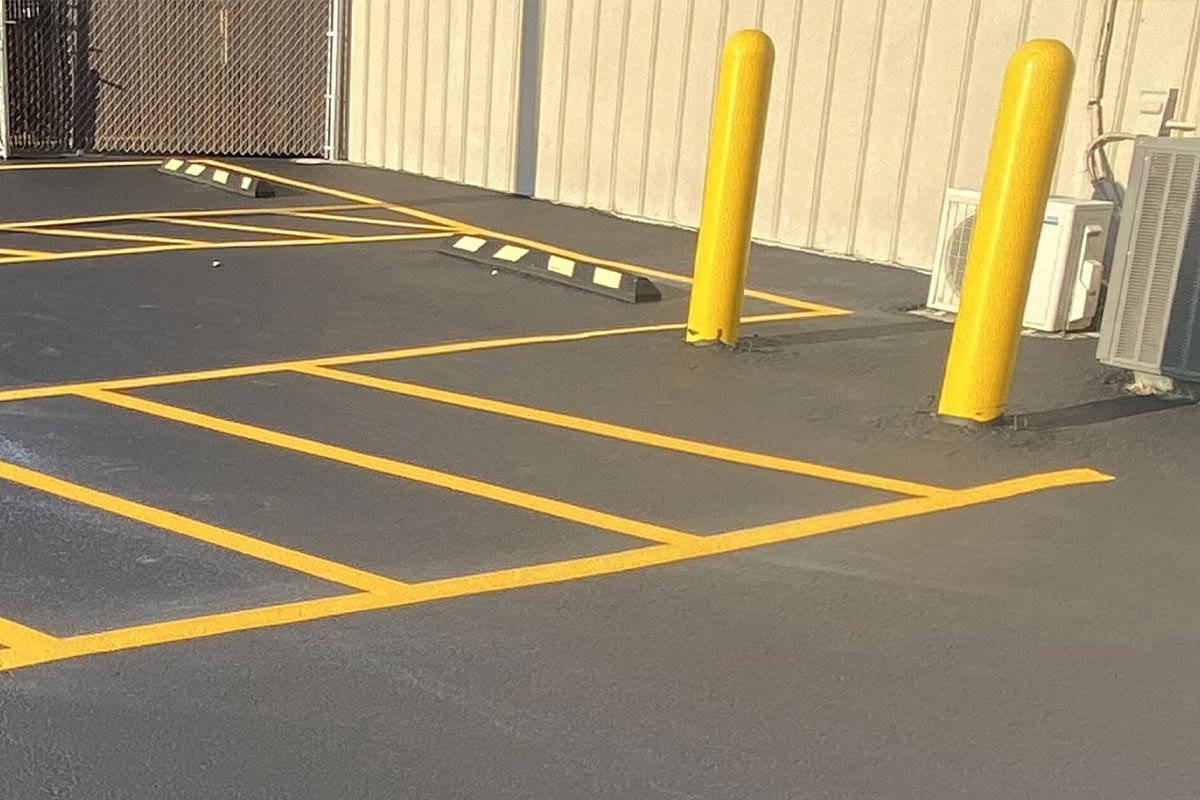
Bollard Installation in Union, NJ
Most commercial properties have four or five places where a vehicle should never be able to reach: the storefront glass, the dock apron, the gas meter, the fire department connection. A bollard is the post that stops it. 1-800-STRIPER of Union installs, replaces and repaints them across Union County and the six surrounding counties, usually alongside striping and wheel-stop work so the whole protective layout goes in together.
Where Bollards Are Needed on a Commercial Property
The test is simple: is there a place on this site where a vehicle at low speed would reach a person, a glazed wall, or something whose failure is expensive or dangerous?
On most commercial properties the answer is four or five: the storefront line, the dock apron, the gas meter or transformer, the fire department connection, and wherever a stall faces a walkway head-on. Those are the locations we survey first.
Storefront and Entrance Protection
Storefront strikes are almost always low-speed pedal errors from a stall facing the glass, and they are the incident bollards exist to prevent.
Protection here is a line rather than a single post: bollards spaced so a vehicle cannot pass between them, set far enough off the glazing that a deflected vehicle still stops short of it. Spacing and setback are a layout decision made against the specific frontage, not a catalog default.
Loading Dock and Trailer Bay Bollards
Docks take repeated, deliberate, low-speed contact from large vehicles, which is a different duty from a storefront’s rare accidental one.
We set bollards at dock corners and door jambs to keep a reversing trailer off the building, and at the ends of dock levelers and bumpers where a misaligned approach would otherwise load the structure. On sites with heavy turnover these are consumable and worth inspecting annually.
Protecting Utility Equipment and Fire Connections
Gas meters, electrical transformers, backflow preventers, generators, HVAC condensers and fire department connections all share a problem: they sit at ground level, often near parking, and a strike takes them out of service.
Fire department connections deserve particular attention, because the moment they matter is the moment they must be reachable, so protection has to stop a vehicle without obstructing access. We coordinate that placement with the fire official where a designation exists.
Bollard Types and Materials
| Type | Typical use | Notes |
|---|---|---|
| Steel pipe, concrete-filled | The commercial default | Set into the substrate; painted or sleeved |
| Sleeved steel pipe | Storefronts and public frontages | Plastic cover over the pipe; appearance and easy refresh |
| Stainless or architectural | Entrances on appearance-led sites | Higher cost; specified for finish |
| Cast or ductile iron, decorative | Streetscape and campus frontages | Appearance-led; confirm the impact duty separately |
| Plastic or flexible delineator | Traffic guidance only | Not impact protection; deflects rather than stops |
The last row is where specification most often goes wrong. A flexible delineator organizes traffic. It does not stop a vehicle, and it should never be installed where impact protection is the actual requirement.
Fixed, Removable and Collapsible Bollards
Fixed bollards are permanently set and are the strongest option for their specification. Removable bollards sit in a ground sleeve and lift out with a key, which suits an access route that has to open for deliveries, emergency vehicles or events. Collapsible bollards hinge down to the ground and stay attached, which suits frequent access where storing a removed post is impractical.
Removable and collapsible types trade some capacity for that access: the sleeve or hinge is the design’s limiting element. Where an opening must both close securely and resist impact, that trade-off should be a deliberate decision.
Installation Depth and Anchoring
Burial depth has no universal answer, and we would rather say so than publish a figure that will not fit your site.
What sets it is the bollard’s intended duty, the manufacturer’s or engineer’s specification for that product, and what is under the pavement. A sleeved decorative post protecting a planter is a different install from an impact post at a dock. Every install also needs the substrate confirmed and underground utilities located before excavation. The buried service nobody knew about is the standard failure on this work.
Bollard Painting and Repainting
Repainting is most of the bollard work we actually do. A bollard’s job includes being seen, and a weathered post at a dock or a rust-streaked one at a storefront has partly stopped doing it.
We prepare and repaint steel bollards, and replace plastic sleeves where the cover has faded or cracked rather than repainting over it. On lots being restriped, bollard repainting goes in the same visit, since the site is already closed and the crew already there.
Bollards and Accessible Routes
A bollard placed across an accessible route defeats the route while protecting the pavement, and it is a common and easily avoided error.
The 2010 ADA Standards require accessible parking to sit on the shortest accessible route to an accessible entrance, and that route must remain usable along its length. Bollards therefore go beside the route, not in it, and never inside an access aisle. Because we mark accessible bays and set bollards in the same engagement, the two are resolved together.
For a full list of our pavement marking services, visit our parking lot striping in Union page.
Businesses We Serve




How it Works

GET A FREE ESTIMATE
Contact us today and we’ll have a quote to you in 24 hours

SCHEDULE AN INSTALLATION
We’ll have your installation scheduled in less than 7 days, without affecting your business hours

GET A PARKING LOT THAT POPS
For a budget-friendly price, you’ll get a parking lot that looks like new
We proudly work with:


We proudly work with:


Frequently Asked Questions About Bollard Installation in Union, NJ
Do you need a permit to install a bollard?
We can tell you what we have verified and what we have not. In the Township of Union, Article 14 of the code requires a Construction Department permit before a sign, fixed awning, canopy or projecting object is erected or altered — that provision is about signage and similar attachments, not bollards specifically. Whether a bollard install in your municipality requires a construction permit depends on the work and the local construction official’s view, so confirm it with them rather than assuming either way.
What type of contractor installs bollards?
Bollard work sits with site and pavement contractors rather than with general building trades, because it is excavation, concrete and layout work on a paved surface. Parking lot contractors commonly install them, which is why it pairs naturally with striping and wheel stops — the same visit that marks the lot can set the posts that protect it. Where a bollard is part of an engineered barrier system to a stated impact specification, that specification should come from the engineer or manufacturer.
How deep does a bollard need to be buried?
No universal figure exists, and a contractor offering one has not looked at your site. Embedment depth is set by the bollard’s intended duty, the manufacturer’s or engineer’s specification for the product, and what is beneath the pavement — a sleeved decorative post protecting a planter has entirely different requirements from an impact post at a loading dock. What is universal is that the substrate must be confirmed and underground utilities located before any excavation begins.
Can New Jersey’s fire code require bollards on an existing building?
NJAC 5:70-3.1(d) provides that the State Fire Prevention Code shall not be cited as the basis for any retrofit requirement — but it carries an explicit exception for vehicle impact protection. So while New Jersey’s fire code generally cannot be used to force upgrades to an existing building, vehicle impact protection is carved out of that protection — one of the very few things it can require you to add. Very few contractors in this market know it, and no rival publishes it.
What is the difference between a crash-rated and a standard bollard?
A standard bollard is specified by its construction. A rated one has been tested to a published method, and which method matters. ASTM F3016 is the low-speed surrogate test method for vehicle impact protective devices, and it is the appropriate reference for storefront and parking-lot protection. ASTM F2656 is a defined-threat perimeter security test method for vehicle security barriers, aimed at a different problem entirely. Most bollard marketing conflates the two, which is how sites end up over- or under-specified.
Where should bollards go at a storefront?
As a line rather than as single posts: spaced closely enough that a vehicle cannot pass between them, and set far enough off the glazing that a vehicle deflected by one still stops short of the glass. The locations that need it most are stalls that face the frontage head-on, since storefront strikes are overwhelmingly low-speed pedal errors from a parked position. Spacing and setback are decided against the specific frontage, not taken from a catalog.
Are removable bollards as strong as fixed ones?
Not for the same design, and the reason is structural rather than a question of quality. A fixed bollard is continuous into its foundation; a removable one relies on a ground sleeve, and a collapsible one on a hinge — and in both cases that connection is the limiting element. They are the right choice where an opening genuinely has to be opened for deliveries, emergency access or events. Where the opening must both close and resist impact, treat the trade-off as a deliberate decision.
How often do bollards need repainting?
By condition rather than by schedule, and the condition to watch is visibility. A bollard’s job includes being seen before it is struck, so a weathered post at a dock or a rust-streaked one at a storefront has partly stopped working. Rust breaking through the coating is the point to act, because from there it accelerates. On lots being restriped we repaint bollards in the same visit, since the site is already closed and the crew already on it.
Do bollards have to keep the accessible route clear?
This is where bollards are most often installed wrongly. The 2010 ADA Standards require accessible parking to be on the shortest accessible route to an accessible entrance, and that route must stay usable along its whole length. A bollard set in the path, or inside an access aisle, obstructs exactly what the Standards require to be kept clear. Bollards belong beside the route rather than in it, which is a layout decision made when the accessible bays are marked.
Can you install bollards without closing the business?
In almost all cases, yes. Bollard work is localized — a dock corner, a section of storefront, a utility enclosure — so it is phased area by area rather than closing the lot. Most of our commercial work is scheduled so it does not interrupt your daily operations, which often means early mornings or a weekend for the busiest frontages. The one constraint is cure time on newly set posts, which we cone off and plan around with you before the crew arrives.