
Warehouse Line Painting
In Northwest Houston, TX
OSHA-Compliant Safety Markings
1-800-STRIPER provides professional warehouse line painting in Northwest Houston, TX — permanent aisle and passageway markings, pedestrian walkways, equipment staging zones, and dock lanes meeting the marking duty OSHA sets for industrial and distribution facilities across Harris and Waller counties.
1-800-STRIPER® of NW Houston PROVIDes Warehouse Line Painting Services NEAR YOU
Want your indoor space to operate more efficiently?
Warehouse and interior markings ensure clear traffic lanes, organized storage zones, and designated spaces designed to help your business operate safely and efficiently.
Benefits:
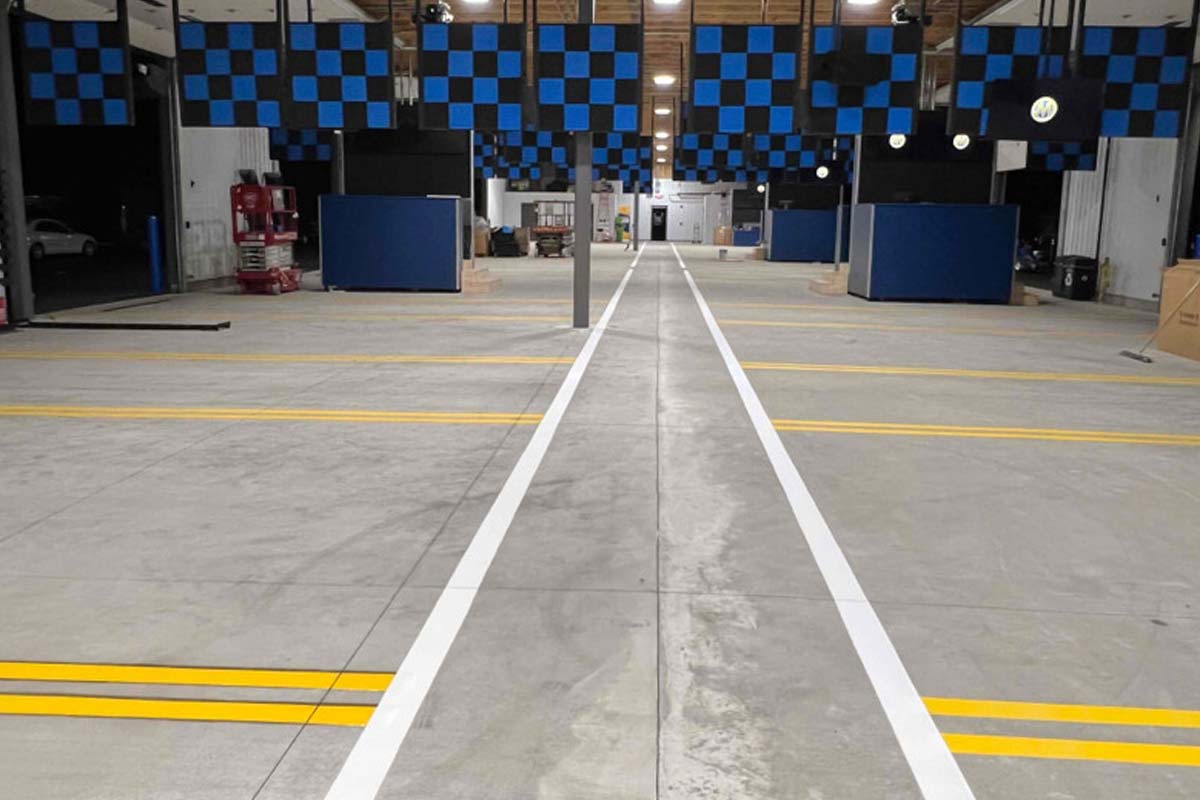
What OSHA Actually Requires — and What It Leaves to You
Almost every warehouse-striping page on the internet cites the wrong regulation. The aisle-marking duty is not in 29 CFR 1910.22 — that section covers surface conditions, loads, access and egress, and inspection and maintenance, and the word “aisle” does not appear in it.
The duty is in 29 CFR 1910.176(a), and it reads:
> “Where mechanical handling equipment is used, sufficient safe clearances shall be allowed for aisles, at loading docks, through doorways and wherever turns or passage must be made. Aisles and passageways shall be kept clear and in good repair, with no obstruction across or in aisles that could create a hazard. Permanent aisles and passageways shall be appropriately marked.“
Read it again for what is *not* there. No line width. No line color. No minimum aisle width. No spacing. The regulation says “appropriately marked” and “sufficient safe clearances” and stops.
That silence is the useful part. It means the specification is yours to set based on the equipment you run and the traffic you carry, and it means anyone quoting you a mandatory 2-inch yellow line as an OSHA requirement is repeating a convention as though it were a rule.
The nearest thing to a color rule is 29 CFR 1910.144, the safety color code, which makes red the basic color for fire protection equipment, danger and stop, and yellow the basic color for caution and for marking physical hazards — striking against, stumbling, falling, tripping, and caught-in-between. That is where the yellow-aisle convention comes from. It is a color assignment for hazard classes, not a dimensioned aisle-striping standard.
Markings a Distribution Facility Needs
| Marking | What it does | What sets the specification |
|---|---|---|
| Permanent aisle and passageway lines | The one marking OSHA explicitly requires | 1910.176(a) — “appropriately marked”, no dimension given |
| Pedestrian walkways | Separates people from forklift travel | Facility risk assessment; yellow per the 1910.144 caution convention |
| Fire equipment and exit access | Keeps extinguishers, hydrants and egress clear | Red per 1910.144(a)(1); egress width per your fire code |
| Dock and staging lanes | Positions trailers, pallets and staged freight | Your operation — no federal dimension |
| Equipment and battery charging zones | Bounds charging, LP storage and equipment parking | Your operation and applicable storage rules |
| Racking and pallet-position outlines | Keeps stock inside its footprint | Warehouse layout, not regulation |
| Hazard and caught-in-between points | Marks pinch points and blind corners | Yellow per 1910.144(a)(3) |
We mark what your operation runs, in a layout agreed with your safety lead, using the color conventions above rather than inventing a scheme nobody else in your business will recognize.
The distribution corridor along the Grand Parkway through Katy, out to Brookshire and Pattison in Waller County, is where most of this work sits for us — large-format distribution buildings, third-party logistics operators and light-industrial tenants, where an aisle repaint has to happen between shifts or not at all.
For a full list of our pavement marking services, visit our parking lot striping in Northwest Houston page.
Businesses We Serve




How it Works

GET A FREE ESTIMATE
Contact us today and we’ll have a quote to you in 24 hours

SCHEDULE A STRIPING
We’ll have your space restriped in less than 7 days, without affecting your business hours

GET A PARKING LOT THAT POPS
For a budget-friendly price, you’ll get a parking lot that looks like new
We proudly work with:


We proudly work with:


Frequently Asked Questions About Warehouse Line Painting in Northwest Houston, TX
Does OSHA require warehouse aisles to be marked?
Yes — permanent ones. 29 CFR 1910.176(a) states that permanent aisles and passageways shall be appropriately marked, and that sufficient safe clearances shall be allowed for aisles, at loading docks, through doorways and wherever turns or passage must be made. Temporary or shifting lanes are not covered by that sentence; permanent ones are.
What color and width does OSHA require for aisle lines?
Neither. This is the answer most sources get wrong. 1910.176(a) requires marking but specifies no color, no line width and no aisle width — only “appropriately marked” and “sufficient safe clearances.” The safety color code at 1910.144 assigns yellow to caution and physical hazards and red to fire equipment, danger and stop, which is where the industry’s yellow-aisle convention comes from. It is a widely used convention, not a dimensioned mandate. You set the specification for your operation; we mark to it.
Isn’t 1910.22 the aisle-marking rule?
No, though it is cited that way constantly. 1910.22 is titled “General requirements” for walking-working surfaces, and its subsections are surface conditions, loads, access and egress, and inspection, maintenance and repair. The word “aisle” appears in it zero times, and it contains no marking requirement. The aisle-marking duty sits in 1910.176(a). We checked both sections at source rather than repeating the citation everyone else uses.
What markings does a distribution facility need beyond aisles?
Pedestrian walkways separating foot traffic from forklift travel, clear zones around fire equipment and exit access, dock and staging lanes, equipment and battery-charging areas, racking and pallet-position outlines, and hazard marking at pinch points and blind corners. Only the permanent aisles are federally required to be marked; the rest are driven by your risk assessment and how the building actually runs.
Can you paint over an existing sealed or coated floor?
Usually, with the right preparation. Sealed and coated concrete is common in newer distribution buildings around Katy and Brookshire, and the coating is exactly what makes adhesion a question. We test the surface, clean it, and abrade or prime where the existing finish will not hold paint on its own. Where a floor has a heavy topical coating we will tell you what preparation it needs rather than laying paint over a surface that will peel under forklift traffic.
How much of the facility has to be out of service?
Less than most operations expect. We work aisle by aisle or zone by zone so the building keeps running, and we schedule around shifts — nights, weekends or planned shutdowns. Each marked zone stays closed to traffic until the paint has cured enough to take forklifts, which is the constraint that sets the sequence. For a facility on continuous operation we phase the work over several visits rather than asking you to stop.